Facts
The petitioners’ father, Rohini Prasad, and one Jagdeesh Prasad jointly purchased land (Khasra No. 298/1).
Source reference: para. 2Upon Rohini Prasad’s death, the respondent sought mutation of the land based on an allegedly forged and unregistered sale deed.
Source reference: para. 2The Tahsildar impounded the document via the Collector of Stamps and subsequently allowed the mutation.
Source reference: para. 3This order was upheld by the Sub-Divisional Officer (SDO) but overturned by the Additional Commissioner, who held that the Tahsildar should have referred the parties to a Civil Court to determine title.
Source reference: para. 3, 7The Board of Revenue later quashed the Additional Commissioner’s order, restoring the mutation in favor of the respondent.
Source reference: para. 3The petitioners challenged this before the High Court under Article 227 of the Constitution.
Source reference: para. 1Issues
1. Whether the Revenue Authorities have the jurisdiction to refer parties to a Civil Court for a declaration of title during mutation proceedings under Sections 109 and 110 of the M.P. Land Revenue Code, 1959.
Source reference: para. 7-82. Whether an unregistered and disputed sale deed can serve as a basis for mutation entries in revenue records.
Source reference: para. 3, 9Law Applied
The court primarily applied Sections 109 and 110 of the Madhya Pradesh Land Revenue Code, 1959, which govern the acquisition of rights and the mutation of names in the land record.
Source reference: para. 4, 7It distinguished these from Section 178 of the Code, which pertains to partition and allows for the referral of title disputes to a civil court.
Source reference: para. 7-8The court relied on the established principle that mutation entries are for fiscal purposes and do not confer title.
Source reference: para. 8The court further considered the evidentiary value of documents under the Indian Stamp Act (regarding impounding) and the burden of proof in challenging a sale deed executed by a predecessor-in-interest.
Source reference: para. 3, 9Reasoning
The Court found that the Additional Commissioner erred by treating the proceedings as a title dispute under Section 178 of the Code, whereas the matter fell strictly under Sections 109 and 110.
Source reference: para. 7-8Unlike Section 178, Sections 109 and 110 do not empower Revenue Authorities to relegate parties to a Civil Court for a declaration of title.
Source reference: para. 7The Court reasoned that since the sale deed was purportedly signed by the petitioners' father, the burden of proof lay on the petitioners to approach a Civil Court to challenge its validity.
Source reference: para. 9The Board of Revenue correctly identified that the Additional Commissioner acted under a "misconception" of law.
Source reference: para. 8, 11Furthermore, since mutation does not confer legal title, the revenue entry made after the document was duly impounded by the Collector of Stamps remained procedurally valid.
Source reference: para. 3, 8Holding
The High Court dismissed the writ petition, holding that the Board of Revenue committed no error in setting aside the Additional Commissioner’s order.
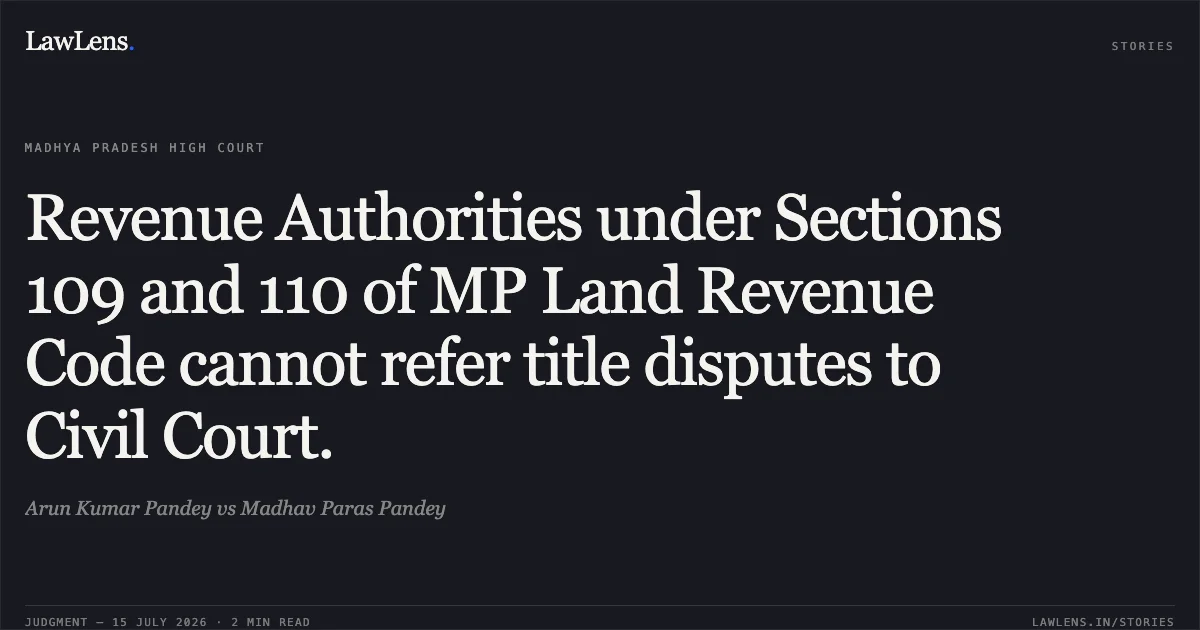
The court affirmed that in mutation proceedings under Sections 109 and 110 of the M.P. Land Revenue Code, authorities cannot refer title disputes to a Civil Court; instead, the aggrieved party (the petitioners) must independently seek a civil declaration to invalidate the disputed sale deed.
Source reference: para. 7-9No interference was warranted under Article 227.
Source reference: para. 10Acts & Sections Cited
3 provisions across 1 statute referred to in this judgment. Each provision opens on LawLens.
MP Land Revenue Code 19593
Original Court PDF
Arun Kumar PandeyvsMadhav Paras Pandey
Click to open original judgment
Original judgment, available to read, download and summarize on LawLens.in