Facts
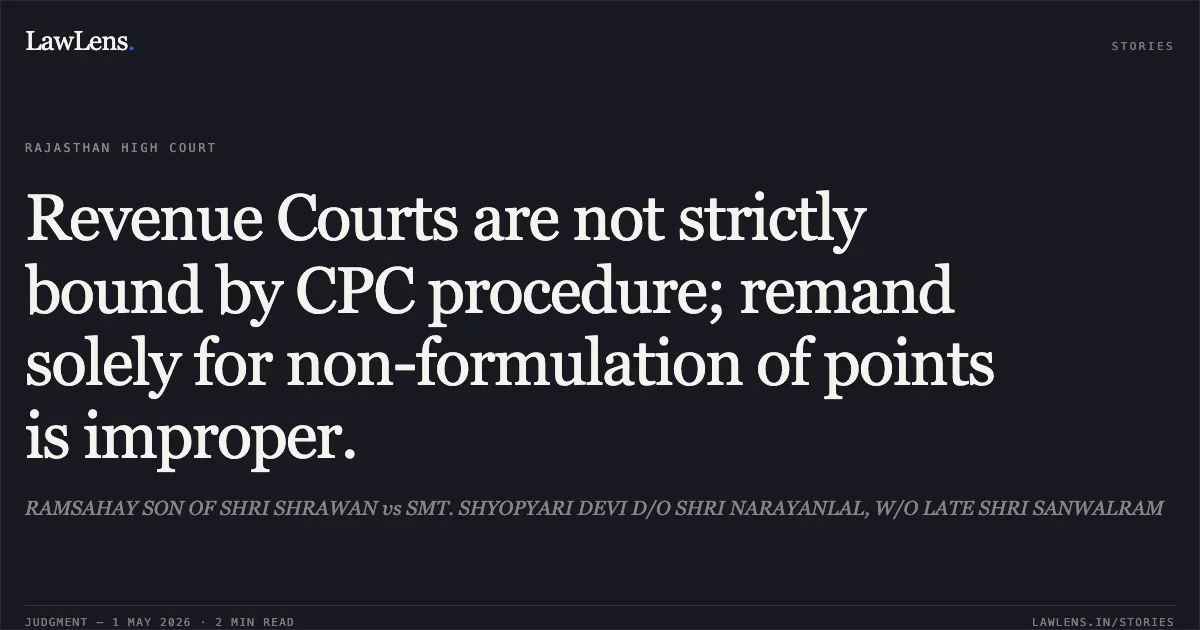
The appellants challenged an order passed by the Board of Revenue dated 15.12.2022. The Board of Revenue had set aside a decision of the Revenue Appellate Authority (RAA) and remanded the case back to the RAA for a fresh decision on the grounds that the RAA failed to formulate specific points of determination or follow the mandatory provisions of Order 41 Rule 31 of the CPC
Source reference: p. 3, para. 2The appellants initially challenged this remand before a Single Judge of the High Court, who upheld the Board's decision, reasoning that Revenue Courts must follow CPC procedures as an appeal is a continuation of original proceedings
Source reference: p. 4, para. 3The matter subsequently came before the Division Bench in a Special Appeal (Writ).
Source reference: no citationIssues
1. Whether Revenue Courts are strictly required to follow the procedural mandates of Order 41 Rule 31 of the CPC, specifically regarding the formulation of points for determination, when deciding revenue disputes
Source reference: p. 4, para. 42. Whether the Board of Revenue was justified in remanding the case to the RAA rather than deciding the merits of the second appeal based on the existing evidence
Source reference: p. 5, para. 5Law Applied
Revenue Courts are not "Courts" in the ordinary sense within the definition of the CPC and thus are not strictly required to follow CPC procedures for adjudicating revenue disputes
Source reference: p. 4, para. 3-4An appellate court (being a court of both fact and law) should not remand a case simply because a lower court’s judgment lacked detailed reasoning if the evidence is already on record
Source reference: p. 4, para. 4Arvind Kumar Jaiswal (D) Thr. LR. Vs. Devendra Prasad Jaiswal Varun [SLP (C) No. 9172/2020]
Source reference: p. 4, para. 4Section 224 of the Rajasthan Tenancy Act, 1955
Source reference: p. 5, para. 5-6Reasoning
The Division Bench reasoned that the Single Judge and the Board of Revenue erred in applying strict CPC standards to Revenue Court proceedings. The Court emphasized that because Revenue Courts are specialized bodies, their judgments cannot be set aside merely for failing to frame separate issues or "points of determination" if the substance of the dispute is clear
Source reference: p. 4, para. 4The Bench noted that the Board of Revenue possessed the full power to examine the evidence and decide the case on its merits during the second appeal, rather than delaying the process through a remand
Source reference: p. 5, para. 5Following the Arvind Kumar Jaiswal precedent, the Court found that since the evidence was available on record, the Board of Revenue was duty-bound to adjudicate the matter itself to ensure the expeditious disposal of a long-pending appeal
Source reference: p. 4-5Holding
The Court held that Revenue Courts are not strictly governed by the procedural technicalities of the CPC.
The High Court allowed the appeal and set aside the judgment of the Single Judge dated 06.12.2023, as well as the Board of Revenue’s remand order dated 15.12.2022
Source reference: p. 5, para. 6The Court revived the second appeal under Section 224 of the Rajasthan Tenancy Act, 1955, and directed the Board of Revenue to decide the matter on its merits based on the existing record, preferably within six months
Source reference: p. 5, para. 6-7Original Court PDF
RAMSAHAY SON OF SHRI SHRAWANvsSMT. SHYOPYARI DEVI D/O SHRI NARAYANLAL, W/O LATE SHRI SANWALRAM
Click to open original judgment
Original judgment, available to read, download and summarize on LawLens.in