01Facts
The petitioners claimed ownership and possession over Khasra Nos. 2052/1 and 2052/2, purchased through a registered sale deed dated 27 August 2021.
¶ 3Respondent No. 4, claiming ownership over adjoining Khasra No. 2052/3, alleged that the petitioners were encroaching upon his land, felling trees, and raising construction thereon.
¶ 3The petitioners objected that the Tehsildar lacked jurisdiction to grant injunctive relief and that the dispute concerned non-agricultural residential property, falling within the exclusive jurisdiction of the Civil Court.
¶ 3–5, 10Pursuant to directions issued by the High Court in an earlier writ petition, the Tehsildar passed an order dated 25 April 2022 restraining construction.
¶ 1, 3–402Issues
i.Whether the Tehsildar or another Revenue Authority could entertain an application seeking an injunction under Sections 37 and 39 of the Specific Relief Act, 1963?
¶ 8(i)ii.Whether a Revenue Authority could grant an order substantially amounting to an injunction under Order XXXIX Rules 1 and 2 of the Code of Civil Procedure, 1908, by describing it as a stay order?
¶ 8(ii)iii.Whether the Revenue Court had jurisdiction where the disputed property was a residential property containing a permanent structure?
¶ 10–1403Law Applied
The Court held that the power to grant temporary or permanent injunctions is vested in the competent Civil Court under Sections 37 and 39 of the Specific Relief Act, 1963, read with Order XXXIX Rules 1 and 2 of the CPC; disputes concerning declaration of title fall within the Civil Court’s jurisdiction under Section 34 of the Specific Relief Act.
¶ 11The jurisdiction of Revenue Courts is generally confined to agricultural or revenue-assessed land and does not extend to residential property upon which permanent structures have been constructed.
¶ 10–11The Court relied on Maya Lalchandani (Mrs.) v. Board of Revenue, (2009) 3 MPLJ 660, holding that provisions concerning inherent powers or application of CPC procedure do not confer substantive power on Revenue Authorities to grant injunctions.
¶ 12Seraj Ahmad v. State of Chhattisgarh, 2017 (4) C.G.L.J. 559, which held that Revenue Courts cannot grant injunctions and that an injunction order passed by a Revenue Authority is without jurisdiction.
¶ 12Vandana Gupta v. State of Chhattisgarh, WPC No. 235/2020, which recognised that a writ petition may be entertained notwithstanding an alternative remedy where the impugned order is wholly without jurisdiction, applying Whirlpool Corporation v. Registrar of Trade Marks, (1998) 8 SCC 1.
¶ 13Provisions in the judgment · 6 · Linked ones open on LawLens
Specific Relief Act, 1963 Section 34Section 37Section 39
Code of Civil Procedure, 1908 Section 39
MP Land Revenue Code 1959 Section 32Section 43
04Reasoning
The High Court found that the earlier Civil Court judgment had recorded the existence of a boundary wall and a pucca residential house on the disputed property and that this finding had attained finality.
¶ 10Consequently, the property was not merely agricultural or open land amenable to Revenue Court jurisdiction, but a residential property involving disputed possession and title.
The Tehsildar’s order restraining construction was, in substance, an injunction of the kind contemplated by Sections 37 and 39 of the Specific Relief Act and Order XXXIX Rules 1 and 2 of the CPC.
¶ 11–13The Court held that neither the procedural applicability of the CPC nor any alleged inherent power of a Revenue Authority could enlarge its substantive jurisdiction to grant such relief.
¶ 11–13Since the Tehsildar acted without jurisdiction, the High Court considered the writ petition maintainable notwithstanding any alternative statutory remedy.
¶ 1305Holding
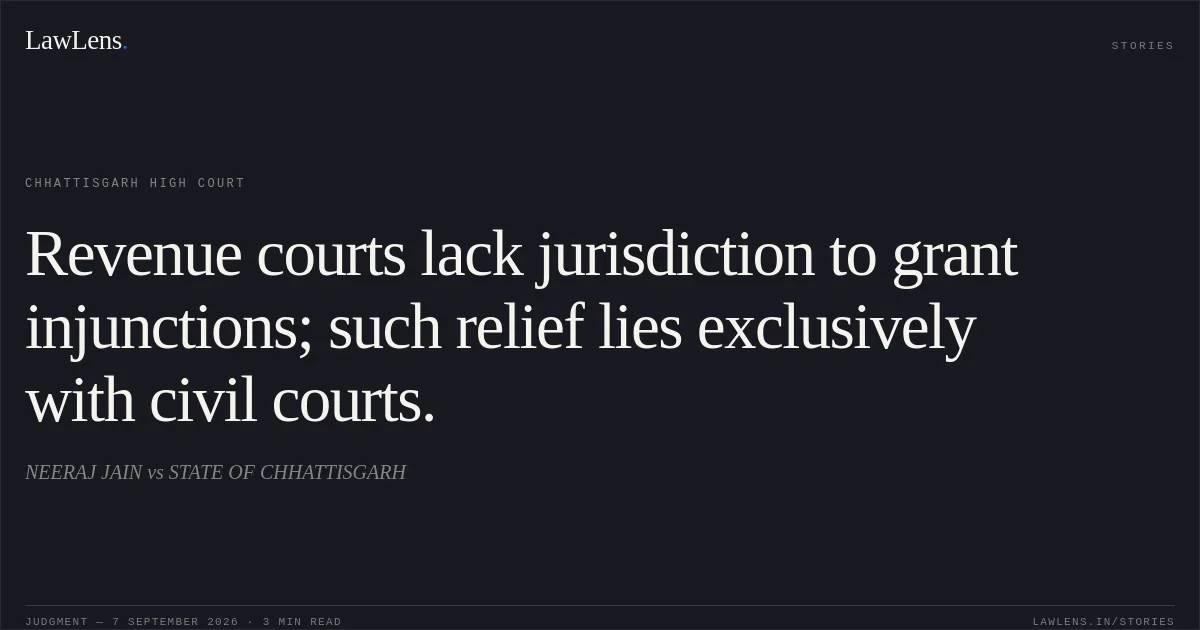
The Court answered the issues against the Revenue Authorities and held that the Tehsildar had no power or jurisdiction to entertain the application for injunction or to restrain construction over the residential property.
¶ 15The entire proceedings before the Tehsildar in Revenue Case No. 202112120600051/B-121/2021-22 and the interim order dated 25 April 2022 were quashed.
¶ 15The writ petition was accordingly allowed.
¶ 15Original Court PDF
NEERAJ JAINvsSTATE OF CHHATTISGARH
Click to open original judgment
Original judgment, available to read, download and summarize on LawLens.in