Facts
The respondents, claiming through their grandfather Byatappa, sought a declaration concerning Sy. No. 218 and an injunction against the petitioner’s interference with their possession. Their claim relied on a registered sale deed dated 12 May 1964 from Ramappa to Byatappa and on a prior partition suit in which the claim to Sy. No. 218 was rejected.
Source reference: pp. 2–7, paras. 2–4.1The petitioner claimed through vendors whose title derived from V. R. Suryanarayana, Ramappa’s son, and relied on a registered sale deed dated 14 December 2021 and revenue entries in the vendors’ names.
Source reference: pp. 2–7, paras. 2–4.1The Trial Court rejected the respondents’ application for temporary injunction; the First Appellate Court reversed that decision and granted an injunction. The petitioner challenged the appellate order under Article 227 of the Constitution
Source reference: pp. 2–7, paras. 2–4.1Issues
1. Whether the First Appellate Court was justified in granting an injunction restraining the petitioner from interfering with the respondents’ possession of Sy. No. 218
Source reference: pp. 3–7, paras. 3.1, 4.1, 6–82. Whether the revenue entries relied on by the petitioner justified refusing an injunction despite the registered 1964 sale deed and the prior partition-suit determination concerning Sy. No. 218
Source reference: pp. 3–7, paras. 3.1, 4.1, 6–8Law Applied
Order XXXIX Rules 1 and 2 of the Code of Civil Procedure govern applications for temporary injunction.
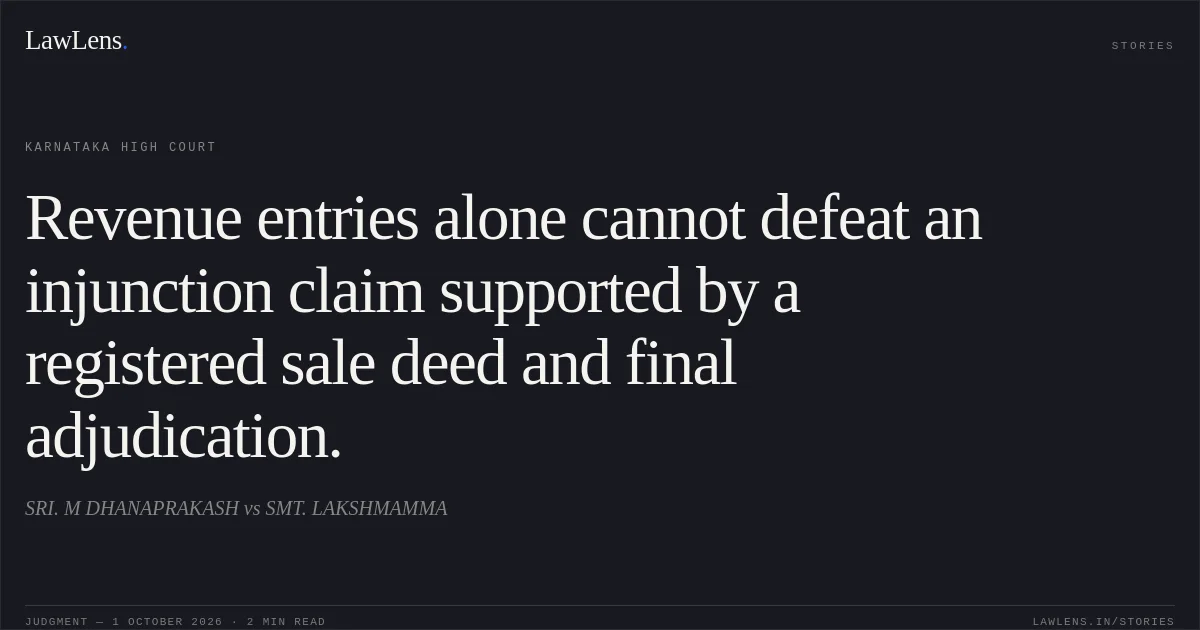
Source reference: pp. 2, 6–7, paras. 2, 7–9In considering such relief, revenue entries alone do not constitute a sufficient basis to deny an injunction where a registered sale deed is on record; the Court must consider the documentary material relevant to the claimed right and possession.
Source reference: pp. 2, 6–7, paras. 2, 7–9A party claiming through a litigant cannot assert a right that was rejected in a prior proceeding and attained finality.
Source reference: pp. 2, 6–7, paras. 2, 7–9The High Court’s supervisory jurisdiction was invoked under Article 227 of the Constitution.
Source reference: pp. 2, 6–7, paras. 2, 7–9No precedent was cited in the judgment
Source reference: pp. 2, 6–7, paras. 2, 7–9Reasoning
The High Court noted that the respondents relied on the 1964 registered sale deed in favour of Byatappa and that Sy. No. 218 had been included in the earlier partition suit, where V. R. Suryanarayana’s claim was rejected and the decision attained finality.
Source reference: pp. 5–7, paras. 6–8Because the petitioner claimed through persons deriving title from Suryanarayana, they could not assert a right inconsistent with that final determination.
Source reference: pp. 5–7, paras. 6–8The Court further held that the Trial Court had relied merely on revenue records, which could not, by themselves, defeat the respondents’ claim in the face of the registered deed.
Source reference: pp. 5–7, paras. 6–8It therefore found that the First Appellate Court had properly considered the record in granting the injunction
Source reference: pp. 5–7, paras. 6–8Holding
The Court answered the issues in favour of the respondents
declined to interfere with the First Appellate Court’s injunction order, and dismissed the writ petition
Source reference: p. 7, paras. 8–9Original Court PDF
SRI. M DHANAPRAKASHvsSMT. LAKSHMAMMA
Click to open original judgment
Original judgment, available to read, download and summarize on LawLens.in