Facts
The respondents-plaintiffs claimed ownership and possession of agricultural land measuring 4 Kanals 18 Marlas on the basis of a registered sale deed dated 13.05.1965 and sought a declaration of title with permanent injunction.
Source reference: para. 3The appellants-defendants, representing Dera Bhai Mastan Singh, contended that the land had previously been dedicated to the Dera for Dharam-Arth purposes and had remained in its possession through successive Mahants.
Source reference: para. 4They relied principally on revenue entries describing Attar Singh’s possession as “gair marusi bila lagan bawaja Dharam Arth”.
Source reference: paras. 4, 16The Trial Court dismissed the suit, holding that the property had been dedicated to the Dera and that the plaintiffs had failed to prove delivery of possession under the sale deed; it also found that the vendors owned only one-half share.
Source reference: paras. 5–6The First Appellate Court affirmed the dismissal.
Source reference: paras. 7–9In second appeal under Section 100 CPC, the High Court reversed those findings and decreed the suit, holding that the revenue entries did not establish dedication or adverse possession.
Source reference: paras. 10–13The defendants appealed to the Supreme Court.
Source reference: para. 14Issues
Whether the High Court was justified under Section 100 of the CPC in reversing the concurrent findings of the Trial Court and the First Appellate Court.
Source reference: para. 21(a)Whether the revenue entries recording possession as “gair marusi bila lagan bawaja Dharam Arth” established a completed dedication of the property to the Dera or otherwise proved the defendants’ title.
Source reference: para. 21(b); paras. 23–25Whether the defendants had perfected title by adverse possession through long and continuous possession by the Dera and its successive Mahants.
Source reference: paras. 21(b), 27–33Whether the plaintiffs’ sale deed could confer title to the entire suit property when the vendors allegedly owned only one-half share.
Source reference: paras. 34–38Law Applied
Revenue records, including Jamabandis and Khasra Girdawaris, are relevant evidence of possession but do not, by themselves, create or extinguish title or conclusively establish ownership, as held in Suraj Bhan v. Financial Commissioner and Vadiyala Prabhakar Rao v. Government of Andhra Pradesh.
Source reference: para. 23A dedication of immovable property to a religious or charitable institution may be proved without a formal deed where unequivocal conduct establishes it, but the party asserting dedication must prove a clear and permanent intention by the owner to divest ownership.
Source reference: para. 25Adverse possession requires actual, open, continuous and hostile possession, accompanied by a clear denial of the true owner’s title; mere long possession is insufficient, particularly where possession originated permissively or lawfully, as held in T. Anjanappa v. Somalingappa.
Source reference: para. 28The commencement of hostile possession must be specifically pleaded and proved.
Source reference: para. 30Under Section 100 CPC, concurrent findings may be interfered with where they result from misapplication of law, disregard of material evidence, or an erroneous understanding of settled legal principles, in accordance with Kondiba Dagadu Kadam v. Savitribai Sopan Gujar and A. Shahul Hameed v. N. Malligarjuna.
Source reference: paras. 39–40Further, each party must succeed on the strength of its own title, and a transferor cannot convey a better title than that possessed by the transferor.
Source reference: paras. 36–37Reasoning
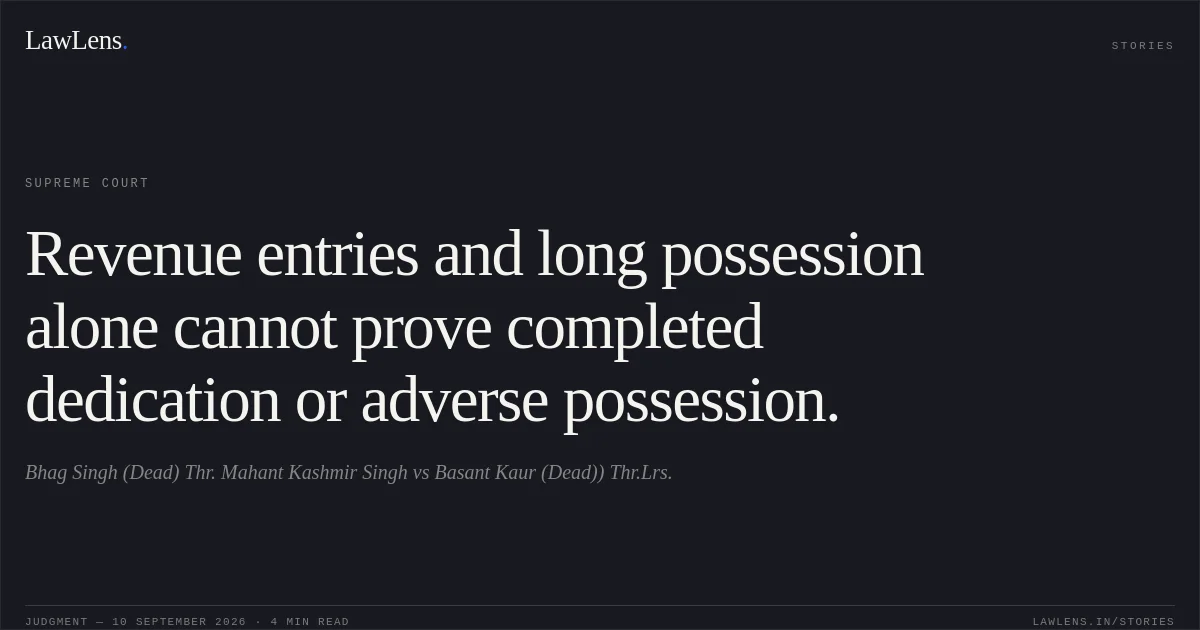
The Supreme Court held that the revenue entry referring to possession for Dharam-Arth purposes could indicate the nature of possession but did not conclusively prove either a completed dedication or transfer of ownership to the Dera.
Source reference: paras. 25, 32, 42The defendants’ own case was that Attar Singh entered possession as Mahant for the Dera, which suggested a non-hostile origin of possession and was inconsistent with a simultaneous claim of adverse possession unless a later hostile change was proved.
Source reference: para. 29Neither the pleadings nor the evidence identified when possession became hostile, nor was any overt repudiation of the true owners’ title established; therefore, the essential foundation for adverse possession was absent.
Source reference: para. 30The Trial Court and First Appellate Court had impermissibly equated prolonged possession with adverse possession and treated the revenue entries as establishing ownership.
Source reference: paras. 31–34Their conclusions involved an erroneous application of law, enabling the High Court to interfere under Section 100 CPC.
Source reference: paras. 39–41Although the respondents’ sale deed could not transfer more than the vendors’ legally owned share, that defect did not establish a superior title in the appellants, who continued to bear the burden of proving dedication or adverse possession.
Source reference: paras. 34–38Holding
The Supreme Court held that the appellants failed to prove either a completed dedication vesting the property in Dera Bhai Mastan Singh or acquisition of title by adverse possession.
The High Court was justified in interfering under Section 100 CPC because the concurrent findings rested on an erroneous application of legal principles rather than merely on a competing factual assessment.
Source reference: paras. 40–41The judgment and decree of the High Court dated 22.03.2011 were affirmed, subject to the clarification that the plaintiffs’ sale deed could operate only to the extent of the interest lawfully possessed by the vendors.
Source reference: paras. 42–44The Civil Appeal was dismissed.
Source reference: paras. 42–44Acts & Sections Cited
1 provisions across 1 statute referred to in this judgment. Each provision opens on LawLens.
Code of Civil Procedure, 19081
Original Court PDF
Bhag Singh (Dead) Thr. Mahant Kashmir SinghvsBasant Kaur (Dead)) Thr.Lrs.
Click to open original judgment
Original judgment, available to read, download and summarize on LawLens.in