Facts
The applicant, a retired Postal Assistant, was placed under suspension in February 2009 and subsequently retired in May 2009
Source reference: p. 2Disciplinary proceedings were initiated under Rule 14 of the CCS (CCA) Rules, 1965 (continued under Rule 9 of the Pension Rules), alleging that his failure to follow prescribed checks facilitated a fraud of approximately ₹12.7 lakh involving the premature closure of MIS/RD accounts
Source reference: p. 2-3, 8On 08.01.2016, a Presidential Order imposed a penalty of 20% pension withholding for five years and the withholding of ₹1,50,000 from his gratuity
Source reference: p. 3-4Thereafter, the Postal Department initiated revenue recovery (RR) proceedings for ₹12,16,834 to recoup the remaining loss to the exchequer
Source reference: p. 4, 7The applicant challenged the RR notices, arguing that the disciplinary penalty constituted the final determination of his liability and that recovery proceedings should be stayed pending the outcome of a related criminal case (C.C. No. 1212/2013)
Source reference: p. 4-5Issues
1. Whether the imposition of a disciplinary penalty bars the department from initiating separate revenue recovery proceedings to recoup the actual financial loss caused to the exchequer
Source reference: p. 11, 162. Whether the repeal of the Public Accountants Default Act, 1850, in 2019 invalidates recovery proceedings initiated via requisition in 2017
Source reference: p. 15-163. Whether revenue recovery proceedings must be kept in abeyance until the finalization of pending criminal proceedings regarding the same fraud
Source reference: p. 16-17Law Applied
The Tribunal applied Rule 9 of the CCS (Pension) Rules, 1972, regarding the power to withhold pension and gratuity post-retirement
Source reference: p. 8It further relied on Rule 204 of the Postal Manual Volume III and Para 3 of Appendix 4 of the PT Financial Handbook Volume I, which establish the personal liability of employees to make good government losses caused by their negligence or fraud
Source reference: p. 12-13Sections 3 and 4 of the Public Accountants Default Act, 1850, were invoked to recover defalcation amounts as arrears of land revenue
Source reference: p. 14-15Additionally, the Tribunal considered the saving clause of the Repealing and Amending Act, 2019 (Act 31 of 2019), which protects actions taken under a statute prior to its repeal
Source reference: p. 15-16Reasoning
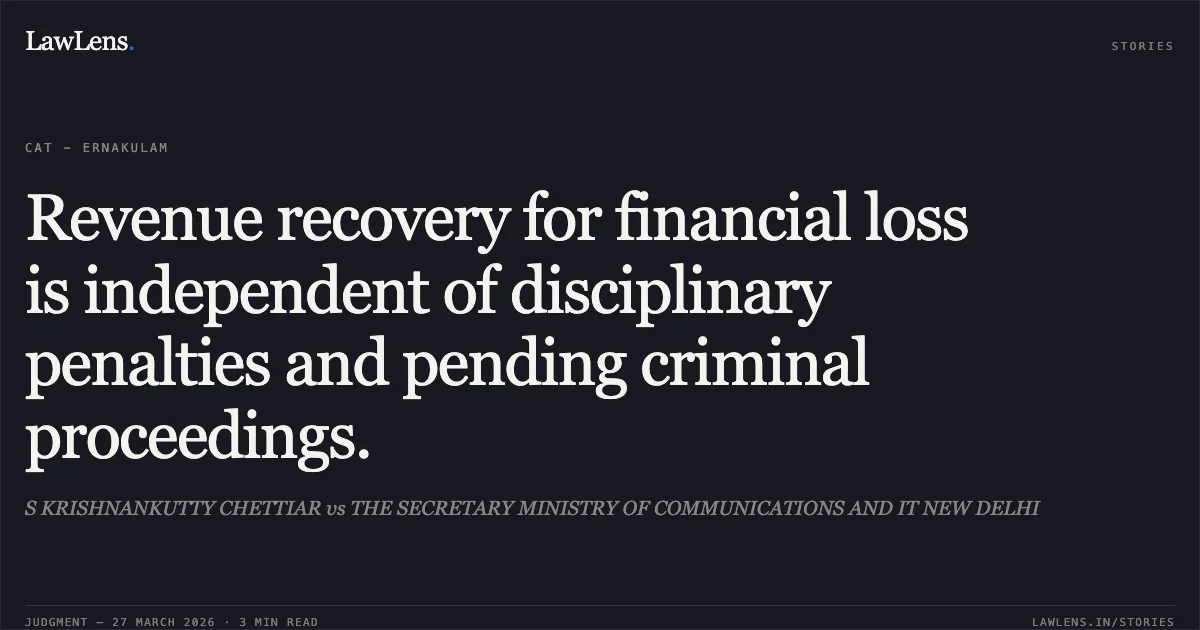
The Tribunal reasoned that disciplinary penalties for misconduct and recovery proceedings for financial loss are not mutually exclusive and serve distinct purposes—the former as punishment and the latter as restitution to the public exchequer
Source reference: p. 16It was observed that the quantification of the loss (₹12,14,040) was based on detailed inquiries into 32 fraud cases and was not denied by the applicant
Source reference: p. 9, 16The Tribunal rejected the "double jeopardy" argument, noting that the settled amounts in the disciplinary order were not part of the amounts quantified for revenue recovery
Source reference: p. 16Regarding the repeal of the Public Accountants Default Act, 1850, the Tribunal held that since the recovery requisition was made in 2017, the action was protected by the saving clause of the 2019 Repealing Act
Source reference: p. 15-16Finally, the Tribunal held that criminal proceedings for fraud and civil recovery proceedings for financial loss operate independently; thus, the pendency of a criminal trial does not bar the department from recovering dues
Source reference: p. 16-17Holding
The Tribunal dismissed the Original Application, holding that the revenue recovery proceedings were legal, within jurisdiction, and distinct from the disciplinary penalty
It concluded that the department is entitled to recover the loss caused to the public exchequer regardless of the pending criminal case or the prior disciplinary penalty
Source reference: p. 16-17No order as to costs was made
Source reference: p. 17Original Court PDF
S KRISHNANKUTTY CHETTIARvsTHE SECRETARY MINISTRY OF COMMUNICATIONS AND IT NEW DELHI
Click to open original judgment
Original judgment, available to read, download and summarize on LawLens.in