Facts
The petitioner filed Civil Suit No. 311/2023 for specific performance of an agreement to sell dated 18.01.2022 against respondents No. 2 to 14.
Source reference: para 2Subsequently, the respondents allegedly executed a second agreement with respondent No. 1 and instituted a second suit (No. 103/2024), suppressing the first suit's existence.
Source reference: para 2In the second suit, a compromise application under Order XXIII Rule 3 CPC was filed. The High Court, in M.P. No. 6032/2024 (dated 11.11.2025), directed the Trial Court to record this compromise and pass a conditional decree subject to statutory permissions.
Source reference: para 4The petitioner filed this review petition alleging collusion and error apparent on the record, arguing that the subsequent suit and decree defeat his prior rights.
Source reference: para 5Issues
1. Whether there exists an error apparent on the face of the record or sufficient grounds under Order 47 Rule 1 of the CPC to warrant a review of the order dated 11.11.2025.
Source reference: para 82. Whether the petitioner’s claims of collusion and deceit between the respondents constitute a valid ground for review jurisdiction as opposed to appellate jurisdiction.
Source reference: para 14-15Law Applied
Order 47 Rule 1 of the Code of Civil Procedure (CPC), which limits review to the discovery of new evidence, errors apparent on the face of the record, or other analogous sufficient reasons.
Source reference: para 8Asharfi Devi v. State of U.P. (2019) to establish that a review is not an "appeal in disguise" and errors must be self-evident without long-drawn reasoning.
Source reference: para 9Kamlesh Verma v. Mayawati (2013) regarding the impermissibility of re-arguing merits.
Source reference: para 10Lily Thomas v. Union of India (2000) on the strict parameters of review.
Source reference: para 11Malleeswari v. K. Suguna (2025) which underscores that a review court does not sit in appeal over its own order.
Source reference: para 13Reasoning
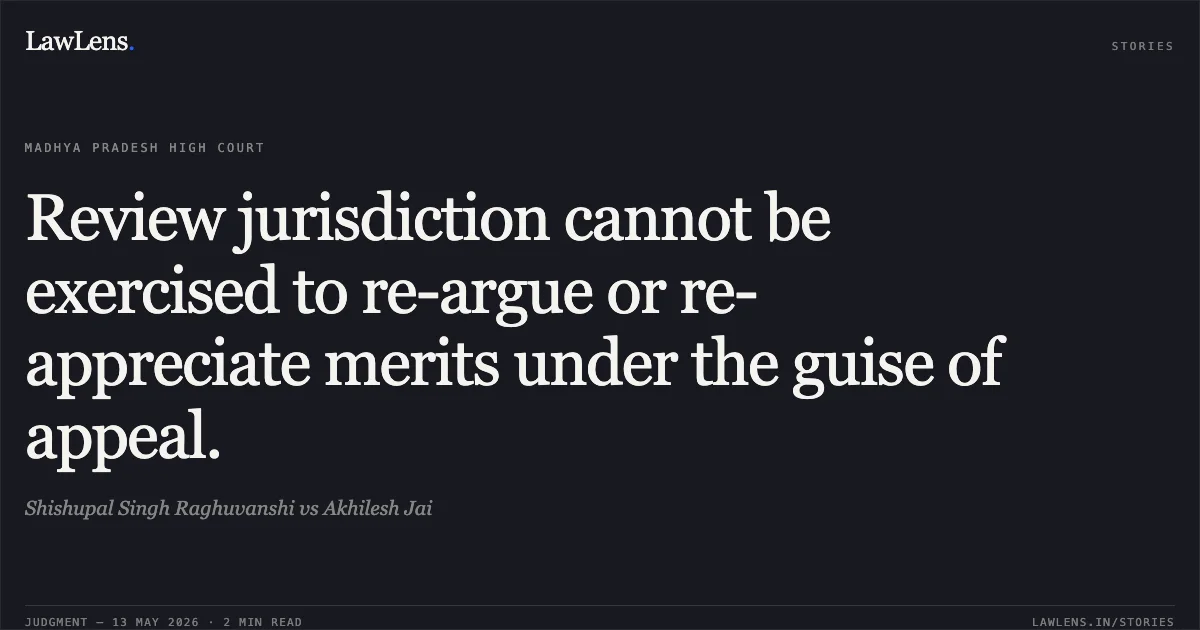
The court examined the petitioner’s contention that the second suit was a result of collusion intended to bypass the petitioner’s prior agreement. However, the court found that these arguments were essentially an attempt to re-litigate the merits of the case already decided in Miscellaneous Petition No. 6032/2024.
Source reference: para 14Applying the cited precedents, the court reasoned that an "error apparent" must be strike-evident and not one requiring a complex process of reasoning or re-appreciation of evidence.
Source reference: para 12Since the petitioner’s grounds required a reconsideration of factual findings regarding the validity of the second agreement and the alleged deceit, the court determined that such grievances fall within appellate territory rather than the narrow, circumscribed scope of review jurisdiction.
Source reference: para 15-16Holding
The High Court dismissed the review petition, holding that no ground for review under Order 47 Rule 1 CPC was made out.
The court concluded that the petitioner failed to demonstrate any patent error or discover new evidence that met the legal threshold for review, noting that the contentions raised were merely placeholders for a rehearing. No order as to costs was made.
Source reference: para 15-17Acts & Sections Cited
3 provisions across 2 statutes referred to in this judgment. Each provision opens on LawLens.
MP Land Revenue Code 19591
Code of Civil Procedure, 19082
Original Court PDF
Shishupal Singh RaghuvanshivsAkhilesh Jai
Click to open original judgment
Original judgment, available to read, download and summarize on LawLens.in