Facts
The applicant, a Store Assistant at DESIDOC (DRDO), originally filed OA No. 4189/2025 seeking a direction for the respondents to decide on his pending representations regarding his deputation to the Ministry of External Affairs
Source reference: p. 2, para. 3The Tribunal disposed of the OA on 11.03.2026, directing the respondents to pass a reasoned and speaking order on the representation dated 18.09.2024 and reminder dated 27.03.2025 within four weeks
Source reference: p. 2, para. 1The applicant subsequently filed this Review Application (RA) on two grounds: first, that no counsel for the respondents was present during the oral dictation of the order; and second, that the Tribunal failed to consider a specific prayer to permit him to file an additional comprehensive representation
Source reference: p. 2, para. 2Issues
1. Whether there exists an "error apparent on the face of the record" justifying a review of the order dated 11.03.2026 under Section 22(3)(f) of the Administrative Tribunals Act, 1985
Source reference: p. 3, para. 42. Whether a review application can be maintained for the purpose of re-arguing the merits of the case or seeking alternative reliefs not granted in the original order
Source reference: p. 3, para. 5; p. 4, para. 8Law Applied
The court applied Section 22(3)(f) of the Administrative Tribunals Act, 1985 and Rule 17 of the CAT (Procedure) Rules, 1987, which empower the Tribunal to review its decisions based on principles analogous to Order 47 Rule 1 of the CPC
Source reference: p. 2, para. 1; p. 3, para. 6The court relied on the Supreme Court judgments in Union of India v. Tarit Ranjan, which clarifies that the scope of review is limited to self-evident mistakes
Source reference: p. 3, para. 5State of West Bengal v. Kamal Sengupta, which established that an erroneous decision cannot be corrected under the guise of review and that the power is restricted to errors apparent on the face of the record without requiring long debate
Source reference: p. 3-4, para. 6Reasoning
The Tribunal examined the grounds raised by the applicant and found that they did not meet the threshold of an "error apparent on the face of the record."
Source reference: no citationRegarding the absence of the respondents' counsel during dictation, the Tribunal noted the order was passed with the consent of the parties and such a grievance does not constitute a reviewable error
Source reference: p. 4, para. 7, 8Concerning the prayer for a "comprehensive representation," the Tribunal held that the original order already addressed the core grievance by directing the disposal of existing representations
Source reference: p. 4, para. 7The Tribunal reasoned that the applicant was attempting to re-argue the case and seek a modification of the relief originally granted, which is impermissible as the review jurisdiction does not allow for a "long process of reasoning" or a "merits-based" re-evaluation of the initial decision
Source reference: p. 3, para. 5; p. 4, para. 8Holding
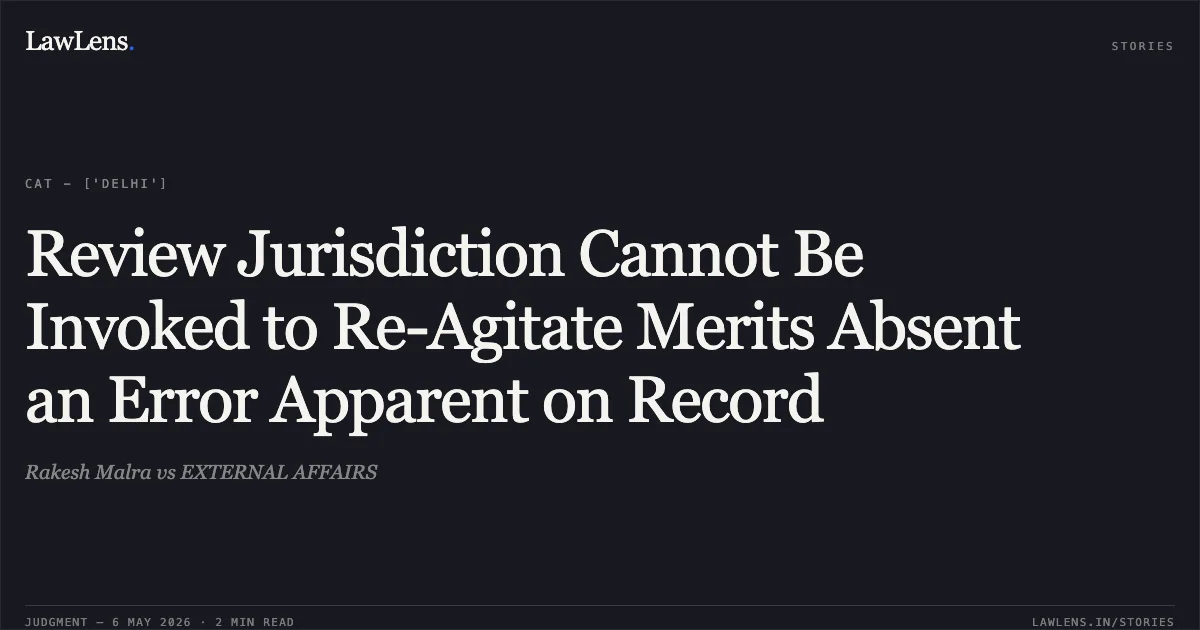
The Tribunal held that the applicant failed to point out any self-evident error in the order dated 11.03.2026. The court clarified that if the applicant believes the view taken by the Tribunal was erroneous, the remedy lies in a higher forum, not through a review
Consequently, the Review Application was dismissed in circulation, and all pending Miscellaneous Applications were disposed of
Source reference: p. 5, para. 9, 10Acts & Sections Cited
3 provisions across 2 statutes referred to in this judgment. Each provision opens on LawLens.
Administrative Tribunals Act, 19851
Code of Civil Procedure, 19082
Original Court PDF
Rakesh MalravsEXTERNAL AFFAIRS
Click to open original judgment
Original judgment, available to read, download and summarize on LawLens.in