Facts
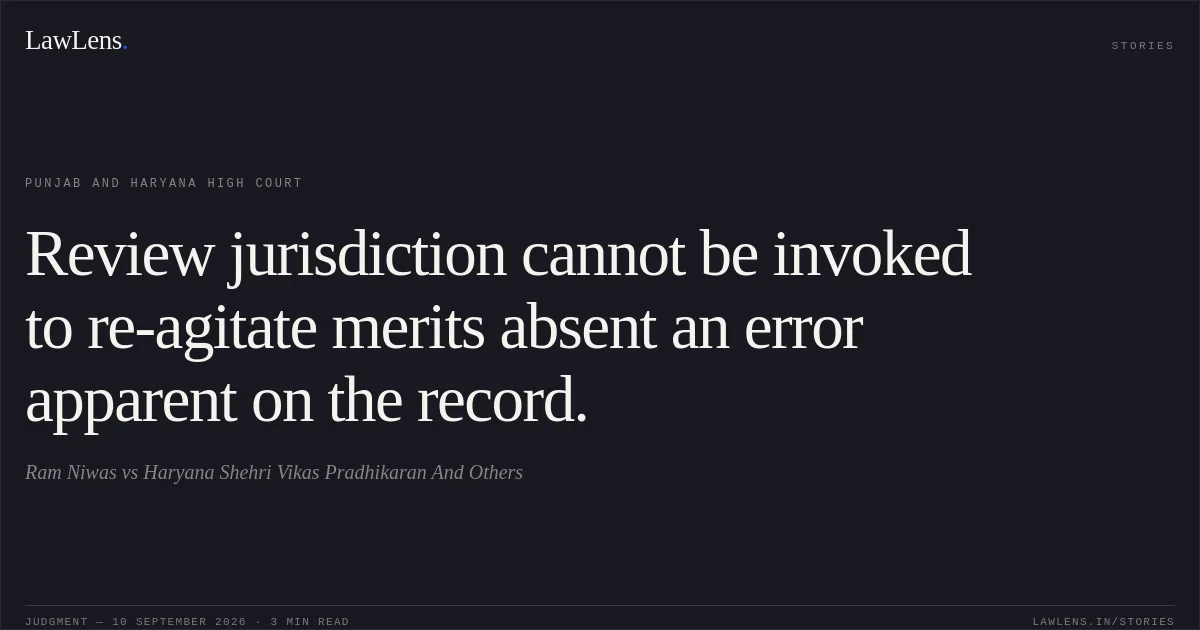
The review applicants, Haryana Shehri Vikas Pradhikaran and its officers, sought review under Section 114 read with Order XLVII Rule 1 CPC of the order dated 11 March 2026, by which Ram Niwas’s writ petition had been allowed.
Source reference: para. 1The original decision had relied upon the Industrial Tribunal’s award dated 1 March 2001 and the petitioner’s undisputed continuous service as a Chowkidar from 14 June 2002.
Source reference: paras. 2–3The applicants contended that the award had subsequently been modified in CWP-6130-2002, since the petitioner had relinquished his claim to continuity of service for 1996–2002 and to back wages, and that his case was not covered by any regularisation policy.
Source reference: para. 2The Court condoned the 135-day delay in filing the review and took Annexures A-1 to A-8 on record.
Source reference: CM-15789-CWP and CM-15791-CWPIssues
Whether the subsequent modification of the Industrial Tribunal’s award disclosed a new and important matter, an error apparent on the face of the record, or any other sufficient reason warranting review of the order dated 11 March 2026?
Source reference: paras. 5–10Whether the review application was, in substance, an impermissible attempt to re-argue the merits of the writ petition and convert review jurisdiction into appellate jurisdiction?
Source reference: paras. 3, 5–8Whether costs should be imposed upon the review applicants for compelling the petitioner to defend a second round of litigation?
Source reference: para. 11Law Applied
The Court applied Section 114 and Order XLVII Rule 1 CPC, under which review is maintainable only upon discovery of new and important matter or evidence despite due diligence, an error apparent on the face of the record, or another sufficient reason analogous to the specified grounds.
Source reference: para. 5It relied on Kamlesh Verma v. Mayawati, 2013 SCC OnLine SC 714, holding that review cannot be used to reappreciate evidence, correct an erroneous decision, or function as an appeal in disguise.
Source reference: para. 6State of Telangana v. Mohd. Abdul Qasim (Died), 2024 INSC 310, which requires the newly discovered material to have existed and been unavailable despite due diligence, and describes review as a restrictive and exceptional jurisdiction.
Source reference: para. 7The principles referred to from Aribam Tuleshwar Sharma v. Aribam Pishak Sharma, (1979) 4 SCC 389 and Parison Devi v. Sumitri Devi, (1997) 8 SCC 715, that an error must be self-evident and not discoverable only through a process of reasoning.
Source reference: para. 8Reasoning
The Court held that the modification of the award did not affect the factual basis of the original writ decision: the petitioner had undisputedly worked continuously as a Chowkidar from 14 June 2002, and the earlier judgment was founded on that service period rather than on any claim to continuity between 1996 and 2002 or on back wages.
Source reference: para. 9The applicants therefore failed to establish concealment, withholding of material facts, discovery of qualifying new evidence, or any patent error apparent on the record.
Source reference: para. 9Their objections sought reconsideration of the merits and a different interpretation of the record, which was impermissible in review proceedings and could be pursued, if at all, in appeal.
Source reference: paras. 5–8Holding
The Court dismissed the review application, finding that no ground under Order XLVII Rule 1 CPC had been established.
The applicants were directed to comply with the original judgment dated 11 March 2026 within four weeks of receiving a certified copy of the order.
Source reference: para. 10Considering that the Class-IV petitioner had been compelled to defend a second round of litigation without any apparent error in the original judgment, the Court imposed costs of ₹20,000, payable within four weeks; in default, the petitioner was given liberty to seek contempt proceedings under Article 215 of the Constitution.
Source reference: para. 11Pending miscellaneous applications were disposed of accordingly.
Source reference: para. 12Acts & Sections Cited
3 provisions across 2 statutes referred to in this judgment. Each provision opens on LawLens.
Limitation Act, 19631
Code of Civil Procedure, 19082
Original Court PDF
Ram NiwasvsHaryana Shehri Vikas Pradhikaran And Others
Click to open original judgment
Original judgment, available to read, download and summarize on LawLens.in