Facts
The petitioner’s father, Late Ramdhanu Porte, an Assistant Teacher, died in harness on 04.11.2006, when the petitioner was a minor. The petitioner attained majority in 2010 and subsequently applied for compassionate appointment. His application was rejected on 29.05.2018 as being delayed by approximately eight years, contrary to the applicable policy requiring an application within six months of the employee’s death. His writ petition was dismissed by the learned Single Judge on 28.06.2019, and the subsequent writ appeal was dismissed by the Division Bench on 03.01.2022
Source reference: para. 3In the review petition, the petitioner contended that his mother had submitted an application for compassionate appointment in 2008, which had allegedly been returned without consideration. He relied on documents obtained under the Right to Information Act and argued that the earlier decision proceeded on the State’s incorrect submission that the first application was made only in 2013. The State opposed the review, asserting that the petitioner was seeking reappreciation of facts, which was impermissible in review jurisdiction
Source reference: paras. 4–5Issues
Whether the alleged application submitted by the petitioner’s mother in 2008 constituted an error apparent on the face of the record warranting review of the order dated 03.01.2022?
Source reference: paras. 4, 7, 12Whether the petitioner could seek reconsideration of the factual and merits-based findings made by the Division Bench under the guise of review?
Source reference: paras. 8–11Law Applied
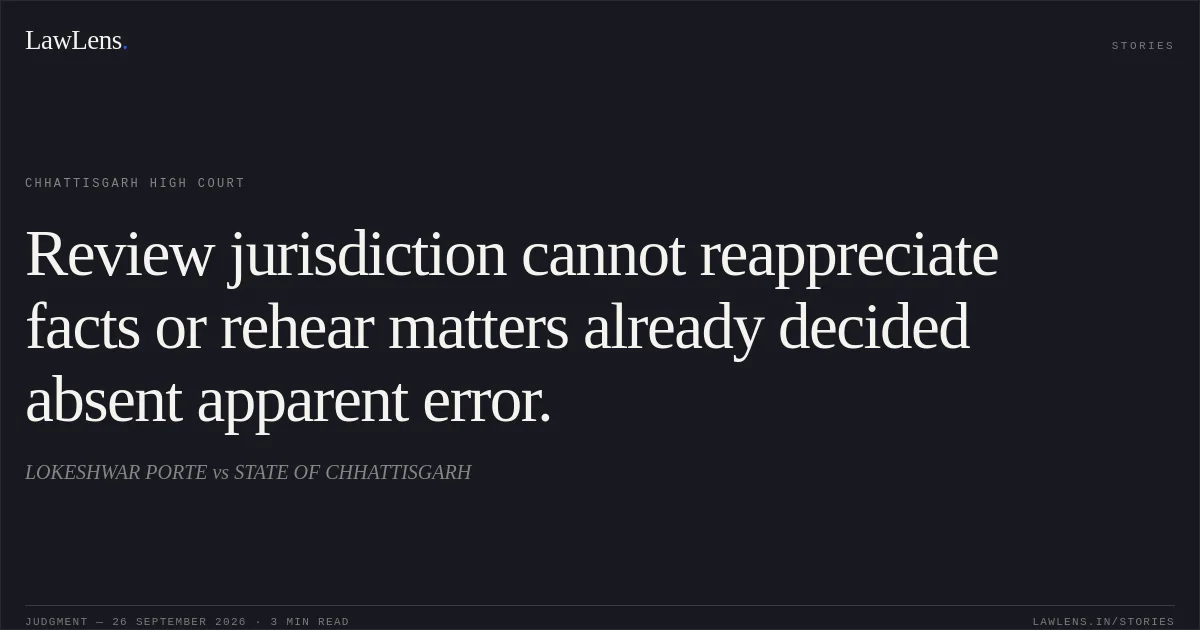
The Court applied the limited scope of review jurisdiction under Order 47 Rule 1 of the Code of Civil Procedure, under which review is maintainable only on grounds such as discovery of new and important matter, mistake or error apparent on the face of the record, or another sufficient reason.
Source reference: para. 8Relying on Surendra Kumar Vakil & Ors. v. Chief Executive Officer, MP & Ors., (2004) 10 SCC 126, the Court held that a point already heard and decided cannot ordinarily constitute a ground for review, even if the decision is alleged to be erroneous. Relying on Asharfi Devi (Dead) through LRs v. State of Uttar Pradesh & Ors., (2019) 5 SCC 86, and Shri Ram Sahu (Dead) through LRs v. Vinod Kumar Rawat & Ors., Civil Appeal No. 3601 of 2020, the Court reiterated that an error must be self-evident and apparent on the face of the record; review cannot function as an appeal or permit rehearing and correction of an allegedly erroneous decision.
Source reference: paras. 8–10Reasoning
The Court examined the earlier Division Bench order dated 03.01.2022 and found that the contention regarding an application allegedly submitted by the petitioner’s mother had already been noticed and considered. The Division Bench had also considered that the petitioner attained majority in 2010 and thereafter submitted his own application in 2013.
Source reference: para. 7Consequently, the petitioner’s reliance on the alleged 2008 application and the RTI documents did not disclose a self-evident error; determining their effect would require reconsideration of the factual merits and reappreciation of the material already considered. Such an exercise would amount to rehearing the writ appeal, which is impermissible in review jurisdiction. The Court therefore held that the petitioner had not established an error apparent on the face of the record or any other sufficient ground under Order 47 Rule 1 CPC.
Source reference: paras. 10–12Holding
The Court answered the issues against the petitioner. It held that the alleged prior application by the petitioner’s mother did not establish an error apparent on the face of the record, particularly because the contention had already been considered by the Division Bench.
The review petition seeking review of the order dated 03.01.2022 was accordingly dismissed, with no order as to costs.
Source reference: para. 12Original Court PDF
LOKESHWAR PORTEvsSTATE OF CHHATTISGARH
Click to open original judgment
Original judgment, available to read, download and summarize on LawLens.in