Facts
The petitioner, Shailendra Dubey, sought review of the High Court’s order dated 05.08.2026 passed in W.P.(C) No. 4111 of 2022, whereby the Court had reduced the penalty imposed under Section 20(1) of the Right to Information Act, 2005, from ₹9,250 to ₹5,000, while sustaining the finding that penalty was imposable
Source reference: para. 1–2The petitioner contended that the order under review contained an error apparent on the face of the record because the finding sustaining the penalty continued to operate against him despite the reduction in its quantum. The State Information Commission opposed the review, and the Court examined whether the petitioner’s grounds fell within the limited scope of review jurisdiction
Source reference: para. 2–8Issues
Whether the order dated 05.08.2026 disclosed an error apparent on the face of the record warranting review, particularly in relation to the penalty imposed under Section 20(1) of the Right to Information Act, 2005?
Source reference: para. 2–8Whether the petitioner’s challenge amounted merely to a request for reconsideration or re-appreciation of the findings, which would be impermissible in review jurisdiction?
Source reference: para. 3–7Law Applied
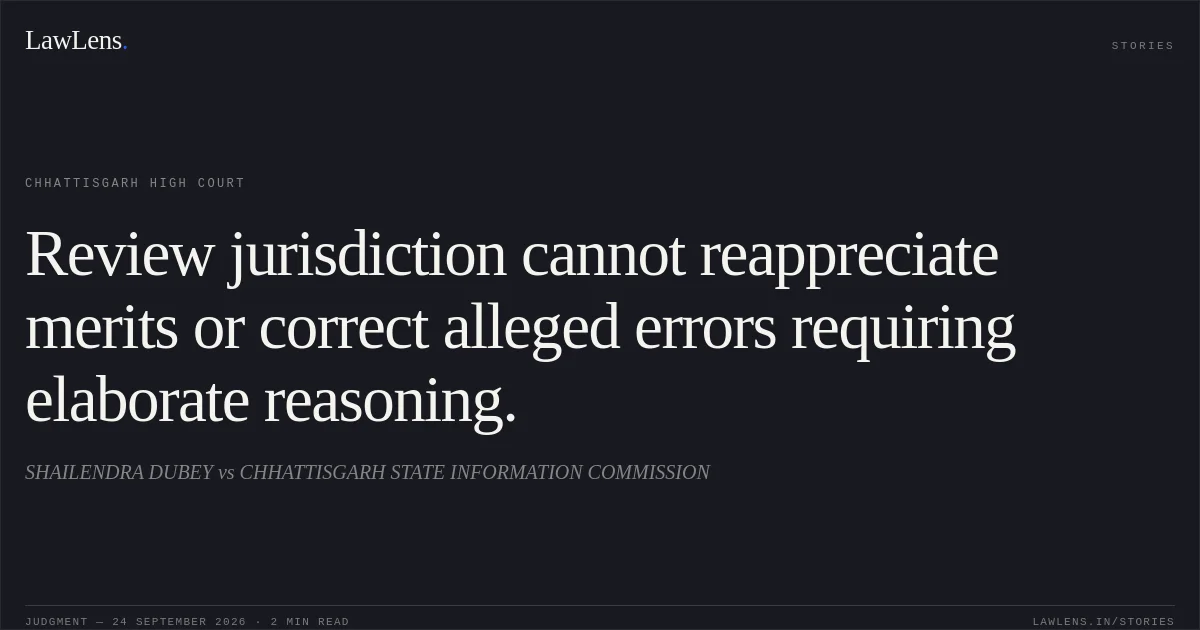
The Court applied the limited scope of review jurisdiction, holding that review is permissible only where there is an error apparent on the face of the record or another recognised ground for review; it cannot be used for re-hearing, re-appreciation of evidence, correction of every alleged error, or substitution of one possible view for another
Source reference: para. 4The Court relied on Devaraju Pillai v. Sellayya Pillai, (1987) 1 SCC 61; Meera Bhanja v. Nirmala Kumari Choudhury, (1995) 1 SCC 170; Avijit Tea Co. Pvt. Ltd. v. Terai Tea Co., (1996) 10 SCC 174; Lily Thomas v. Union of India, AIR 2000 SC 1650; Akhilesh Yadav v. Vishwanath Chaturvedi, (2013) 2 SCC 1; and Sasi v. Aravindakshan Nair, (2017) 4 SCC 692, which reiterate that review cannot assume the character of an appellate proceeding
Source reference: para. 5Section 20(1) of the Right to Information Act, 2005 was relevant to the underlying penalty proceedings
Source reference: para. 2Reasoning
The Court found that the petitioner’s challenge was directed at the correctness of the earlier finding sustaining the imposition of penalty, rather than at a patent or self-evident error in the order
Source reference: para. 3–4Determining whether the penalty under Section 20(1) was legally sustainable would require reconsideration of the merits and re-examination of conclusions already reached by the Court
Source reference: para. 3, 7The petitioner failed to identify any material fact, binding legal provision, manifest mistake, or patent error that had been inadvertently overlooked
Source reference: para. 6Since the grounds required appellate-style reassessment rather than correction of an apparent error, they fell outside the permissible scope of review jurisdiction
Source reference: para. 6–8Holding
The High Court held that no error apparent on the face of the record or other legally recognised ground for review was established.
The Review Petition was accordingly dismissed, with no order as to costs
Source reference: para. 8–10However, the Court clarified that dismissal of the Review Petition would not prevent the petitioner from pursuing any other appropriate remedy available before the competent appellate forum in accordance with law
Source reference: para. 11Acts & Sections Cited
1 provisions across 1 statute referred to in this judgment. Each provision opens on LawLens.
Right to Information Act, 20051
Original Court PDF
SHAILENDRA DUBEYvsCHHATTISGARH STATE INFORMATION COMMISSION
Click to open original judgment
Original judgment, available to read, download and summarize on LawLens.in