Facts
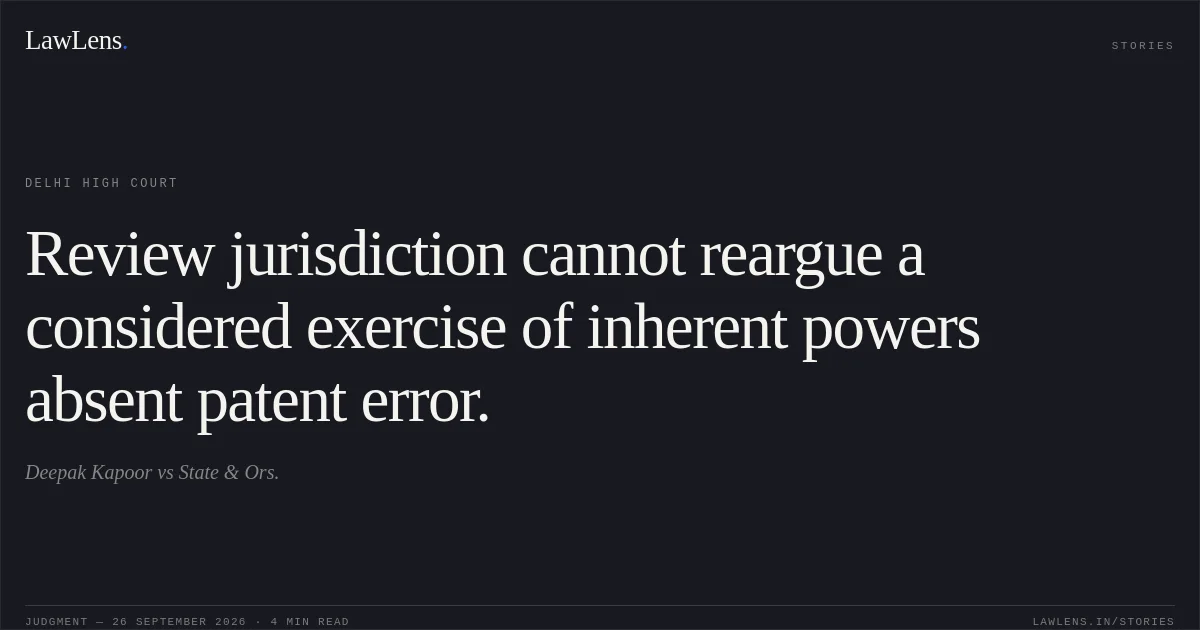
Respondent No. 2 sought review under Section 114 read with Order XLVII Rule 1 CPC of the order dated 25 August 2026, to the extent it allowed IA No. 20687/2026 filed by respondent No. 5, the deceased testator’s mother.
Source reference: paras. 1–3The earlier order directed the petitioner, the sole executor named in the Will, and respondent No. 2 to disclose on affidavit the deceased’s estate, including its particulars, inventory, valuation and present status, and directed respondent No. 2 to produce records concerning the Delhi Development Authority’s transfer of Flat No. 125, Munirka Vihar.
Source reference: para. 3It further restrained alienation, transfer, encumbrance or other dealings with estate assets without the Court’s permission, subject to specified exceptions for recurring pensionary payments and a sale permitted in another application.
Source reference: para. 3The order expressly stated that it did not determine the validity of the Will or Codicil, the parties’ rights in the estate, or the correctness of the DDA transfer.
Source reference: para. 4Respondent No. 2 contended that IA No. 20687/2026 had not been properly taken up, that no opportunity to file a reply had been granted, and that the Court could not invoke Section 151 CPC in view of Section 269(2) of the Indian Succession Act, 1925.
Source reference: paras. 5–7The Court noted that respondent No. 2 was represented on both 4 August and 25 August 2026, that no reply had been filed during the intervening three weeks, and that no request for deferment or permission to file a reply had been made when the application was heard.
Source reference: paras. 12–14Issues
Whether the order dated 25 August 2026 suffered from a procedural irregularity or error apparent on the face of the record because IA No. 20687/2026 was allegedly decided without notice or an opportunity to file a reply.
Source reference: paras. 5, 12–14Whether the Court’s invocation of its inherent powers under Section 151 CPC to preserve the deceased’s estate was impermissible in view of Section 269(2) of the Indian Succession Act, 1925.
Source reference: paras. 6, 15–18Whether the directions requiring disclosure of the estate and restraining dealings with estate assets warranted review under Order XLVII Rule 1 CPC.
Source reference: paras. 1, 9–11, 19–20Law Applied
The Court applied Section 114 read with Order XLVII Rule 1 CPC, under which review is available only for discovery of new and important matter or evidence, a mistake or error apparent on the face of the record, or another sufficient reason.
Source reference: para. 9Relying on Kamlesh Verma v. Mayawati, (2013) 8 SCC 320, the Court reiterated that review is not an appeal in disguise, that mere disagreement with the reasoning or the possibility of another view is insufficient, and that the error must be patent and self-evident.
Source reference: para. 10Under Parsion Devi v. Sumitri Devi, (1997) 8 SCC 715, an error requiring a process of reasoning to discover is not an error apparent on the face of the record.
Source reference: para. 11The Court also relied on Lily Thomas v. Union of India, (2000) 6 SCC 224, for the principle that review may correct a mistake but cannot substitute one judicial view for another.
Source reference: para. 18The power to issue protective directions under Section 151 CPC was considered by reference to Bai Avabai Hormusji Tata Trust v. Shernaz Faroukh Lawyer, 2026 SCC OnLine SC 927, and Sarup Singh v. Govt. of NCT of Delhi, 2022 SCC OnLine Del 3991.
Source reference: para. 15Reasoning
The Court found no procedural error warranting review because respondent No. 2 was represented when IA No. 20687/2026 was listed on 4 August 2026 and when it was taken up on 25 August 2026; no reply was filed in the intervening period, and no request was made for adjournment or permission to file one.
Source reference: paras. 12–14The challenge based on Section 269 of the Indian Succession Act did not disclose an error apparent on the face of the record. The issue concerning the Court’s power to issue protective directions had already been considered and answered in the original order by relying on the relevant Supreme Court and coordinate Bench authorities.
Source reference: para. 15Seeking reconsideration of that conclusion on the basis that a different interpretation of Sections 151 and 269 was possible amounted to an appellate challenge, which is impermissible in review proceedings.
Source reference: paras. 16–18Moreover, the impugned directions were procedural and protective: the disclosure orders determined no entitlement, while the restraint preserved the estate pending adjudication, remained subject to further orders and the Court’s leave, and did not affect specified pensionary payments or the permitted sale.
Source reference: para. 19Holding
The Court held that respondent No. 2 established neither a procedural irregularity nor an error apparent on the face of the record, and that the challenge to the exercise of Section 151 CPC jurisdiction was effectively an attempt to reargue the merits in review.
Since the directions were interlocutory, protective and non-determinative of substantive rights, no ground for review under Order XLVII Rule 1 CPC was made out.
Source reference: para. 19Review Petition No. 415/2026 was accordingly dismissed, with the matter directed to remain listed before the Joint Registrar (Judicial) on 7 December 2026, the date already fixed.
Source reference: paras. 20–21Acts & Sections Cited
3 provisions across 2 statutes referred to in this judgment. Each provision opens on LawLens.
Code of Civil Procedure, 19082
Indian Succession Act, 19251
Original Court PDF
Deepak KapoorvsState & Ors.
Click to open original judgment
Original judgment, available to read, download and summarize on LawLens.in