Facts
The appellant, M. Ganeshan, was appointed to a Group ‘C’ post in 1983 through a selection process involving a 10% quota reserved for Group ‘D’ employees.
Source reference: para. 2The Tribunal held that this constituted a fresh appointment and was to be treated as direct recruitment, entitling him to the first and second Assured Career Progression (ACP) benefits at par with similarly situated employees.
Source reference: para. 2The respondents’ writ petition was dismissed by the Calcutta High Court, which found that the appellant had been treated as a direct recruit for relevant purposes and that his 2006 ACP benefit, retrospectively granted from 1999, was his first ACP benefit.
Source reference: para. 3; para. 5In review, the respondents contended that the benefits granted to six similarly situated employees had subsequently been withdrawn by a review DPC.
Source reference: para. 4The High Court treated parity as the sole basis of its earlier decision, recalled the dismissal order, and allowed the writ petition subject to extending the pecuniary benefit received by those six employees to the appellant.
Source reference: para. 4The appellant challenged that review order before the Supreme Court.
Source reference: para. 1Issues
Whether the High Court exceeded the permissible scope of review jurisdiction by recalling its earlier judgment on the basis that parity was the sole ground for dismissal of the writ petition, when the judgment also contained independent findings on the appellant’s fresh appointment and ACP entitlement.
Source reference: para. 5–8Whether the High Court’s unchallenged findings that the appellant’s Group ‘C’ appointment was a fresh appointment and that the ACP benefit granted in 2006 retrospectively from 1999 was his first ACP benefit could be displaced in review proceedings.
Source reference: para. 7–8Whether the Tribunal’s direction to consider and grant the appellant first and second ACP benefits was liable to be restored.
Source reference: para. 2; para. 9–10Law Applied
The Court applied the principle that review jurisdiction is confined to correcting an error apparent on the face of the record and cannot be exercised to rehear or alter a judgment merely because a party disputes one of its factual or legal grounds.
Source reference: para. 8A review court must correctly identify the basis of the original judgment and cannot disregard independent findings that were not challenged in the review proceedings.
Source reference: para. 6–8The Court also applied the ACP scheme as interpreted in the prior proceedings: where appointment to a Group ‘C’ post is a fresh appointment and is treated as direct recruitment, the employee’s ACP entitlement is to be assessed from that appointment; a benefit granted retrospectively from 1999 was to be treated as the first ACP benefit, not the second.
Source reference: para. 5; para. 7No statutory provision or precedent was separately cited in the judgment.
Source reference: no citationReasoning
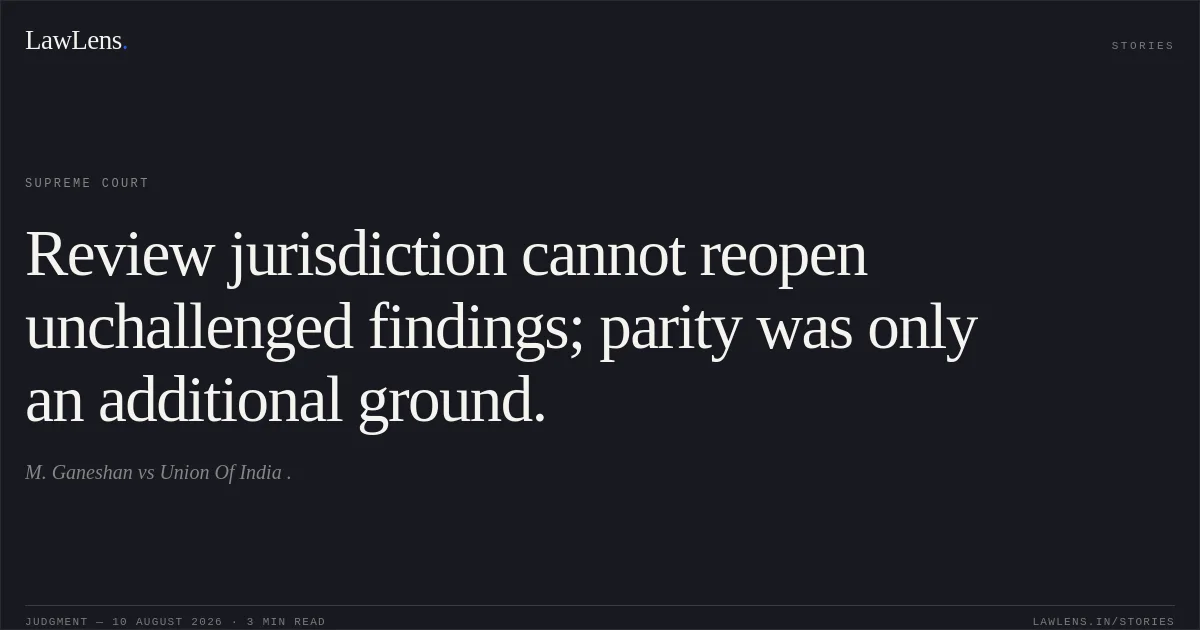
The Supreme Court examined the High Court’s earlier dismissal order and found that parity with other employees was only an additional ground, not the sole basis for the decision.
Source reference: para. 5–6The earlier order independently held that the appellant’s Group ‘C’ appointment was a fresh appointment, that his prior Group ‘D’ status ceased to be relevant beyond 1983, and that the ACP benefit granted in 2006 retrospectively from 1999 constituted his first ACP benefit.
Source reference: para. 5Those findings were not challenged in the review petition.
Source reference: para. 7Consequently, the subsequent withdrawal of benefits from six other employees could not invalidate the independent reasoning supporting the appellant’s claim.
Source reference: para. 7By treating parity as the sole basis and recalling the earlier judgment on that footing, the High Court committed an error apparent on the face of the record and improperly expanded its review jurisdiction.
Source reference: para. 6–8Holding
The Supreme Court allowed the appeal, set aside the High Court’s review order dated 19 July 2013, and restored the High Court’s order dated 16 March 2010 dismissing the respondents’ writ petition.
The respondents were directed to give effect to the Tribunal’s order, including consideration and grant of the appellant’s first and second ACP benefits in accordance with law, within three months.
Source reference: para. 10There was no order as to costs.
Source reference: para. 10Original Court PDF
M. GaneshanvsUnion Of India .
Click to open original judgment
Original judgment, available to read, download and summarize on LawLens.in