Facts
The dispute involves plot numbers in Village Takipur, Aligarh, following consolidation operations that began in 1973.
Source reference: p. 1Predecessors of both the petitioners and respondents filed cross-objections under Section 9-A(2) of the U.P. Consolidation of Holdings (U.P.C.H.) Act, 1953.
Source reference: p. 1-2After several rounds of litigation, the High Court, in Om Prakash v. DDC (Writ-B No. 710 of 1980), remanded the title revision back to the Deputy Director of Consolidation (DDC) to decide the matter afresh on merits.
Source reference: p. 2Upon remand, the DDC passed an order on February 3, 2025, abating (terminating) the revision proceeding on the grounds that the original records were unavailable (weeded out or lost) and neither party had produced sufficient documents to reconstruct the file.
Source reference: p. 3, 7The petitioners challenged this abatement as arbitrary and passed without a proper hearing.
Source reference: p. 4Issues
1. Whether a title revision under Section 48 of the U.P.C.H. Act can be abated solely on the ground of non-availability or loss of original records.
Source reference: p. 7, 102. Whether the revisional court is obligated to follow a specific procedure for the reconstruction of records before dismissing a case for lack of evidence.
Source reference: p. 7-8Law Applied
The court primarily applied the inherent powers of the court under Section 151 of the Code of Civil Procedure (CPC) for the reconstruction of lost or destroyed records.
Source reference: p. 7-8Precedent Ram Khelawan v. Deputy Director of Consolidation (1987 RD 350) established that when records are lost, parties must be given the "fullest opportunity" to provide certified or even uncertified copies (if not objected to) to reconstruct the file.
Source reference: p. 8Precedent Lochan v. D.D.C., Mathura (2015 (128) RD 381) held that consolidation litigation is not voluntary but forced upon landowners by law, necessitating a resolution on merits.
Source reference: p. 10Reasoning
Under Section 151 of the CPC, the judiciary has an inherent duty to reconstruct files that are lost, burnt, or misplaced through no fault of the parties.
Source reference: p. 7-8The High Court observed that the DDC failed to afford a "proper opportunity" of hearing to the petitioners before abating the case.
Source reference: p. 7Following the Ram Khelawan principle, the DDC should have invited all available documentation—including statements recorded in previous judgments—to reconstruct the proceedings rather than terminating the litigation.
Source reference: p. 8-9The court emphasized that because consolidation is a mandatory legal process, the authorities cannot abdicate their duty to decide title disputes merely due to administrative record-keeping failures.
Source reference: p. 10Holding
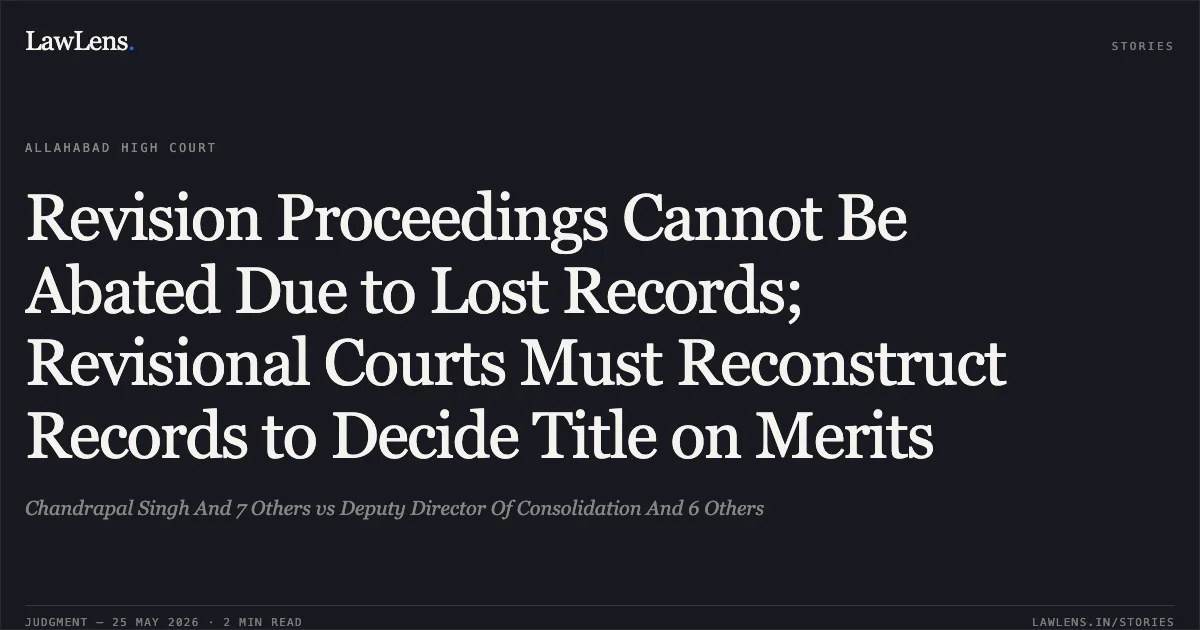
The High Court held that non-availability of records is not a valid ground for abatement of a title revision.
The High Court allowed the writ petition, quashed the impugned order dated February 3, 2025, and remitted the matter back to the DDC/Revisional Court with directions to restore the revision, reconstruct the record, and decide the case on merits within three months.
Source reference: p. 10-11Acts & Sections Cited
1 provisions across 1 statute referred to in this judgment. Each provision opens on LawLens.
Code of Civil Procedure, 19081
Original Court PDF
Chandrapal Singh And 7 OthersvsDeputy Director Of Consolidation And 6 Others
Click to open original judgment
Original judgment, available to read, download and summarize on LawLens.in


