Facts
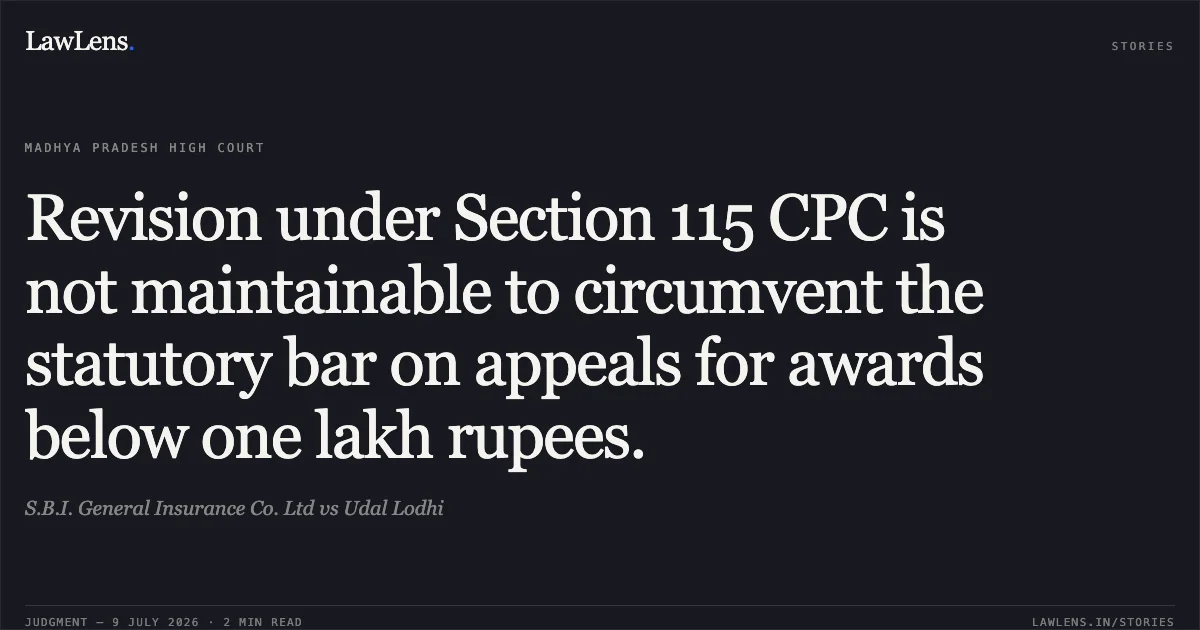
The petitioner Insurance Company filed a revision petition under Section 115 of the CPC challenging an award of ₹32,796/- passed by the Motor Accident Claims Tribunal.
Source reference: para. 1The Insurance Company argued that following the 2019 Amendment to the Motor Vehicles Act (specifically the renumbering of Section 149 to Section 150), the "pay and recover" principle—where the insurer pays the claimant and recovers from the owner—is no longer applicable once a breach of policy is found.
Source reference: para. 2–3The petitioner maintained that despite the low quantum, the case involved a significant legal question of larger interest.
Source reference: para. 4Issues
1. Whether a revision petition under Section 115 of the CPC is maintainable against a Claims Tribunal award where the amount in dispute is less than ₹1,00,000/-, given the statutory bar on appeals under Section 173(2) of the Motor Vehicles Act.
Source reference: para. 5–62. Whether the Insurance Company established "irreparable injury" or "failure of justice" sufficient to invoke revisional jurisdiction to settle a legal interpretative issue regarding Section 150 of the amended Motor Vehicles Act.
Source reference: para. 8–10Law Applied
The court applied Section 173(2) of the Motor Vehicles Act, 1988 (as amended in 2019), which bars appeals for awards where the amount in dispute is less than ₹1,00,000/-.
Source reference: para. 5, 9The court relied on the five-judge bench precedent in National Insurance Company v. Shrikant Vinod Tiwari (2007), which held that while a revision under Section 115 CPC is not absolutely barred, it is limited to cases involving a lack of jurisdiction, irreparable injury, or failure of justice.
Source reference: para. 6–7The court also noted Nirbhai Singh v. Darshan Singh (2025), where the Punjab and Haryana High Court deprecated the practice of using Article 227 or revisions to circumvent the statutory threshold for appeals.
Source reference: para. 9Reasoning
The court reasoned that while the Shrikant Vinod Tiwari case permits revisions in "special circumstances," it was not intended to allow insurers to bypass the legislative intent of Section 173(2) for routine matters.
Source reference: para. 8Although the petitioner raised a legal issue regarding the interpretation of the "pay and recover" doctrine under the amended Section 150, the court found this did not constitute a "failure of justice" because the same legal question is already pending in numerous other appeals and before the Supreme Court.
Source reference: para. 8, 10The court highlighted the absurdity of the litigation cost, noting that the expenses for both parties in pursuing the revision would likely exceed the small compensation amount awarded (₹32,796/-), thereby making the intervention contrary to the interests of justice.
Source reference: para. 10Holding
The court declined to entertain the revision, holding that no irreparable loss would be caused to the Insurance Company by allowing the low-quantum award to stand, as the legal issue remains open in other pending litigations.
The Revision was dismissed, with liberty granted to the Insurance Company to seek revival only if the claimant files for enhancement.
Source reference: para. 12–13Acts & Sections Cited
4 provisions across 2 statutes referred to in this judgment. Each provision opens on LawLens.
Code of Civil Procedure, 19081
Motor Vehicles Act, 19883
Original Court PDF
S.B.I. General Insurance Co. LtdvsUdal Lodhi
Click to open original judgment
Original judgment, available to read, download and summarize on LawLens.in