Facts
The petitioner, the victim and informant, alleged that the accused obstructed access to his room and store by installing an iron grill and door.
Source reference: para. 2–8The Magistrate acquitted the accused under Section 341 IPC, finding that the prosecution had not proved who installed the obstruction.
Source reference: para. 2–8The victim’s appeal was dismissed by the Sessions Court, which held that an appeal against acquittal was not maintainable before it, but also considered the merits.
Source reference: para. 2–8The victim then filed this revision challenging the lower courts’ decisions
Source reference: para. 2–8Issues
1. Whether a victim’s appeal against an acquittal by a Magistrate lies before the Court of Sessions under Section 372 CrPC.
Source reference: para. 13–142. Whether the acquittal disclosed a jurisdictional error or other basis for interference in revision, including in light of the evidence concerning the iron gate and the deferred cross-examination of the defence witness.
Source reference: para. 15–18Law Applied
Section 372 CrPC permits a victim to appeal against an acquittal to the court to which an appeal against conviction by that court ordinarily lies; for an acquittal by a Magistrate, that court is the Court of Sessions, as explained in Subhas Chandra Sarkar v. State of West Bengal.
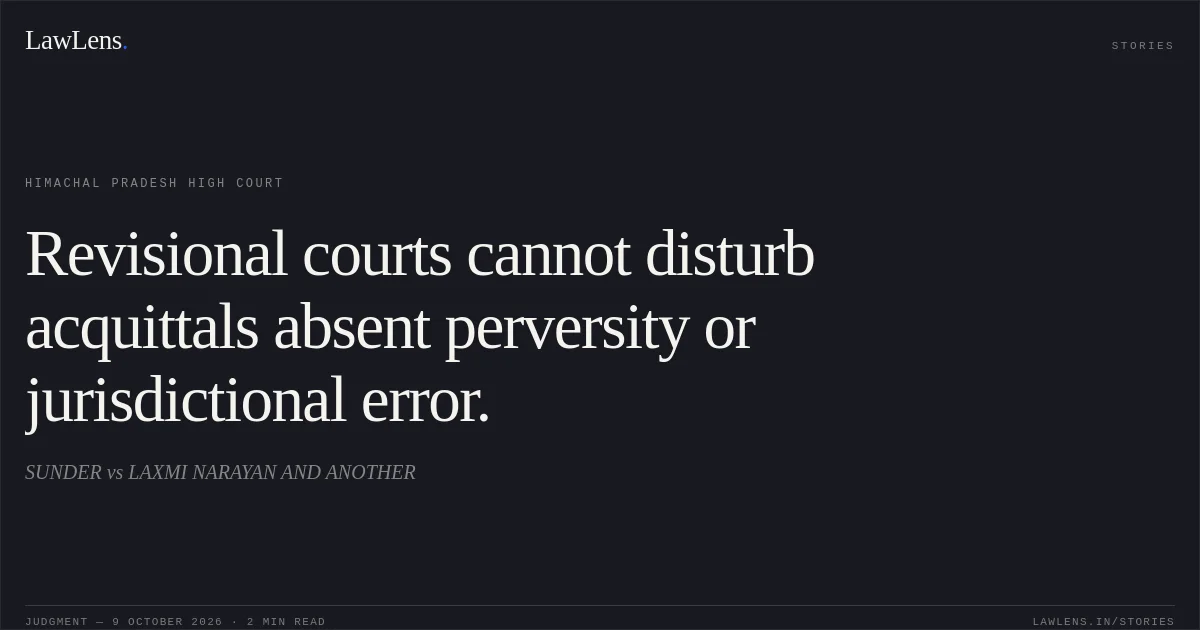
Source reference: para. 13Revisional jurisdiction under Section 397 CrPC is supervisory, not appellate: the court examines the correctness, legality, or propriety of the lower court’s order and should not reappreciate evidence merely because another view is possible. Intervention is justified where, for example, the finding is perverse, legally untenable, based on irrelevant or no material, or reflects arbitrary exercise of discretion, as stated in Kuntegowda v. Thurubaiah and the authorities discussed there.
Source reference: para. 11–12Reasoning
The Sessions Court was wrong to hold that the victim’s appeal was not maintainable before it; Section 372 CrPC placed the appeal before the Sessions Court.
Source reference: para. 13–14That error did not, however, warrant setting aside the acquittal in revision.
Source reference: para. 13–14The prosecution witnesses admitted that they had not seen the grill or gate being installed, while the defence witness’s account concerned a gate installed at a different time and location from the obstruction alleged by the prosecution.
Source reference: para. 16–17The Trial Court also acted properly in closing the prosecution’s opportunity to cross-examine the defence witness after the prosecution failed to produce the receipt it had sought to put to him.
Source reference: para. 15The acquittal was therefore a reasonable view of the evidence, not a finding warranting revisional interference.
Source reference: para. 18Holding
The Court held that the victim’s appeal against the Magistrate’s acquittal was maintainable before the Court of Sessions, but found no basis to disturb the acquittal in revision.
The revision petition was dismissed, and any pending applications were disposed of.
Source reference: para. 20Acts & Sections Cited
10 provisions across 4 statutes referred to in this judgment. Each provision opens on LawLens.
Indian Penal Code, 18601
Code of Criminal Procedure, 19735
Bharatiya Nagarik Suraksha Sanhita, 20233
Negotiable Instruments Act, 18811
Original Court PDF
SUNDERvsLAXMI NARAYAN AND ANOTHER
Click to open original judgment
Original judgment, available to read, download and summarize on LawLens.in