Facts
The deceased appellant (landlord) held a 55-year lease from Uttaradi Math and subsequently sub-leased a shop to Respondent No. 1 (represented by Respondent No. 4) via a registered deed in 1985 for 53 years
Source reference: para. 3-4The deed prohibited sub-letting without written consent
Source reference: para. 7.3The landlord discovered that Respondent No. 4 (the original partner) was no longer in possession, and the business was being conducted by Respondent Nos. 2 and 3, who were strangers to the original agreement
Source reference: para. 4Eviction was sought under the Karnataka Rent Act, 1999, on grounds of unauthorized sub-letting.
Source reference: no citationThe Trial Court allowed eviction, finding that the tenant had unlawfully parted with possession
Source reference: para. 5However, the High Court, in a revision petition under Section 46 of the Act, set aside the order by reappreciating oral and documentary evidence to conclude there was no sub-letting
Source reference: para. 6, 12.6The legal heirs of the landlord appealed to the Supreme Court.
Source reference: no citationIssues
1. Whether the High Court was justified in interfering with the findings of fact recorded by the Trial Court while exercising its revisional jurisdiction under Section 46 of the Karnataka Rent Act, 1999?
Source reference: para. 11(i)2. Whether the burden of proving unlawful sub-letting lies upon the landlord, and if so, whether such burden was duly discharged?
Source reference: para. 11(ii)3. Whether the alleged retirement of the original tenant-partner and continuation of business by Respondent Nos. 2 and 3 constitutes a mere reconstitution of partnership or amounts to unlawful sub-letting/assignment?
Source reference: para. 11(iii)Law Applied
The court primarily applied Section 46 of the Karnataka Rent Act, 1999, which limits revisional jurisdiction to examining the legality, correctness, or propriety of an order, rather than acting as a full-fledged appeal
Source reference: para. 12.1It relied on Hindustan Petroleum Corporation Ltd. v. Dilbahar Singh, establishing that revisional courts cannot reappreciate evidence unless findings are perverse or suffer from manifest illegality
Source reference: para. 12.3Regarding sub-letting, the court applied principles from Mahendra Saree Emporium (II) v. G.V. Srinivasa Murthy and Joginder Singh Sodhi v. Amar Kaur, which state that once a landlord proves exclusive possession by a third party, the burden shifts to the tenant to explain the nature of that possession
Source reference: para. 13.3-13.4Furthermore, it applied the "lifting the veil" doctrine from Celina Coelho Pereira v. Ulhas Mahabaleshwar Kholkar to determine if a partnership reconstitution is a mere "cloak" to conceal sub-letting
Source reference: para. 14.2Reasoning
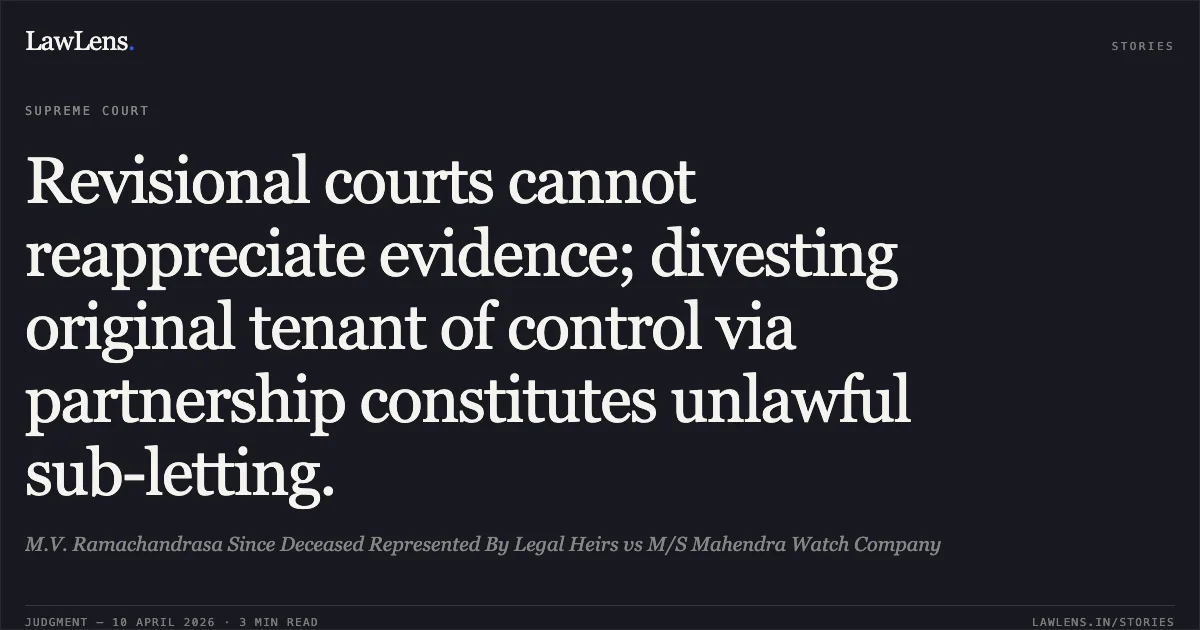
The Supreme Court observed that the High Court exceeded its jurisdiction by undertaking a fresh analysis of depositions and documents, effectively converting a revision into an appeal
Source reference: para. 12.6, 12.9On the merits of sub-letting, the Court found that the landlord discharged the initial burden by proving Respondent No. 4 (the sole original tenant) was absent and Respondent Nos. 2 and 3 held exclusive possession
Source reference: para. 13.6The burden then shifted to the respondents, who failed to produce the original partnership deed or evidence of the landlord's consent for the alleged reconstitution
Source reference: para. 14.5The Court held that for a partnership not to constitute sub-letting, the original tenant must retain legal possession and control
Source reference: para. 14.3Here, the original tenant had retired and divested himself of all control, and the "reconstitution" was deemed a device to circumvent rent control laws
Source reference: para. 14.9-14.10Holding
The Supreme Court allowed the appeal, setting aside the High Court's judgment and restoring the Trial Court’s eviction order
The Court held that the High Court improperly reassessed facts and that the respondents were liable for eviction due to unlawful sub-letting under Sections 27(2)(b)(ii) and 27(2)(p) of the Karnataka Rent Act, 1999
Source reference: para. 12.9, 14.10The respondents were granted three months to vacate and hand over possession to the appellants
Source reference: para. 15Acts & Sections Cited
8 provisions across 5 statutes referred to in this judgment. Each provision opens on LawLens.
KARNATAKA RENT ACT, 19993
Transfer of Property Act, 18822
Code of Civil Procedure, 19081
KARNATAKA ANIMAL DISEASES (CONTROL) ACT, 1961.1
delhi rent control act, 19581
Original Court PDF
M.V. Ramachandrasa Since Deceased Represented By Legal HeirsvsM/S Mahendra Watch Company
Click to open original judgment
Original judgment, available to read, download and summarize on LawLens.in


