Facts
The petitioner-husband and respondent No. 1-wife married on 21 April 2019, and their son was born on 11 September 2023. The parties began living separately from 10 June 2025.
Source reference: p.1, para. 3The wife and minor son thereafter filed a petition under Section 125 CrPC seeking maintenance, asserting monthly expenses of approximately ₹1,50,000 and alleging that the petitioner earned ₹32–35 lakhs annually.
Source reference: p.2, para. 4By order dated 11 May 2026, the Family Court awarded interim maintenance of ₹75,000 per month—₹37,500 each to the wife and son—from the date of filing until disposal of the maintenance proceedings.
Source reference: pp.2–3, para. 5The Family Court estimated the petitioner’s income at not less than ₹2 lakhs per month, noting credits in his bank account and his failure to produce salary slips, income-tax returns, or details of his alleged loan; it deducted ₹50,000 towards maintenance of his parents.
Source reference: pp.2–3, para. 5In revision, the petitioner relied on salary slips showing net monthly income of ₹1.68 lakhs and ₹1.76 lakhs, his ITR reflecting annual income of ₹17,81,310, and alleged housing-loan and personal liabilities.
Source reference: p.3, para. 6He also contended that the wife was qualified, had previously worked as a teacher, and earned through private tuitions.
Source reference: p.3, para. 7Issues
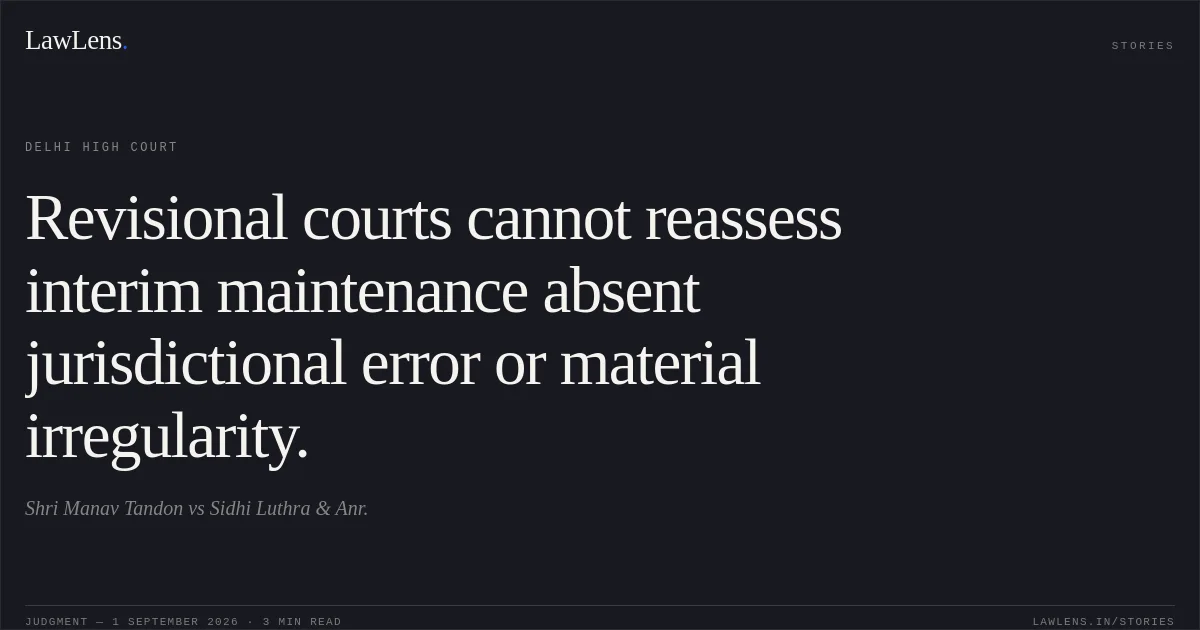
Whether the Family Court’s assessment of the petitioner’s income and award of interim maintenance of ₹75,000 per month suffered from jurisdictional error, material irregularity, perversity, or arbitrariness warranting interference in revisional jurisdiction?
Source reference: pp.3–5, paras. 8, 11–13Whether the alleged earning capacity and income of the wife, and the petitioner’s claimed housing-loan and other financial liabilities, required reduction or modification of the interim maintenance awarded to the wife and minor child?
Source reference: pp.3, 5–6, paras. 6–7, 10–13Law Applied
The Court applied the revisional principles governing correction of the legality, propriety, and correctness of subordinate-court orders, holding that revision is confined to cases involving patent or jurisdictional error, non-compliance with law, findings based on no evidence, material evidence being ignored, or arbitrary, perverse, or grossly erroneous exercise of discretion; it relied on Amit Kapoor v. Ramesh Chander & Anr., (2012) 9 SCC 460, as reiterated in State of Gujarat v. Dilipsinh Kishorsinh Rao, (2023) 17 SCC 688.
Source reference: pp.4–5, para. 8The Court further applied the object of Section 125 CrPC, namely, preventing destitution and securing the wife’s and children’s basic sustenance and dignity.
Source reference: pp.5–6, para. 9Relying on Bhuwan Mohan Singh v. Meena & Ors., (2015) 6 SCC 353, it held that maintenance should enable the wife and children to live with dignity and in a manner broadly consistent with the status of the matrimonial household.
Source reference: pp.5–6, para. 9While fixing interim maintenance, the Court must balance the needs of the wife and minor child against the husband’s financial capacity and existing obligations.
Source reference: p.6, para. 10Reasoning
The High Court held that the Family Court’s assessment was based on the material then available, including bank-account credits, while the petitioner had failed to produce salary slips, ITRs, or supporting documents concerning his alleged loan and liabilities.
Source reference: pp.2–3, 6, paras. 5, 11Although the petitioner subsequently relied on salary slips and an ITR and alleged that the wife earned through private tuition, those matters involved factual assessment and could be finally determined only after evidence was led.
Source reference: p.6, para. 11No material establishing the wife’s actual income or documenting the petitioner’s housing-loan liability had been placed before the Family Court.
Source reference: p.6, para. 11The Family Court had nevertheless accounted for the petitioner’s responsibility towards his parents by deducting ₹50,000 per month.
Source reference: p.6, para. 12In light of the maintenance being awarded for both the wife and minor child, the amount of ₹75,000 per month could not be regarded as excessive or disproportionate.
Source reference: p.6, para. 12Since the impugned order disclosed no jurisdictional error or material irregularity, the limited scope of revision did not permit reassessment of the factual determination.
Source reference: pp.3–5, 6, paras. 8, 13Holding
The Court answered the issues against the petitioner and held that the Family Court’s order did not warrant revisional interference.
The award of interim maintenance of ₹75,000 per month—₹37,500 each for the wife and minor son—was upheld.
Source reference: pp.6–7, paras. 12–14The petition and pending applications were dismissed, without prejudice to the parties’ rights and contentions before the Family Court, where the petitioner’s actual income and liabilities, the wife’s earning capacity, and final entitlement to maintenance would be determined on the basis of evidence.
Source reference: pp.6–7, paras. 12–14Acts & Sections Cited
4 provisions across 2 statutes referred to in this judgment. Each provision opens on LawLens.
Bharatiya Nagarik Suraksha Sanhita, 20232
Code of Criminal Procedure, 19732
Original Court PDF
Shri Manav TandonvsSidhi Luthra & Anr.
Click to open original judgment
Original judgment, available to read, download and summarize on LawLens.in