Facts
The respondent, Laljiram, obtained a civil decree in 2016 declaring him the owner of a property and granting a permanent injunction
Source reference: para. 2ASubsequently, the judgment-debtor, Ambri Bai, executed sale deeds for the same property in favor of her son, Bansilal, in 2017
Source reference: para. 2AThe petitioners, Shrilal and Onkar (relatives of Ambri Bai), signed these sale deeds as witnesses despite allegedly knowing about the civil court’s judgment
Source reference: para. 2A, 11Laljiram filed a private criminal complaint alleging offences under Sections 420, 467, 468, 406, 120-B, 471, and 34 of the IPC
Source reference: para. 2BThe Judicial Magistrate First Class (JMFC) dismissed the complaint, ruling the dispute was purely civil and no forgery occurred as there was no impersonation
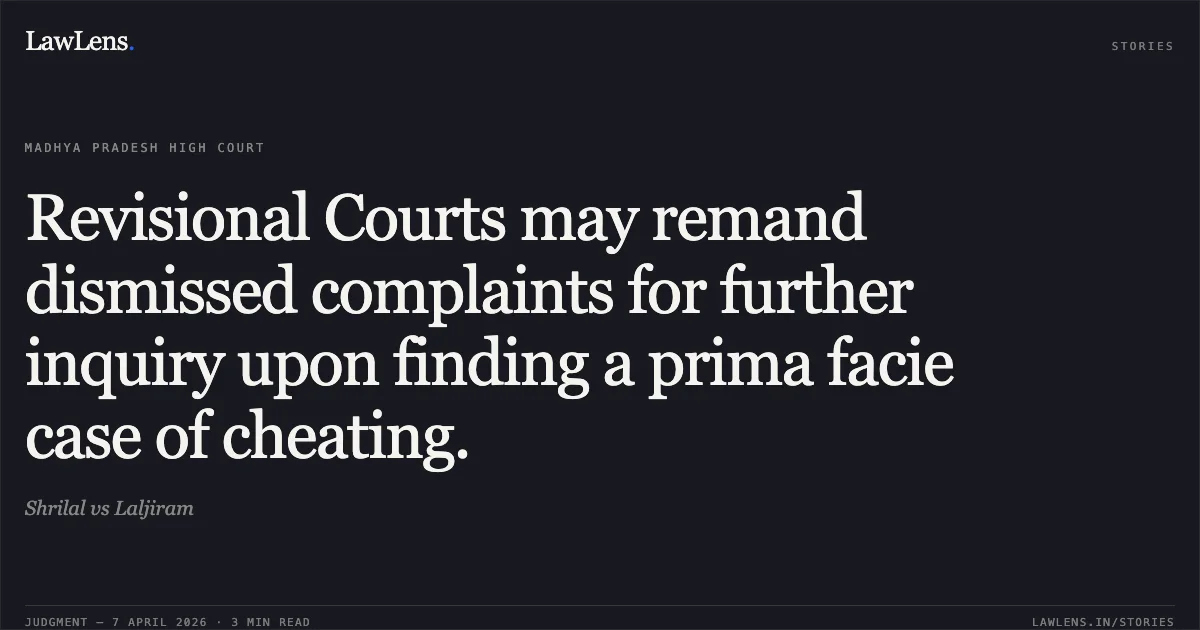
Source reference: para. 2C, 5On revision, the Sessions Judge partially set aside the JMFC’s order, directing the trial court to proceed with the complaint specifically regarding the offence of cheating under Section 420 of the IPC
Source reference: para. 1, 6The petitioners moved the High Court under Section 482 of the CrPC to quash the Revisional Court’s order
Source reference: para. 1Issues
1. Whether the Revisional Court exceeded its jurisdiction under Sections 397 and 398 of the CrPC by directing the Magistrate to take cognizance of the offence
Source reference: para. 3(iii), 82. Whether the act of witnessing a sale deed for property already subject to a civil decree prima facie constitutes the offence of cheating under Section 420 of the IPC
Source reference: para. 6, 11Law Applied
The court primarily applied Sections 397 and 398 of the CrPC, which empower a Revisional Court to examine the legality and propriety of an inferior court's order and direct "further inquiry" into a dismissed complaint
Source reference: para. 8It relied on the Supreme Court precedent in Rajendra Rajoriya v. Jagat Narain Thapak (2018), which clarifies that a Revisional Court’s order to remand a matter for further inquiry is not the same as taking cognizance itself
Source reference: para. 9Regarding the substantive criminal charges, the court referenced Mohd. Ibrahim v. State of Bihar (2009) to distinguish between forgery (impersonation) and the broader scope of cheating under Section 420 of the IPC
Source reference: para. 5, 6Reasoning
The High Court observed that while the JMFC correctly relied on Mohd. Ibrahim to conclude that no forgery (impersonation) took place, it erred in dismissing the allegation of cheating
Source reference: para. 5, 6The court noted that Ambri Bai and the petitioners were aware of the adverse civil decree
Source reference: para. 11By executing and witnessing the sale deeds respectively, they intended to cause wrongful loss to the respondent and deprive him of the fruits of litigation
Source reference: para. 11Regarding the jurisdictional challenge, the High Court held that the Sessions Judge did not "take cognizance" but merely exercised revisionary powers to correct a legal error in the JMFC's dismissal
Source reference: para. 12Following the principles in Rajendra Rajoriya, the court found that the Revisional Court’s direction was effectively a remand for "further inquiry" into the prima facie existence of cheating, which falls within the scope of Section 398 of the CrPC
Source reference: para. 9, 12Holding
The High Court dismissed the petition, upholding the Revisional Court's order
It held that the Sessions Court committed no material illegality in directing the trial court to proceed with the complaint
Source reference: para. 12The Magistrate must conduct the further inquiry independently, based on the material on record, without being influenced by the specific observations regarding the merits of the case made by the Sessions Court or the High Court
Source reference: para. 13Acts & Sections Cited
16 provisions across 3 statutes referred to in this judgment. Each provision opens on LawLens.
Code of Criminal Procedure, 19738
Indian Penal Code, 18607
Scheduled Castes and the Scheduled Tribes (Prevention of Atrocities) Act, 19891
Original Court PDF
ShrilalvsLaljiram
Click to open original judgment
Original judgment, available to read, download and summarize on LawLens.in


