Facts
The petitioners were the legal heirs and representatives of the original defendant-tenant, Gordhanbhai Naranbhai Patel.
Source reference: no citationThe respondents, as landlords, alleged that only three rooms had been let to the tenant and that he had subsequently occupied an additional portion of the property without authority.
Source reference: no citationThe landlords instituted a suit for possession of the additional portion and for mesne profits.
Source reference: no citationThe trial court dismissed the suit on the ground that the landlords had failed to prove that the disputed portion was not part of the tenancy.
Source reference: no citationIn appeal, the Third Additional District Judge, Jamnagar, reversed the decree, held that only three rooms measuring 27 sq. metres had been let to the tenant, directed delivery of possession of the remaining portion, and awarded mesne profits at Rs. 8,372 per month from 14 July 2003 until delivery of possession.
Source reference: pp. 2–6; para. 5.1The tenants initially filed a second appeal, which was converted into the present revision application under Section 29(2) of the Gujarat Rents, Hotel and Lodging House Rates Control Act, 1947 (“Rent Act”).
Source reference: p. 1; para. 2Issues
Whether the appellate court committed a jurisdictional or perversity-related error in finding that the tenant had been let only three rooms and was in unauthorised occupation of the remaining disputed portion?
Source reference: pp. 8–13; paras. 7–11Whether, in the absence of a written rent agreement, the landlords had sufficiently proved the extent of the tenancy through oral and documentary evidence?
Source reference: pp. 8–13; paras. 7.1–10Whether the appellate court could award mesne profits of Rs. 8,372 per month without conducting a separate inquiry under Order XX Rule 12 of the Code of Civil Procedure, 1908?
Source reference: pp. 13–14; para. 12Whether the impugned appellate judgment warranted interference in the High Court’s limited revisional jurisdiction under Section 29(2) of the Rent Act?
Source reference: pp. 6–8, 14; paras. 6–6.1, 13–14Law Applied
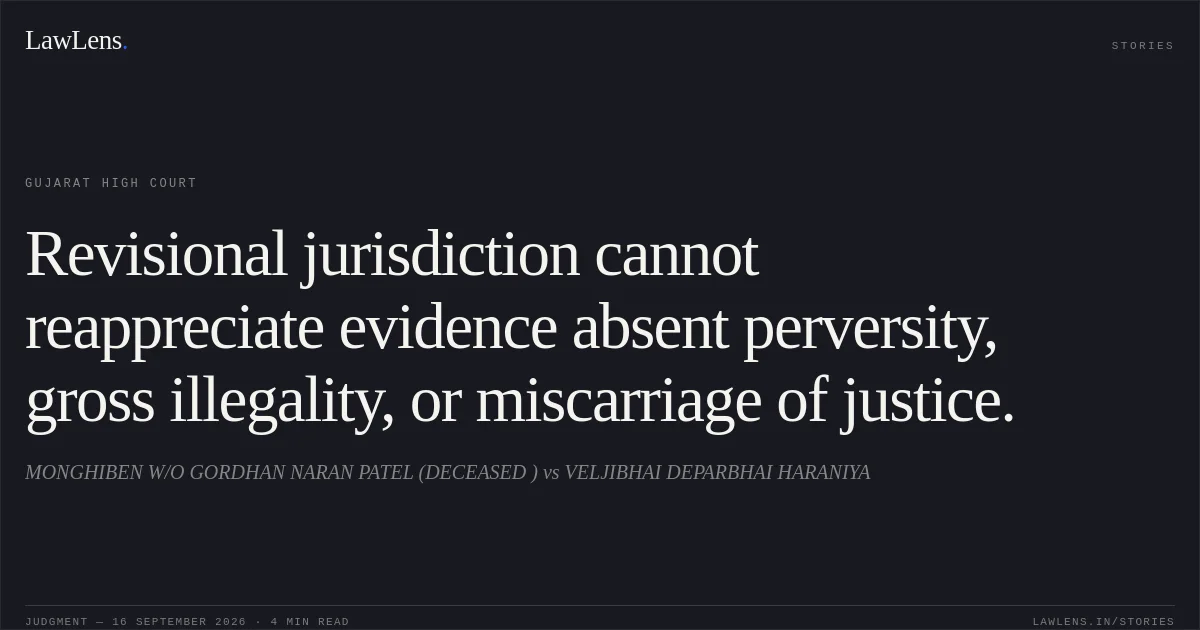
The Court applied Section 29(2) of the Gujarat Rents, Hotel and Lodging House Rates Control Act, 1947, under which revisional interference is limited to examining the legality, propriety, correctness, and regularity of the appellate decision; revision is not equivalent to a full appeal on facts.
Source reference: pp. 1, 6–8; paras. 2, 6–6.1Relying on the Constitution Bench decision in Hindustan Petroleum Corporation Ltd. v. Dilbahar Singh, (2014) 9 SCC 78, the Court held that factual findings may be corrected only where they are perverse, based on no evidence, arrived at by ignoring or misreading material evidence, or are so grossly erroneous that they result in a miscarriage of justice.
Source reference: pp. 6–8; para. 6.1The Court also considered Order XX Rule 12 CPC concerning the ascertainment and award of mesne profits, holding that an inquiry is not necessarily absent merely because the appellate court quantified mesne profits on the basis of evidence already on record.
Source reference: pp. 13–14; para. 12The extent of the tenancy was required to be established on the civil standard of preponderance of probabilities.
Source reference: p. 13; para. 10Reasoning
The High Court found that the appellate court’s conclusion was supported by the evidence of the erstwhile landlord, who specifically testified that only three rooms had been let to the defendant, as well as by the evidence of other tenants and municipal tax-assessment records.
Source reference: pp. 9–12; paras. 7.2–8.1The absence of a written rent note was not determinative because the extent of the tenancy could be proved through reliable oral and documentary evidence.
Source reference: no citationThe tenant had not entered the witness box; his power-of-attorney holder and neighbouring witnesses lacked personal knowledge of the original letting and could establish only his present occupation, not the extent of the tenancy.
Source reference: pp. 12–13; para. 10The appellate court was therefore entitled to prefer the evidence of the erstwhile landlord and the contemporaneous municipal records over the trial court’s inference that the tenancy extent had not been proved.
Source reference: no citationAs to mesne profits, the appellate court had relied on the assessed area of 837.24 square metres and applied a rate of Rs. 10 per square metre, resulting in Rs. 8,372 per month; this constituted an assessment based on evidence and could not be characterised as perverse or jurisdictionally defective.
Source reference: pp. 11, 13–14; paras. 8.1, 12Since no perversity, gross error, or material irregularity was established, the High Court declined to reassess the evidence as if exercising appellate jurisdiction.
Source reference: pp. 7–8, 14; paras. 6.1, 13Holding
The High Court answered the issues against the petitioners.
It held that the appellate court had correctly found that the tenant was entitled to retain only three rooms and was in unauthorised occupation of the remaining suit property.
Source reference: pp. 13–14; paras. 12–14The award of mesne profits at Rs. 8,372 per month was also upheld as being supported by the evidence on record and not invalid for want of a separate inquiry under Order XX Rule 12 CPC.
Source reference: pp. 13–14; paras. 12–14The revision application was rejected in limine, the appellate judgment and decree directing delivery of possession and payment of mesne profits were confirmed, and no order as to costs was made.
Source reference: p. 14; para. 14The request to suspend the order for six weeks to enable the petitioners to approach a higher forum was refused.
Source reference: p. 15; para. 15Acts & Sections Cited
1 provisions across 1 statute referred to in this judgment. Each provision opens on LawLens.
Gujarat Rents, Hotel and Lodging House Rates Control Act, 19471
Original Court PDF
MONGHIBEN W/O GORDHAN NARAN PATEL (DECEASED )vsVELJIBHAI DEPARBHAI HARANIYA
Click to open original judgment
Original judgment, available to read, download and summarize on LawLens.in