Facts
The revisionists, Bidhan and Bikash Trikhatri, were convicted by the Chief Judicial Magistrate, Gangtok, on August 23, 2022, for offences under Sections 380 and 454 of the Indian Penal Code (IPC).
Source reference: para. 6This conviction was upheld by the Sessions Judge, Gangtok, via a judgment dated December 12, 2024, which additionally held the revisionists liable under Section 34 of the IPC.
Source reference: para. 1, 6The prosecution alleged that the revisionists committed house-breaking and theft of a large sum of money and gold jewellery from a residence in Nam Nang, Gangtok.
Source reference: para. 20During the investigation, items were seized from a flat in Bagdogra, and chance fingerprints lifted from the scene were matched with specimen fingerprints of the revisionists.
Source reference: para. 8, 14The revisionists challenged the concurrent findings in the High Court, citing procedural irregularities in the seizure and the collection of fingerprint evidence.
Source reference: para. 8, 13Issues
1. Whether the seizure of evidence was vitiated by the failure to include independent witnesses from the locality of the seizure.
Source reference: para. 82. Whether the conviction based on fingerprint evidence was sustainable in the absence of a court order for obtaining specimen fingerprints or records of their collection by the Investigating Officer.
Source reference: para. 133. Whether the High Court, in its revisional jurisdiction, could re-appreciate evidence in the absence of perversity or a glaring miscarriage of justice.
Source reference: para. 3-44. Whether the sentences imposed were disproportionate given the revisionists’ socio-economic background.
Source reference: para. 19Law Applied
Section 438 of the Bharatiya Nagarik Suraksha Sanhita, 2023 (BNSS), which is in pari materia with Section 397 of the Code of Criminal Procedure, 1973 (Cr.P.C.), regarding the limited scope of revisional jurisdiction to correct jurisdictional errors or manifest injustice.
Source reference: para. 2Kishan Rao v. Shankargouda, which established that revisional courts should not re-appreciate evidence unless findings are perverse.
Source reference: para. 3-4State of Kerala v. Puttumana Illathjathavedan Namboodiri, which defined revisional power as supervisory rather than appellate.
Source reference: para. 3Radha Kishan v. State of U.P. and State of Haryana v. Rajmal, holding that an illegal search does not necessarily vitiate a seizure.
Source reference: para. 10State of Punjab v. Balbir Singh, noting that non-compliance with Section 100 Cr.P.C. does not automatically invalidate a prosecution.
Source reference: para. 11Reasoning
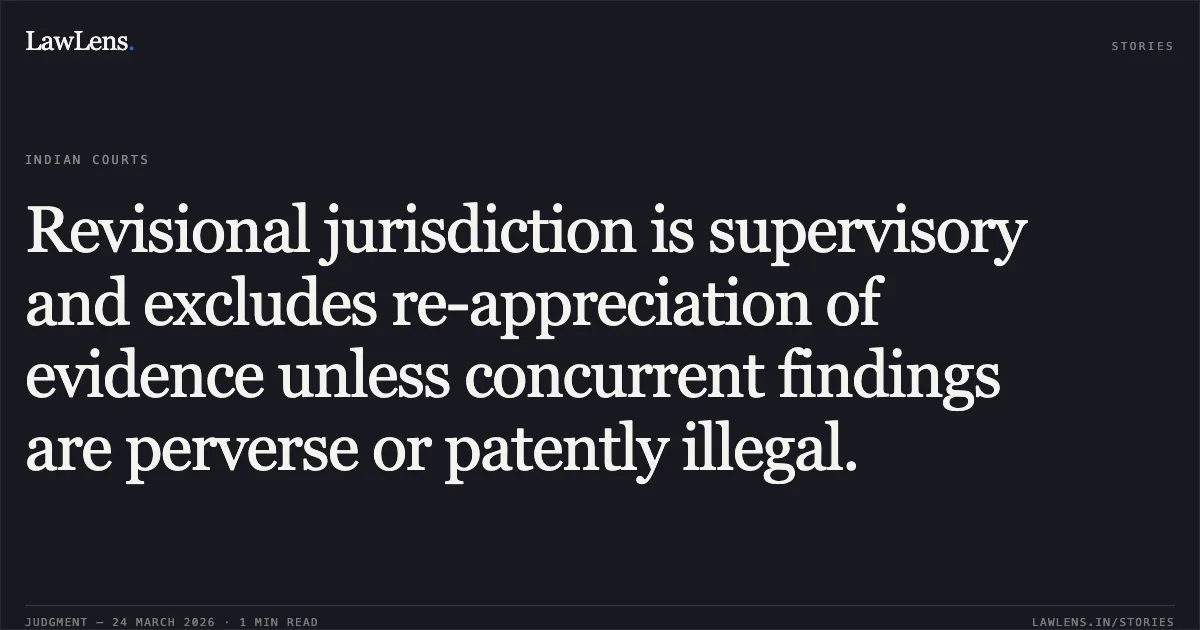
The Court observed that its revisional jurisdiction is supervisory and cannot be treated as a second appeal; interference is warranted only if findings are perverse, tenure in law is untenable, or material evidence is ignored.
Source reference: para. 3-4Regarding the seizure at Bagdogra, the Court noted the seizures were made under Section 102 Cr.P.C., which does not mandate independent witnesses, and the revisionists failed to demonstrate any resulting prejudice.
Source reference: para. 9Applying the precedent from Radha Kishan, the Court held that even if a search is technically illegal, it does not vitiate the seizure of articles unless the evidence itself is unreliable.
Source reference: para. 10On the issue of fingerprints, the Court found that the Investigating Officer and the expert (P.W.2) provided a detailed narrative of the process.
Source reference: para. 14-15Crucially, the defense did not challenge the identity of the specimen fingerprints during cross-examination, and the expert opinion (Exhibit-8) confirmed a match between the chance and specimen prints.
Source reference: para. 15-16Finally, regarding sentencing, the Court held that the punishments (five years for Section 454 and three years for Section 380) were well within the statutory limits of ten and seven years respectively, and were proportionate to the gravity of the theft involving substantial valuables.
Source reference: para. 20-22Holding
The High Court of Sikkim dismissed the revision petition, upholding the concurrent findings of the trial and appellate courts.
The Court held that the procedural objections regarding witnesses for seizure and fingerprint collection did not amount to a gross miscarriage of justice or perversity.
Source reference: para. 12, 17-18The sentences imposed by the Chief Judicial Magistrate were deemed a proportionate response to the wrongdoing, and the Court declined to interfere with them.
Source reference: para. 22The lower court records were ordered to be remitted immediately.
Source reference: para. 24Acts & Sections Cited
11 provisions across 3 statutes referred to in this judgment. Each provision opens on LawLens.
Indian Penal Code, 18603
Code of Criminal Procedure, 19736
Bharatiya Nagarik Suraksha Sanhita, 20232
Original Court PDF
Bidhan trikhatri and Ano.vsState of Sikkim
Click to open original judgment
Original judgment, available to read, download and summarize on LawLens.in