Facts
The appellant, a Sipahi at Sabarmati Central Prison, was alleged to have received a mobile phone for repair from an accused person while on duty.
Source reference: para. 3The allegation arose from a police raid on 23 March 1998 that led to the recovery of arms, explosives, ammunition and mobile phones; a case was registered, inter alia, under Section 122 of the Indian Penal Code, 1860.
Source reference: para. 3The Sessions Court discharged the appellant on 13 September 1999 while directing charges against the other accused.
Source reference: para. 3On the State’s revision, the Gujarat High Court set aside the discharge order on 11 August 2025.
Source reference: paras. 2, 4The appellant appealed to the Supreme Court.
Source reference: no citationIssues
1. Whether the High Court was justified in setting aside the appellant’s discharge and directing that he face trial, given the circumstances and lapse of time.
Source reference: paras. 2, 5–72. Whether the High Court’s reliance on State of Andhra Pradesh v. Golkonda Linga Swamy to criticise the Sessions Court’s approach was sustainable when that decision post-dated the discharge order.
Source reference: paras. 5–6Law Applied
Section 227 of the Code of Criminal Procedure, 1973 provides for discharge at the sessions-trial stage; the State challenged the discharge in revision under Section 397 of the Code.
Source reference: paras. 2–3The High Court relied on State of Andhra Pradesh v. Golkonda Linga Swamy, (2010) 9 SCC 368, for the proposition that a charge may be framed where material shows the possibility of the accused’s involvement, rather than certainty; the Supreme Court noted that this decision did not exist when the Sessions Court made its order.
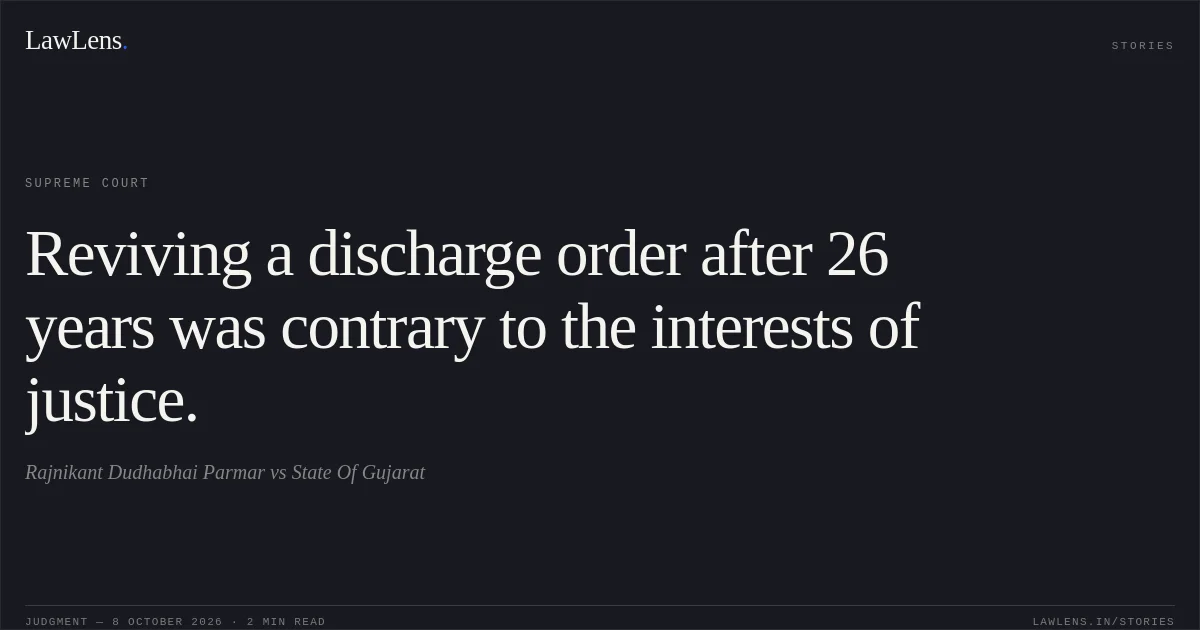
Source reference: paras. 5–6The Court’s decision also rested on its assessment of the interests of justice, including the substantial delay since the discharge and the absence of information about the status of the trial of the other accused.
Source reference: para. 7Reasoning
The Supreme Court held that the High Court’s criticism of the Sessions Court for failing to follow Golkonda Linga Swamy was erroneous because that judgment was delivered after the discharge order.
Source reference: para. 6Although it characterised this error as technical, the Court also considered that the appellant had been discharged in 1999 and that the High Court’s decision came in 2025.
Source reference: para. 7In the absence of a counter-affidavit, the status of the proceedings against the other accused was also unavailable.
Source reference: para. 7In those circumstances, subjecting the appellant to trial after such a long interval would not serve the interests of justice.
Source reference: para. 7Holding
The Court allowed the appeal and set aside the High Court’s judgment restoring the appellant’s discharge.
Pending applications, if any, were disposed of.
Source reference: para. 10Acts & Sections Cited
10 provisions across 4 statutes referred to in this judgment. Each provision opens on LawLens.
Code of Criminal Procedure, 19733
Indian Penal Code, 18601
Arms Act, 19594
Original Court PDF
Rajnikant Dudhabhai ParmarvsState Of Gujarat
Click to open original judgment
Original judgment, available to read, download and summarize on LawLens.in