Facts
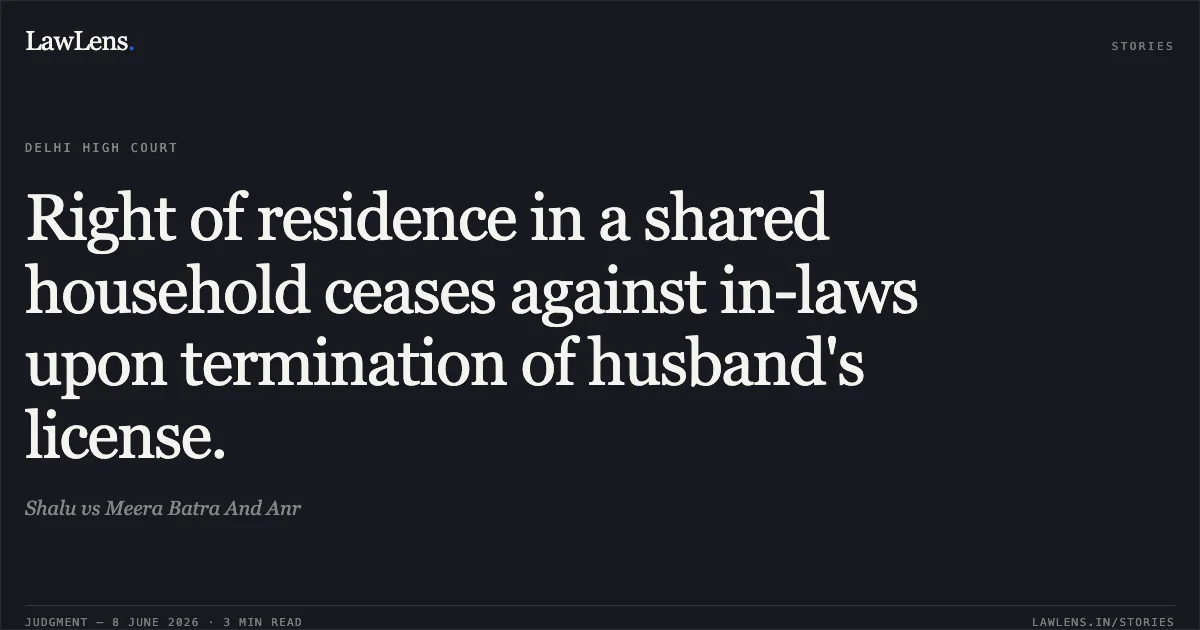
The Plaintiff (Respondent No. 1), Meera Batra, claimed absolute ownership of the suit property (Ground Floor, 2-A/44, Ramesh Nagar) through a Will dated 06.02.2012 executed by her late mother, Smt. Maya Devi
Source reference: para. 3, 11After the mother's demise, the Plaintiff permitted her brother, Defendant No. 1 (Respondent No. 2), to reside on the ground floor as a licensee
Source reference: para. 4In 2012, Defendant No. 1 married the Appellant (Defendant No. 2), and they resided together in the property
Source reference: para. 5Following alleged harassment and matrimonial discord, the Plaintiff terminated the license via legal notice dated 02.07.2015
Source reference: para. 7Defendant No. 1 vacated the premises, but the Appellant refused to leave, claiming the property was her "shared household" and matrimonial home
Source reference: para. 12, 14The Trial Court and First Appellate Court decreed the suit in favor of the Plaintiff, directing the delivery of vacant possession
Source reference: para. 1, 28, 29Issues
1. Whether the Appellant has a legal right to occupy the suit property as a "shared household" or matrimonial home despite the owner being the sister-in-law?
Source reference: para. 27, 492. Whether the lack of a "domestic relationship" between the Plaintiff (landowner) and the Appellant (occupant) precludes protection under the DV Act?
Source reference: para. 28, 503. Whether the suit was a result of collusion between the Plaintiff and the Appellant’s husband to deprive the Appellant of her residence rights?
Source reference: para. 37, 54Law Applied
The Court primarily applied Section 100 of the Code of Civil Procedure, 1908, regarding the requirements for a Regular Second Appeal
Source reference: para. 1, 57principles governing "shared households" under the Protection of Women against Domestic Violence Act, 2005 (DV Act), specifically referencing Satish Chand Ahuja v. Sneha Ahuja (2020) to determine the weight of residence orders in civil proceedings
Source reference: para. 27, 31, 49Section 26 of the DV Act was applied, which permits the seeking of reliefs under the Act in any legal proceeding before a civil or family court
Source reference: para. 52aw of licenses under the Indian Easements Act, whereby a licensee’s right ceases upon revocation by the owner
Source reference: para. 48, 55Reasoning
The Court observed that the Plaintiff’s ownership was established via a duly proved Will
Source reference: para. 44Since Defendant No. 1 (the husband) was a mere licensee and had vacated the property, the Appellant’s status was reduced to that of a trespasser, as her right to stay was derivative of her husband’s license
Source reference: para. 48, 55Regarding the DV Act claims, the Court found no "domestic relationship" between the Appellant and her sister-in-law (the Plaintiff), as they never resided together in a joint household or shared a kitchen
Source reference: para. 27, 50The Court held that while Section 26 of the DV Act allows civil courts to consider residence rights, the Appellant failed to prove the property was a "shared household" belonging to the husband or a joint family
Source reference: para. 53The Court dismissed the "collusion" argument, noting that the Appellant’s remedy for residence lies against her husband in her pending DV Act proceedings, not against the sister-in-law who allowed them to stay in good faith
Source reference: para. 54, 56Holding
The High Court dismissed the appeal, holding that no substantial question of law arose
The Court affirmed the concurrent findings of the lower courts that the Plaintiff is the absolute owner and the Appellant has no independent legal right to occupy the premises
Source reference: para. 51, 55matrimonial discord between spouses cannot result in a "penalty" for a third-party relative (the sister-in-law) who owns the property
Source reference: para. 56The decree for mandatory and permanent injunction was upheld, directing the Appellant to handover vacant and peaceful possession
Source reference: para. 28, 58Acts & Sections Cited
1 provisions across 1 statute referred to in this judgment. Each provision opens on LawLens.
Code of Civil Procedure, 19081
Original Court PDF
ShaluvsMeera Batra And Anr
Click to open original judgment
Original judgment, available to read, download and summarize on LawLens.in