Facts
The petitioner’s mother, an Assistant Teacher in a government-aided school, died in harness on May 19, 2018
Source reference: p.2The petitioner, possessing a graduation degree, applied for appointment on compassionate grounds. Although he sought a Class-III post, he was appointed to a Class-IV post on March 4, 2023
Source reference: p.2He joined the post on March 13, 2023, without initial objection
Source reference: p.2-3Later, the petitioner filed a representation and this writ petition seeking a mandamus to be appointed to a Class-III post, alleging discrimination because other similarly situated persons were appointed to Class-III posts and claiming that such a vacancy existed at the time of his appointment
Source reference: p.2-3Issues
1. Whether a candidate who has already accepted and joined a Class-IV appointment on compassionate grounds can subsequently claim a right to be appointed to a Class-III post based on educational qualifications.
Source reference: p.5 / para. 8.12. Whether compassionate appointment is a vested right to a specific post or a humanitarian measure to relieve immediate financial distress.
Source reference: p.5 / para. 7Law Applied
The court primarily relied on the principles of Article 14 and 16 of the Constitution of India regarding equality in public employment, noting that compassionate appointment is an exception to the general rule
Source reference: p.12the Supreme Court precedents in Umesh Kumar Nagpal v. State of Haryana (1994), which established that compassionate appointment is a relief against destitution and not a right to a specific category of post
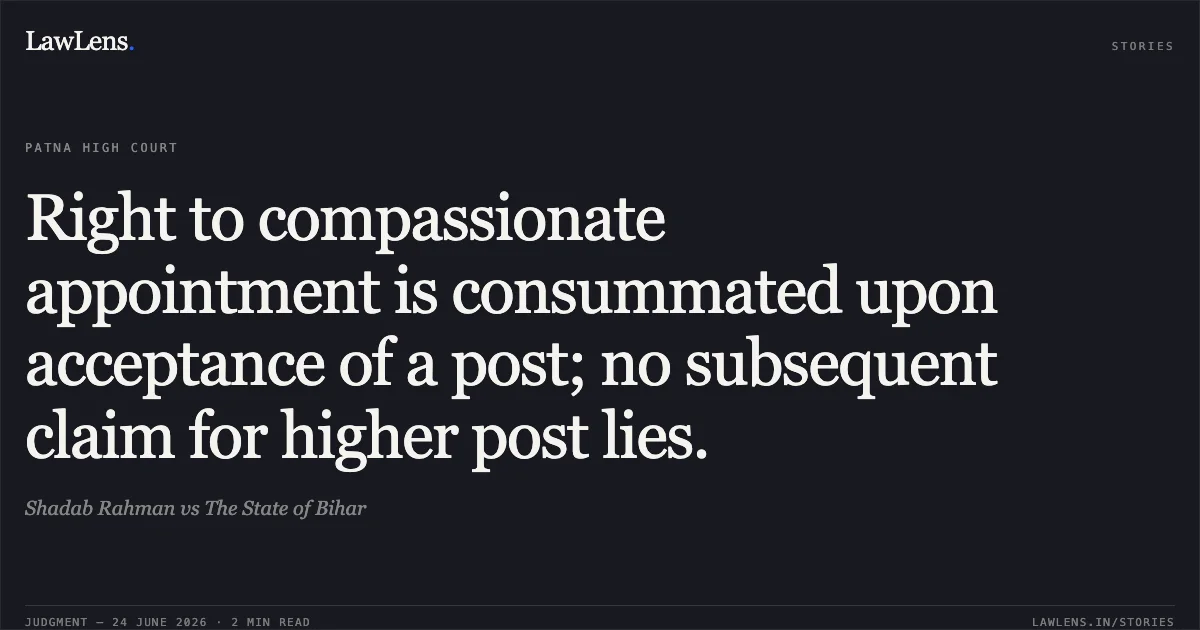
Source reference: p.5-6State of Rajasthan v. Umrao Singh (1994) and The Director of Town Panchayat v. M. Jayabal (2025), which hold that once the right to compassionate appointment is consummated by joining a post, no further claim for a higher post survives
Source reference: p.8-10Division Bench ruling in Ravi Kant Jha v. State of Bihar (2016) regarding the non-availability of supernumerary posts for such claims
Source reference: p.11-14Reasoning
The court reasoned that the fundamental objective of compassionate appointment is to enable a family to tide over a sudden financial crisis following the death of a breadearner
Source reference: para. 7Applying this to the facts, the court noted that the petitioner’s financial crisis was resolved the moment he accepted the Class-IV appointment in March 2023
Source reference: para. 8The court emphasized that the right to seek compassion is "consummated" upon joining duty; allowing a secondary claim for a higher post would result in "endless compassion," which is legally impermissible
Source reference: para. 9-10The court further observed that educational qualification for a higher post does not entitle a candidate to that post as a matter of right in compassionate cases, as such appointments cannot be used as a "ladder to climb up in seniority" at the expense of general candidates
Source reference: para. 11-12Holding
The court answered that the petitioner has no surviving right to claim a Class-III post after having accepted and served in a Class-IV post
The High Court held that the writ petition lacked merit as the state's obligation was fulfilled upon the initial appointment. The petition was dismissed, and all pending applications were disposed of
Source reference: para. 8-9Acts & Sections Cited
1 provisions across 1 statute referred to in this judgment. Linked provisions open on LawLens.
Government Resolution dated 21.08.2020 (Memo No. 1128)1
Original Court PDF
Shadab RahmanvsThe State of Bihar
Click to open original judgment
Original judgment, available to read, download and summarize on LawLens.in