Facts
The appellant was declared the winner of the Gram Panchayat Pradhan election by a margin of one vote
Source reference: para. 3.1The first respondent (unsuccessful candidate) filed an election petition under Section 12-C of the U.P. Panchayat Raj Act, 1947
Source reference: para. 3.2During the trial, two witnesses submitted evidence via affidavit
Source reference: para. 3.3The appellant filed an application seeking to cross-examine these witnesses, which the Election Tribunal rejected on 08.06.2022, citing a lack of stated reasons and the discretionary nature of Rule 4 of the 1994 Rules
Source reference: para. 3.4, 16The High Court dismissed the appellant’s writ petition, observing that Rule 4 of the 1994 Rules constitutes a "complete code" that excludes general provisions of the CPC regarding cross-examination
Source reference: para. 5, 10Issues
1. Whether the scheme of Rule 4 of the U.P. Panchayat Raj (Settlement of Election Disputes) Rules, 1994, excludes the right of a contesting party to cross-examine witnesses
Source reference: para. 72. Whether the Election Tribunal’s refusal to permit cross-examination in the specific facts of this case was legally sustainable
Source reference: para. 13Law Applied
The court interpreted Rule 4(1) of the U.P. Panchayat Raj (Settlement of Election Disputes) Rules, 1994, which mandates that election petitions be tried "as nearly as may be" in accordance with the Code of Civil Procedure (CPC), 1908
Source reference: para. 8It relied on Muddasani Venkata Narsaiah v. Muddasani Sarojana, which establishes cross-examination as a "matter of substance" and an integral facet of natural justice
Source reference: para. 10It further applied the principle from K.L. Tripathi v. State Bank of India, stating that while fair play is not a rigid formula, the right to cross-examine is indispensable when a lis involves disputed questions of fact
Source reference: para. 11Reasoning
The Court clarified that the High Court erred in labeling Rule 4 as a "complete code" that ousts the right to cross-examination; rather, the phrase "as nearly as may be" indicates a legislative intent to preserve essential trial features
Source reference: para. 8-9The Court reasoned that while Rule 4(ii) and (iv) grant the Tribunal discretion to dispense with full recording of evidence, this discretion must be exercised based on whether the testimony touches upon the "real controversy" of the case
Source reference: para. 13If a statement is merely a narration of undisputed facts, cross-examination may be denied to prevent delay; however, the burden lies on the applicant to justify the need for such cross-examination
Source reference: para. 13In the present case, the appellant’s application was found to be boilerplate and devoid of any specific justification or reasons why the veracity of the witnesses needed to be tested
Source reference: para. 14-15Holding
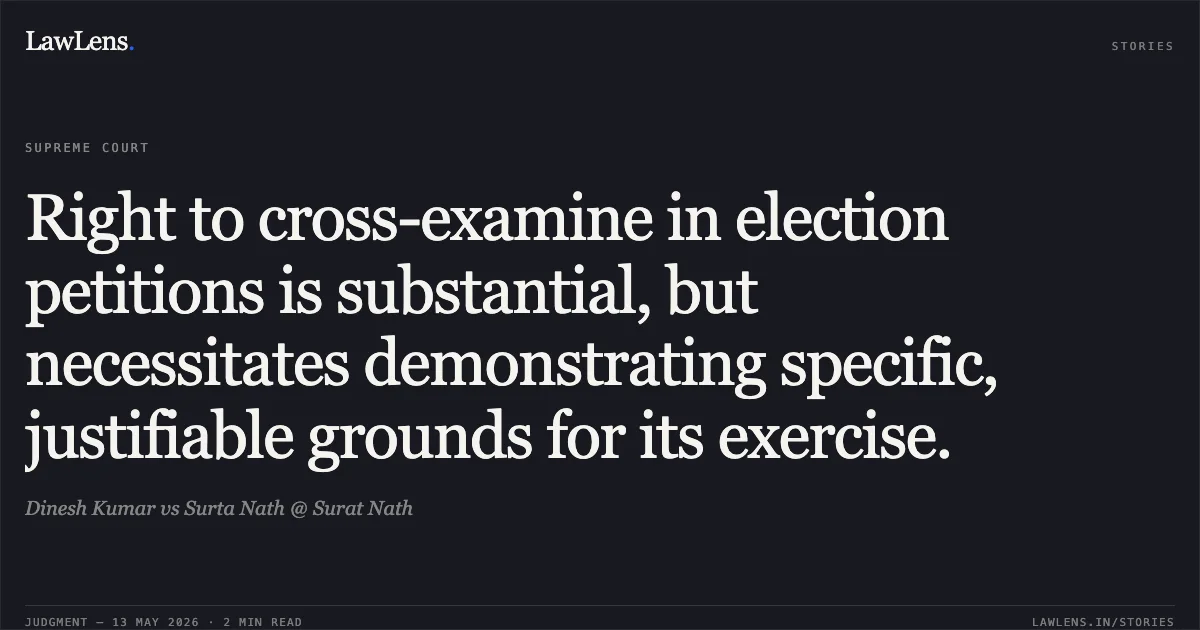
The Supreme Court dismissed the appeal, holding that while the right to cross-examine is a substantive component of natural justice, it is not an absolute right in election disputes under the 1994 Rules
The Court upheld the Election Tribunal's order because the appellant failed to provide sufficient and justifiable reasons for the request
Source reference: para. 19However, it specifically set aside the High Court’s legal observation that the CPC/Evidence Act provisions on cross-examination have no applicability, clarifying that a Tribunal may permit it upon a reasoned application
Source reference: para. 17-18Acts & Sections Cited
2 provisions across 1 statute referred to in this judgment. Each provision opens on LawLens.
Code of Civil Procedure, 19082
Original Court PDF
Dinesh KumarvsSurta Nath @ Surat Nath
Click to open original judgment
Original judgment, available to read, download and summarize on LawLens.in


