Facts
The petitioners are accused in a murder trial (Sessions Trial Nos. 446, 448, and 465 of 2023) involving charges under Sections 302, 147, 148, 149, 120-B, 452, and 212 of the IPC.
Source reference: p. 1Initially, on April 21, 2023, charges under the Arms Act, 1959, were framed under Sections 3/25.
Source reference: p. 1After ten prosecution witnesses were examined—including investigating officers PW-8 (S.I. Jitendra Singh) and PW-9 (SHO Awadhesh Kumar Singh)—the trial court altered the charges on June 6, 2025, adding Section 5/27 of the Arms Act.
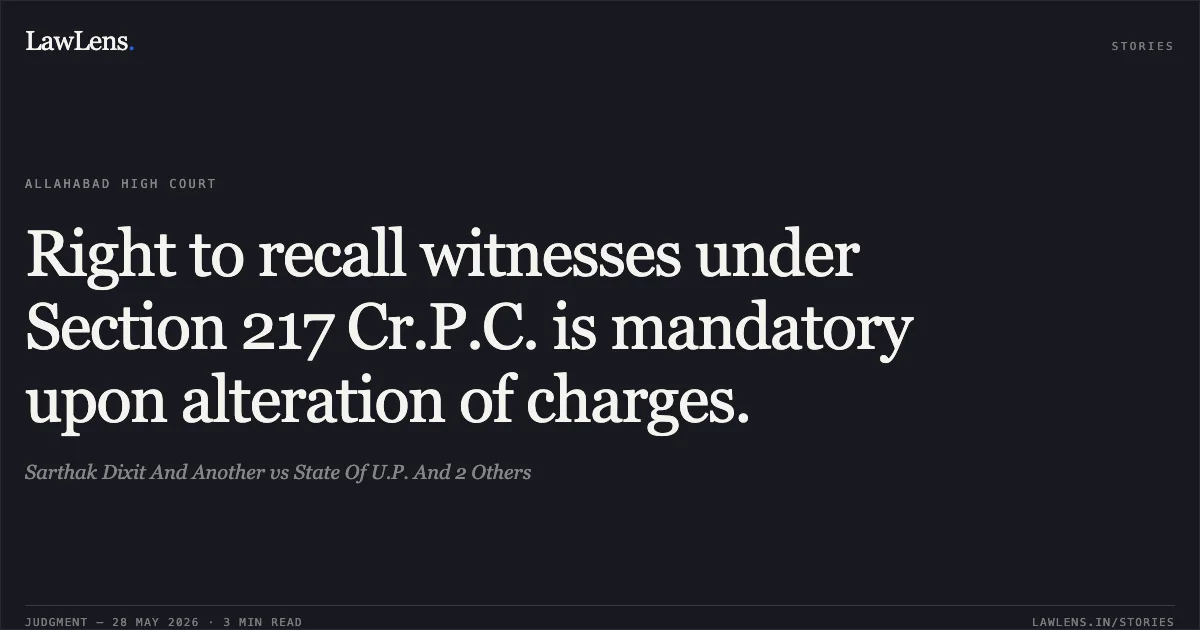
Source reference: p. 1The petitioners moved an application under Section 217 of the Cr.P.C. to recall PW-8 and PW-9 for further cross-examination regarding the altered charges.
Source reference: p. 1The trial court dismissed this application via an order dated August 27, 2025, citing that the request was a tactic to delay the trial.
Source reference: p. 2Issues
1. Whether an order rejecting a prayer to recall witnesses following an alteration of charge under Section 217 Cr.P.C. is an interlocutory order and thus barred from revision under Section 397(2) Cr.P.C.
Source reference: p. 2, 42. Whether the accused has a statutory right to recall prosecution witnesses for cross-examination upon the alteration of charges, provided the request is not for the purpose of vexation or delay.
Source reference: p. 3, 5Law Applied
The court primarily applied Section 217 of the Cr.P.C., which mandates that when a charge is altered or added to after the commencement of trial, the court shall allow the accused to recall or re-summon witnesses unless it considers the request is for vexation or delay.
Source reference: p. 3Section 311 Cr.P.C., which provides general discretionary power to the court to summon material witnesses at any stage.
Source reference: p. 3-4Section 397(2) Cr.P.C., which bars revisions against interlocutory orders, noting that orders affecting substantive rights under Section 217 are not purely interlocutory.
Source reference: p. 4The court also invoked Section 397(2) Cr.P.C., which bars revisions against interlocutory orders, noting that orders affecting substantive rights under Section 217 are not purely interlocutory.
Source reference: p. 4The court relied on the guarantee of a fair trial under Article 21 of the Constitution of India.
Source reference: p. 5Reasoning
The court reasoned that Section 217 Cr.P.C. creates a specific statutory right for the accused that is distinct from the discretionary power under Section 311 Cr.P.C.
Source reference: p. 4While Section 311 orders are interlocutory and non-revisable, an order denying the right under Section 217 affects a fundamental procedural safeguard and is therefore subject to revision.
Source reference: p. 4The court found the trial court’s "delay" justification erroneous; the petitioners, being in custody since 2022, had no incentive to stall proceedings and had filed the application promptly after the charge was altered.
Source reference: p. 5The court noted that because PW-8 and PW-9 were directly involved in the recovery of weapons, their cross-examination prior to the addition of Section 5/27 of the Arms Act was insufficient to cover the nuances of the new, more severe charges.
Source reference: p. 5Holding
The Court answered that an order under Section 217 Cr.P.C. is not hit by the bar of Section 397(2) Cr.P.C.
The petitioners are entitled to recall the witnesses to ensure a fair trial.
Source reference: p. 5The revision petition was allowed, the impugned order dated August 27, 2025, was set aside, and the trial court was directed to recall PW-8 and PW-9 for further cross-examination by the accused-petitioners.
Source reference: p. 5-6Acts & Sections Cited
15 provisions across 3 statutes referred to in this judgment. Each provision opens on LawLens.
Indian Penal Code, 18606
Arms Act, 19595
Code of Criminal Procedure, 19734
Original Court PDF
Sarthak Dixit And AnothervsState Of U.P. And 2 Others
Click to open original judgment
Original judgment, available to read, download and summarize on LawLens.in