Facts
Initially, the deceased plaintiff, Chanda Pawar, and her three sisters filed an eviction suit against the petitioner.
Source reference: para. 2The High Court eventually dismissed that suit in S.A. No. 1930/2006, holding the petitioner to be a co-owner.
Source reference: para. 2Subsequently, Chanda Pawar filed a second suit for permanent injunction to protect her possession of a specific portion of the property, claiming her right as a descendant of the original owner, Krishna Rao.
Source reference: para. 2, 7During the pendency of this second suit, Chanda Pawar died.
Source reference: para. 2Her two sisters, who reside in different cities (Bilaspur and Seoni) and were not plaintiffs in the second suit, sought substitution as her legal representatives (LRs).
Source reference: para. 2The petitioner challenged the Trial Court's order dated 19.09.2024, which permitted this impleadment, arguing that a suit for injunction is a personal action regarding possession that does not survive the plaintiff.
Source reference: para. 1, 3Issues
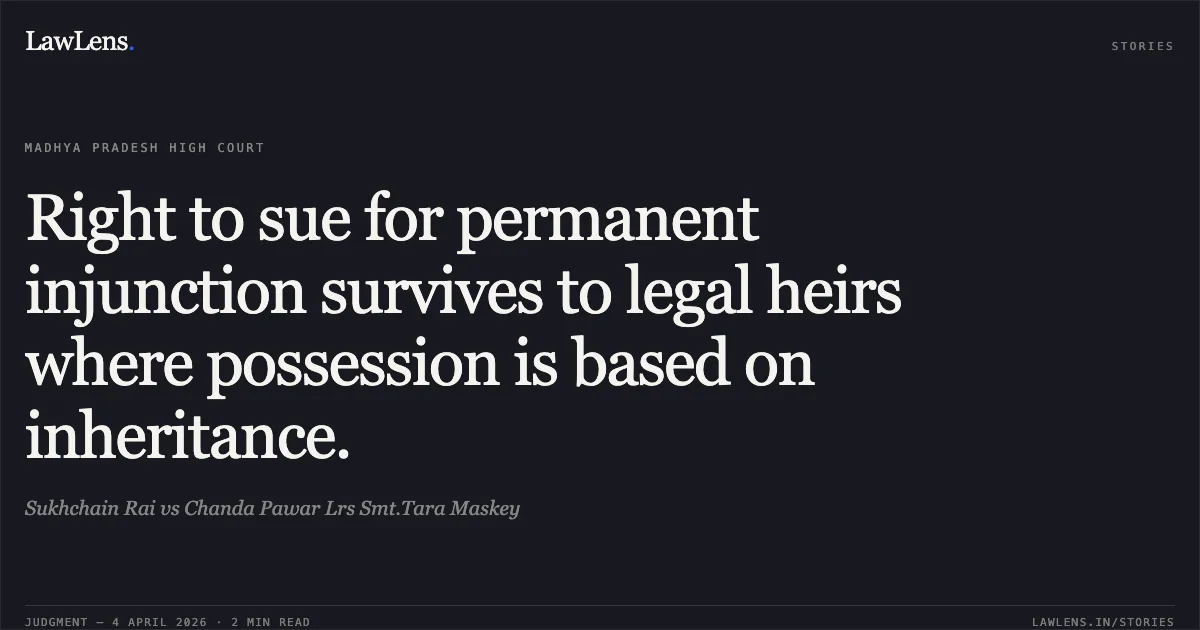
1. Whether the right to sue survives for the sisters of a deceased plaintiff in a suit for permanent injunction when the possession was claimed as a member of a family by way of inheritance.
Source reference: para. 7, 82. Whether the maxim actio personalis moritur cum persona applies to a suit for injunction involving property possession claimed through family lineage.
Source reference: para. 8, 9Law Applied
The Court primarily applied Order 22, Rule 1 of the Code of Civil Procedure (CPC), which mandates that the death of a plaintiff shall not cause a suit to abate if the right to sue survives.
Source reference: para. 8It relied on the Supreme Court precedent in Puran Singh v. State of Punjab (1996) 2 SCC 205, which clarified that the maxim actio personalis moritur cum persona (a personal action dies with the person) is limited to specific actions like defamation, assault, or personal injuries.
Source reference: para. 8In property-related actions where rights devolve upon legal representatives, the right to sue survives.
Source reference: para. 8Reasoning
The Court reasoned that Chanda Pawar’s claim to possession was not a purely personal right (such as a right to occupy as an employee) but was based on her status as a descendant of the original owner, Krishna Rao.
Source reference: para. 7, 9Because she occupied the property as a family member claiming via inheritance, her sisters—being other members of the same family and legal heirs—possess a heritable right to protect that possession.
Source reference: para. 7The Court distinguished this from personal torts, noting that the right to sue persists if it involves property interests that do not extinguish upon death.
Source reference: para. 8, 9The Court further observed that the sisters' lack of actual physical residence in the property at the time of death did not negate their status as legal representatives entitled to continue the suit.
Source reference: para. 7Holding
The High Court held that the right to sue survived Chanda Pawar’s death because her claim was rooted in heritable family rights rather than a non-transferable personal right.
Consequently, the sisters were rightly impleaded as legal representatives.
Source reference: para. 10The Court found no error in the Trial Court’s order and dismissed the petition.
Source reference: para. 10Acts & Sections Cited
2 provisions across 2 statutes referred to in this judgment. Each provision opens on LawLens.
Code of Civil Procedure, 19081
Limitation Act, 19631
Original Court PDF
Sukhchain RaivsChanda Pawar Lrs Smt.Tara Maskey
Click to open original judgment
Original judgment, available to read, download and summarize on LawLens.in


