Facts
The petitioners had constructed a residence in “Chirag Row House,” Isanpur, Ahmedabad, allegedly encroaching upon the society’s road line.
Source reference: paras. 4–5; pp. 2–3They applied for regularisation under the Gujarat Regularization of Unauthorized Development Act, 2022 (“GRUDA”) in 2022.
Source reference: paras. 4–5; pp. 2–3During the pendency of the application, the respondent-Corporation issued a removal notice dated 22 March 2024.
Source reference: paras. 4–5; pp. 2–3The application was rejected on 19 October 2024, and the petitioners’ statutory appeal was dismissed on 22 June 2026.
Source reference: paras. 4–5; pp. 2–3Residents of the society were joined as respondents Nos. 6 and 7 because they could be materially affected by any relief granted to the petitioners.
Source reference: paras. 2–3; pp. 1–2Issues
Whether the petitioners’ construction situated on the society’s road line could be regularised under Rule 8(4) of the Gujarat Regularization of Unauthorized Development Rules, 2022, where the approved society layout prescribed a 7.5-metre approach road.
Source reference: paras. 9, 12–18; pp. 4–8Whether the appellate authority’s reliance on objections and departmental opinions not supplied to the petitioners violated the principles of natural justice and required remand for fresh consideration.
Source reference: para. 13; p. 6Whether FAQs Nos. 64–66 issued under GRUDA entitled the petitioners to regularisation on the basis that a minimum road width of 4.5 metres would remain available.
Source reference: paras. 6, 16; pp. 3, 7–8Law Applied
The Court applied Rule 8(4) of the Gujarat Regularization of Unauthorized Development Rules, 2022, which prohibits regularisation with respect to road width or the setback required under the CGDCR; permits regularisation where road width is not provided and maintained, subject to specified deduction from the plot; and allows relaxation of the prescribed road width only on the condition that the road does not become less than 4.50 metres wide.
Source reference: para. 12; p. 5The Court held that the provision applies where no specific road width is prescribed, and that the statutory Rule prevails in the event of any inconsistency with administrative FAQs.
Source reference: para. 16; p. 7It also applied the principles of natural justice concerning disclosure of adverse material, while observing that “negative equality” under Article 14 cannot compel the repetition of an erroneous benefit.
Source reference: paras. 13, 16–17; pp. 6–8Reasoning
The Court found that the approved layout plan prescribed a 7.5-metre approach road for the society.
Source reference: paras. 12, 14–15; pp. 5–7Since a specific road width was provided, the conditional relaxation mechanism under Rule 8(4)—including the minimum 4.5-metre safeguard—could not be invoked to regularise construction encroaching upon that road line.
Source reference: paras. 12, 14–15; pp. 5–7The Court rejected the petitioners’ interpretation of FAQs Nos. 64–66, holding that they had to be read consistently with Rule 8(4) and could not override the Rule.
Source reference: para. 16; pp. 7–8Although the Court acknowledged that the petitioners had not been furnished the private respondents’ objections and certain subsequent departmental opinions, it concluded that remand would serve no useful purpose because the petitioners’ case failed on the substantive interpretation of Rule 8(4).
Source reference: paras. 13, 15; p. 6–7The Court also rejected the claim of discriminatory treatment, noting that an erroneous benefit granted to another person does not create a right to similar treatment.
Source reference: paras. 16–17; pp. 7–8Holding
The Civil Application for joining party was allowed, and the applicants were joined as respondents Nos. 6 and 7.
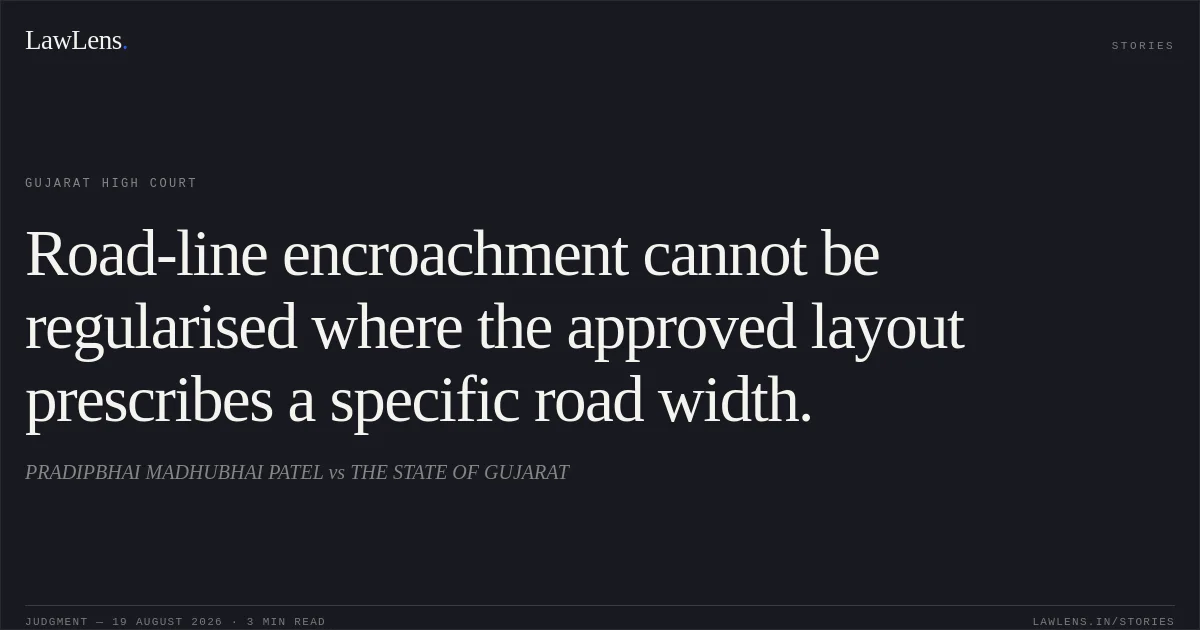
On the merits, the Court held that construction encroaching upon a road whose width was specifically prescribed as 7.5 metres in the approved layout could not be regularised under Rule 8(4).
Source reference: paras. 15, 17–18; pp. 7–8The alleged procedural lapse did not warrant remand because the petitioners could not succeed on the substantive issue.
Source reference: paras. 15, 17–18; pp. 7–8The challenge to the appellate order dated 22 June 2026 was therefore rejected, and the Special Civil Application was disposed of accordingly.
Source reference: paras. 15, 17–18; pp. 7–8Original Court PDF
PRADIPBHAI MADHUBHAI PATELvsTHE STATE OF GUJARAT
Click to open original judgment
Original judgment, available to read, download and summarize on LawLens.in