Facts
The respondent was acquitted by the Special Judge, Prevention of Corruption Act, Sidhi, in Special Case No. 02/2014, by judgment dated 31 December 2016, of offences under Sections 7 and 13(1)(d) read with Section 13(2) of the Prevention of Corruption Act.
Source reference: para. 2The Special Police Establishment sought leave to appeal against the acquittal, but the application was filed on 14 February 2018, with a delay of 305 days beyond the prescribed limitation period of 90 days.
Source reference: para. 3The applicant attributed the delay to the movement of the file between the District Prosecution Office, the Superintendent of Police, the Additional Director General of Police, the Law Department, the Advocate General’s office and the Special Public Prosecutor, followed by appointment of an Officer-in-Charge and collection of documents.
Source reference: para. 3The respondent opposed condonation, contending that the explanation was vague, unsatisfactory and merely relied on bureaucratic delay.
Source reference: para. 4Issues
1. Whether the applicant established “sufficient cause” under Section 5 of the Limitation Act for condoning the 305-day delay in filing the application for leave to appeal against acquittal.
Source reference: paras. 6, 11–152. Whether routine administrative movement of files, red-tapism and procedural delay in governmental functioning constituted sufficient cause for condonation of delay, particularly where the appeal challenged an acquittal.
Source reference: paras. 7–143. Whether the seriousness of the corruption allegations and the asserted public interest justified condonation despite the absence of a satisfactory explanation for the delay.
Source reference: paras. 12–14Law Applied
Section 5 of the Limitation Act confers discretionary power to condone delay only where “sufficient cause” is established; condonation is not a matter of right, and the explanation must be genuine, bona fide and cogent.
Source reference: paras. 9–11Under Section 3 of the Limitation Act, limitation promotes finality and ordinarily requires dismissal of proceedings instituted after the prescribed period, subject to the limited exception in Section 5.
Source reference: para. 9The court considered State of Nagaland v. Lipok Ao, 2005 (3) SCC 752, which recognised that governmental functioning may involve procedural delay, but applied the later and more restrictive principles in Postmaster General v. Living Media (India) Ltd., (2012) 3 SCC 563; State of M.P. v. Bherulal, (2020) 10 SCC 654; Sheo Raj Singh v. Union of India, (2023) 10 SCC 531; DDA v. Tejpal, (2024) 7 SCC 433; and Shivamma v. Karnataka Housing Board, 2025 INSC 1104.
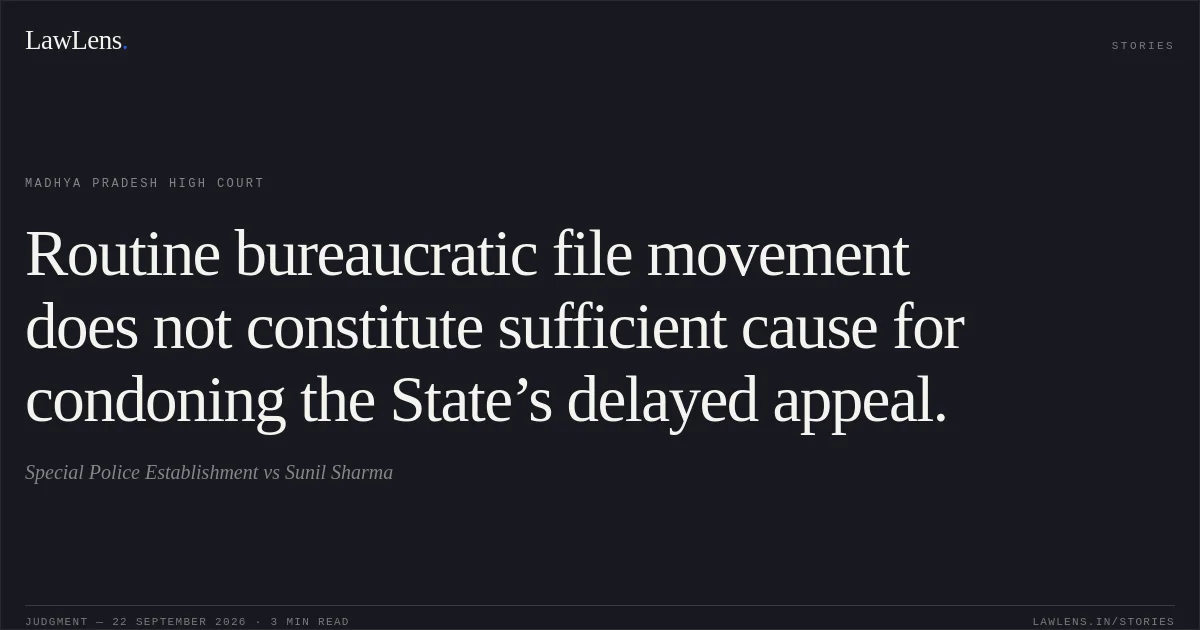
Source reference: paras. 8–11These authorities establish that the State receives no automatic preferential treatment, and that bureaucratic lethargy, administrative inefficiency or routine file movement cannot by themselves constitute sufficient cause; the State must demonstrate reasonable diligence and bona fide efforts.
Source reference: paras. 8–11The court also emphasised the distinction between a genuine “explanation” and a mere “excuse”.
Source reference: paras. 8–10Reasoning
The Court held that the chronology supplied by the applicant merely described routine movement of the file through governmental channels and did not identify any genuine impediment preventing timely filing.
Source reference: paras. 11, 14Although the Law Department directed filing of an appeal on 28 April 2017, the applicant did not explain why the Special Police Establishment’s Rewa unit remained unaware of or failed to act on that decision until 26 December 2017, nor did it identify responsibility for the lapse.
Source reference: para. 14The further delay in appointing the Officer-in-Charge, collecting documents and preparing the appeal demonstrated avoidable inaction and lack of due diligence.
Source reference: para. 14The Court also treated the acquittal as strengthening the respondent’s initial presumption of innocence and noted that a delayed challenge directly affected the liberty and finality accruing to an accused acquitted after trial.
Source reference: para. 12The seriousness of the alleged corruption offences could not cure the failure to establish sufficient cause; indeed, the asserted importance of the case required greater vigilance by the prosecuting authorities.
Source reference: paras. 12–14Accordingly, the explanation was characterised as a lame excuse rather than a cogent and satisfactory justification.
Source reference: para. 14Holding
The Court answered the issues against the applicant and held that the Special Police Establishment failed to establish sufficient cause under Section 5 of the Limitation Act for the 305-day delay.
I.A. No. 2238/2018 seeking condonation of delay was dismissed, and consequently the application for leave to appeal against the acquittal was also dismissed.
Source reference: paras. 16–17Acts & Sections Cited
4 provisions across 2 statutes referred to in this judgment. Each provision opens on LawLens.
Prevention of Corruption Act, 19882
Original Court PDF
Special Police EstablishmentvsSunil Sharma
Click to open original judgment
Original judgment, available to read, download and summarize on LawLens.in