Facts
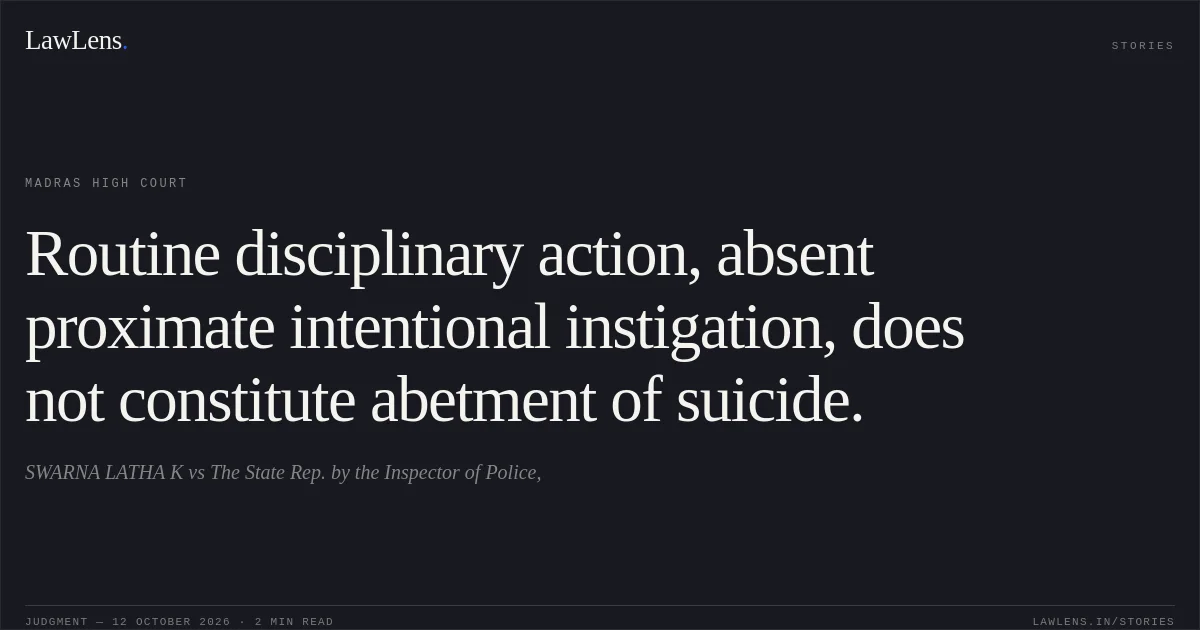
The petitioner, a Senior Deputy Manager (HRD) at the Metropolitan Transport Corporation, sought to quash an FIR registered as Crime No. 676 of 2025 under Section 108 of the Bharatiya Nyaya Sanhita (BNS), alleging abetment of suicide.
Source reference: p. 1–3The deceased, a Junior Engineer, had died by jumping in front of a train and had sent an email naming the petitioner and others as responsible. The alleged conduct included rejecting his leave, marking him absent and initiating disciplinary proceedings.
Source reference: p. 1–3The petitioner relied on records indicating repeated unauthorised absence, prior disciplinary action and earlier suicide threats, as well as material suggesting long-standing family disputes.
Source reference: p. 1–3The FIR was initially registered under Section 194 of the Bharatiya Nagarik Suraksha Sanhita (BNSS) and later altered to Section 108 BNS.
Source reference: p. 2Issues
1. Whether the allegations and materials, even if accepted at face value, disclosed a prima facie offence of abetment of suicide under Sections 108 and 45 BNS against the petitioner
Source reference: p. 4, 102. Whether the FIR should be quashed under Section 528 BNSS where the alleged conduct consisted of ordinary employment-related administrative actions and lacked a proximate nexus with the suicide
Source reference: p. 1, 10Law Applied
Section 108 BNS punishes abetment of suicide, while Section 45 BNS defines abetment through instigation, conspiracy accompanied by an act or illegal omission, or intentional aid.
Source reference: p. 4The Court applied the principles in Vinod Shivakumar v. State of Maharashtra, Ude Singh v. State of Haryana, Prakash v. State of Maharashtra, Pawan Kumar v. State of H.P., Madan Mohan Singh v. State of Gujarat, Abhinav Mohan Delkar v. State of Maharashtra and Amalendu Pal v. State of West Bengal: abetment requires intentional instigation, aid or participation, with the necessary mens rea; harassment alone is insufficient absent a positive act sufficiently proximate to the suicide and a demonstrable connection between the accused’s conduct and the suicide.
Source reference: p. 5–9Section 528 BNSS provides the procedural basis invoked for seeking quashing of the FIR.
Source reference: p. 1Reasoning
The Court considered the deceased’s service and disciplinary record, his repeated unauthorised absences and earlier suicide threats, as well as the material indicating a long-standing family dispute.
Source reference: p. 3, 10It held that rejecting leave, marking an employee absent and initiating disciplinary proceedings were ordinary administrative actions performed in the course of official duties. The record did not disclose a proximate act of instigation or intentional aid, or a mens rea to drive the deceased to suicide.
Source reference: p. 10Accordingly, even accepting the prosecution allegations at face value, the essential ingredients of abetment under Sections 108 and 45 BNS were absent, and continuation of the proceedings would constitute an abuse of process.
Source reference: p. 10Holding
The Court answered the issues in the petitioner’s favour, finding that the allegations did not make out a prima facie offence of abetment of suicide.
It quashed the FIR in Crime No. 676 of 2025 and allowed the criminal original petition; the connected miscellaneous petition was closed.
Source reference: p. 11Acts & Sections Cited
7 provisions across 3 statutes referred to in this judgment. Each provision opens on LawLens.
Bharatiya Nagarik Suraksha Sanhita, 20232
Bharatiya Nyaya Sanhita, 20232
Indian Penal Code, 18603
Original Court PDF
SWARNA LATHA KvsThe State Rep. by the Inspector of Police,
Click to open original judgment
Original judgment, available to read, download and summarize on LawLens.in