Facts
Urmilaben, who lived with her husband, in-laws and minor son, set herself on fire on 21 May 2014 and died after 19 days of treatment.
Source reference: paras. 2, 2.1In a dying declaration recorded by an Executive Magistrate, she said her mother-in-law quarrelled with her over household work and instigated her husband to beat her; she attributed her suicide to that treatment.
Source reference: paras. 2, 2.1, 8Her father did not support the prosecution, and a cousin of the husband who was present at the incident was declared hostile.
Source reference: para. 10The Sessions Court acquitted the respondents of charges under Sections 498-A, 306 and 323 read with Section 114 IPC. The State appealed under Section 378 CrPC.
Source reference: para. 1Issues
1. Whether the Trial Court committed an error of law or fact in appreciating the prosecution evidence and acquitting the respondents.
Source reference: para. 52. Whether the acquittal was affected by illegality or perversity warranting appellate interference.
Source reference: para. 53. Whether the evidence established cruelty under Section 498-A IPC or abetment of suicide under Sections 107 and 306 IPC.
Source reference: paras. 11–12, 16–18Law Applied
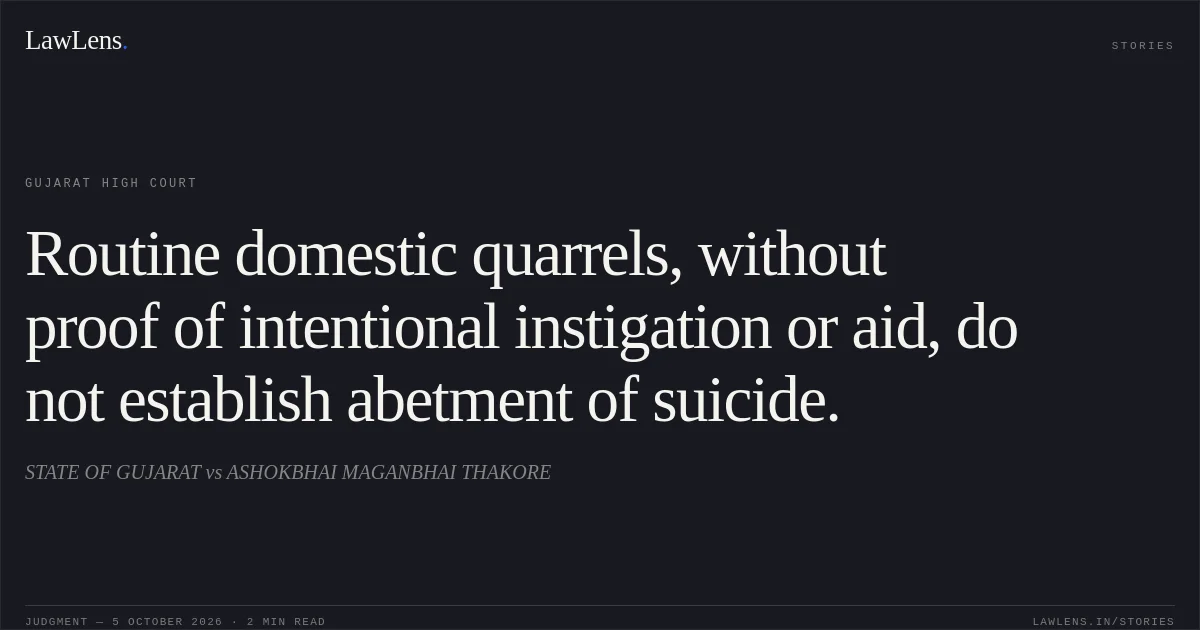
Sections 107 and 306 IPC require proof of abetment, including instigation, conspiracy accompanied by an act or illegal omission, or intentional aid; quarrels or harassment, without evidence satisfying those elements, do not by themselves establish abetment.
Source reference: para. 12Section 498-A IPC defines cruelty to include wilful conduct likely to drive a woman to suicide or cause grave injury or danger to her health, as well as specified harassment connected to an unlawful demand.
Source reference: para. 16Under Chandrappa v. State of Karnataka, as reaffirmed in Rajesh Prasad v. State of Bihar, Babu Sahebagouda Rudragoudar v. State of Karnataka and Ramesh v. State of Karnataka, an appellate court may review evidence in an acquittal appeal, but must account for the reinforced presumption of innocence; where two reasonable views are possible, the acquittal should not be disturbed.
Source reference: paras. 21–24The Court also referred to Ramesh Kumar v. State of Chhattisgarh and Ram Pyarey v. State of Uttar Pradesh.
Source reference: para. 17Reasoning
The Court considered the dying declaration’s allegations of household-work disputes and that the husband beat Urmilaben at his mother’s instigation.
Source reference: paras. 8–12It found no further material showing intentional aid, legally sufficient instigation, or conduct establishing abetment; the father did not support the prosecution, the cousin’s evidence supplied no incriminating material, and the police evidence added nothing material to the statements attributed to the deceased.
Source reference: paras. 8–12On the evidence as a whole, the Court found the prosecution had not proved the charged offences beyond reasonable doubt.
Source reference: paras. 18, 25–26Applying the principles governing appeals against acquittal, it found no perversity, illegality or other basis to displace the Trial Court’s findings.
Source reference: paras. 14–15, 21–24Holding
The Court held that the acquittal disclosed no reviewable error and that the prosecution had failed to prove the charges beyond reasonable doubt.
It dismissed the State’s appeal, confirmed the acquittal, cancelled the bail bond and directed that the record and proceedings be returned to the Trial Court.
Source reference: para. 27Acts & Sections Cited
6 provisions across 2 statutes referred to in this judgment. Each provision opens on LawLens.
Code of Criminal Procedure, 19732
Indian Penal Code, 18604
Original Court PDF
STATE OF GUJARATvsASHOKBHAI MAGANBHAI THAKORE
Click to open original judgment
Original judgment, available to read, download and summarize on LawLens.in