01Facts
The Government of Karnataka, which had been the third respondent in W.P. No. 27186/2017, sought review of the order disposing of that petition on 19 September 2023.
p. 6The review petition was filed on 4 June 2024, with a delay of 223 days; the State applied under Section 5 of the Limitation Act, 1963, to condone it.
pp. 6–7The supporting affidavit attributed the delay to obtaining departmental approvals and processing the matter between government offices.
pp. 6–7The Court considered the delay application and affidavit before deciding whether to extend time.
pp. 3–402Issues
i.1. Whether the State had shown sufficient cause under Section 5 of the Limitation Act, 1963, to condone the 223-day delay in filing the review petition.
pp. 3–5, 7–9ii.2. Whether the review petition could proceed without condonation of that delay.
pp. 9–1003Law Applied
Section 5 of the Limitation Act, 1963, permits a court, in its discretion, to admit a matter after the prescribed period where sufficient cause is shown; condonation is not a right, and the applicant must establish a bona fide and adequate explanation for the delay.
pp. 3–5The Court stated that the applicant must demonstrate diligence and explain the delay from the expiry of the limitation period.
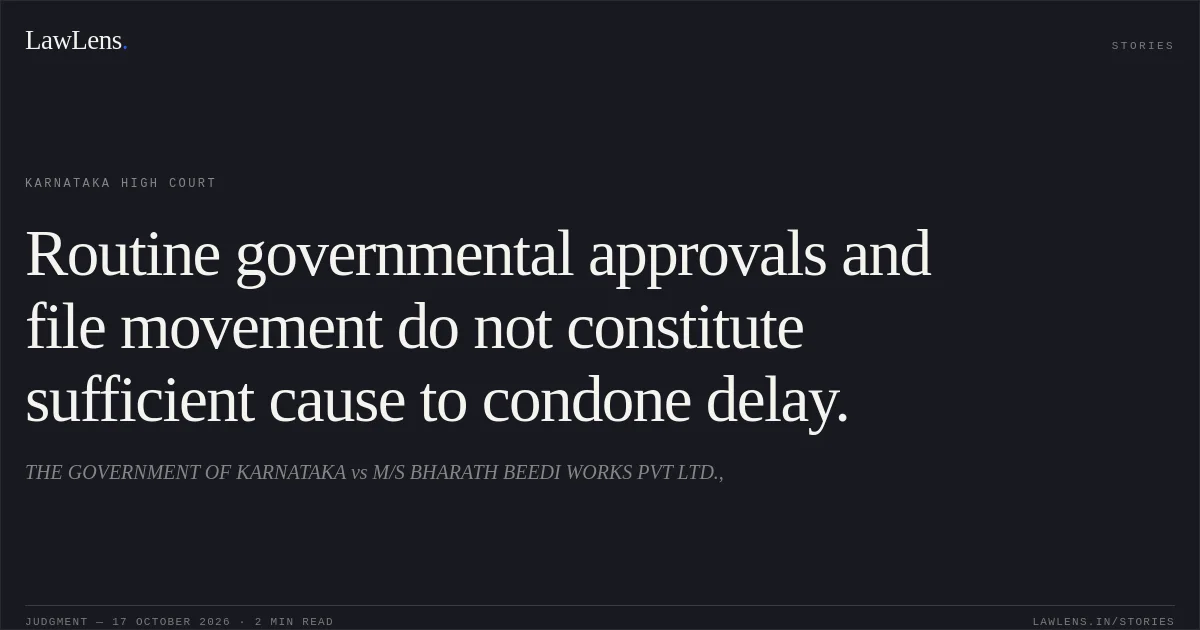
p. 5It further held that routine administrative processing or departmental approvals, without a sufficiently persuasive explanation, do not by themselves constitute sufficient cause, and that the Government is not entitled to special treatment over a private litigant in applying limitation principles.
pp. 7–9The Court also referred to Shivamma (dead) by LRS v. Karnataka Housing Board & Others, Civil Appeal No. 11794 of 2025, disposed of on 12 September 2025, in support of the principle that litigants must not act lethargically or misuse legal process.
p. 9Provisions in the judgment · 2 · Linked ones open on LawLens
Code of Civil Procedure, 1908 Section 114
Limitation Act, 1963 Section 5
04Reasoning
The Court found that the State’s explanation rested on the time taken for intra- and inter-departmental approvals and did not satisfactorily account for the delay.
pp. 7–8It considered those routine internal processes insufficient, particularly given the State’s legal resources and familiarity with court procedures, and rejected the proposition that government status justified greater leniency.
pp. 8–9As the affidavit and submissions did not establish sufficient cause, the Court declined to condone the delay; it therefore did not proceed to determine the merits of the review petition.
p. 905Holding
The Court held that the State had not established sufficient cause for the 223-day delay and refused to extend the time for filing.
p. 9It rejected I.A. No. 1/2024 and the review petition, and declined the AAG’s request for time to file a better affidavit.
pp. 9–10Original Court PDF
THE GOVERNMENT OF KARNATAKAvsM/S BHARATH BEEDI WORKS PVT LTD.,
Click to open original judgment
Original judgment, available to read, download and summarize on LawLens.in