01Facts
The State appealed under Section 2(1) of the Madhya Pradesh Uchcha Nyayalaya (Khand Nyayapeeth Ko Appeal) Adhiniyam, 2005, against the Single Judge’s order dated 8 July 2025 in W.P. No. 11309/2019.
¶ 1It sought condonation of a 213-day delay under Section 5 of the Limitation Act, 1963.
¶ 2The State attributed the delay to internal processing, obtaining legal opinion and approval, and collecting documents; the appeal was filed on 8 October 2026.
¶ 2–3The State submitted that administrative formalities and the need to act through multiple authorities warranted a sympathetic approach.
¶ 402Issues
i.Whether the State established “sufficient cause” under Section 5 of the Limitation Act, 1963, to condone the 213-day delay in filing the writ appeal.
¶ 2, 6, 9–10ii.Whether the writ appeal could proceed once the delay-condonation application was rejected.
¶ 1103Law Applied
Section 5 of the Limitation Act, 1963 permits condonation of delay upon proof of “sufficient cause.”
In considering such an application, courts may account for the procedural characteristics of government decision-making, but the State remains responsible for its officers’ acts and omissions, and an explanation must be distinguished from a mere excuse.
¶ 8The Court also relied on State of M.P. v. Ramkumar Choudhary, which addressed official lapses causing delay and called for streamlining government legal processes and fixing responsibility.
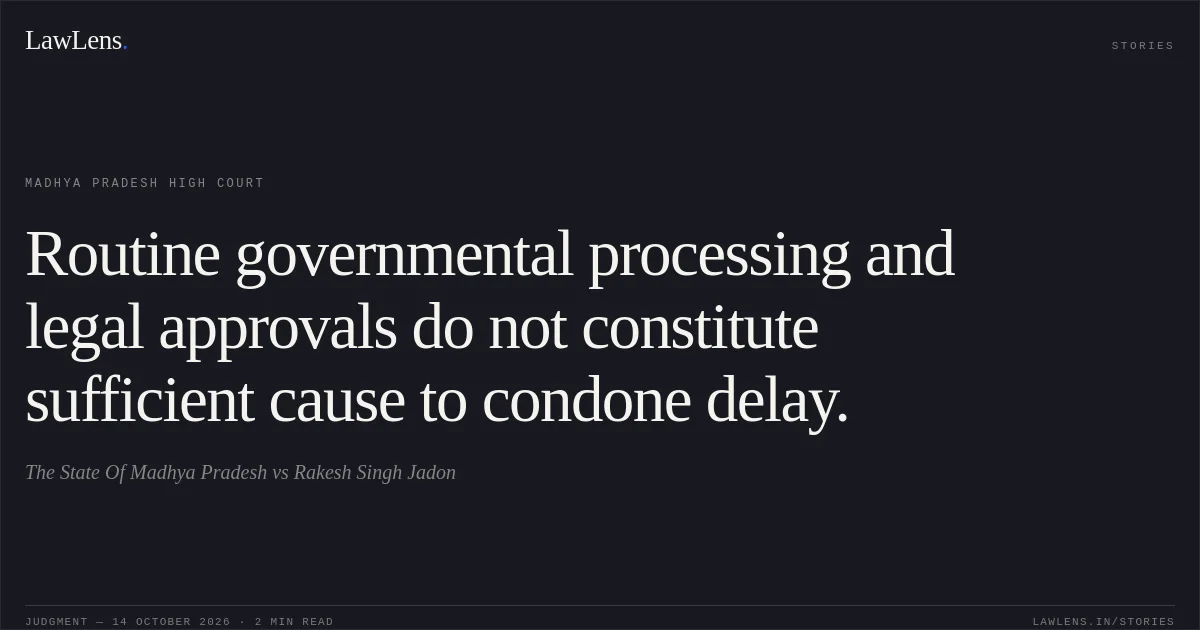
¶ 7The Court held that routine processing through authorities and obtaining legal opinion or permission, without a satisfactory explanation for the lack of prompt action, does not by itself constitute sufficient cause.
¶ 6, 9Provisions in the judgment · 1 · Linked ones open on LawLens
Limitation Act, 1963 Section 5
04Reasoning
The State’s account described the movement of the matter between officials and the time taken to obtain legal opinion and permission, but did not satisfactorily explain why the appeal was not processed with due promptitude or filed within limitation.
¶ 3, 6Applying the principles discussed in the cited Supreme Court authorities, the Court held that governmental procedures may warrant some latitude, but do not exempt the State from demonstrating sufficient cause.
¶ 8–9Since the application offered only administrative processing as the explanation, the State had not met that requirement.
¶ 8–905Holding
The Court rejected I.A. No. 14624/2026 because the State had not shown sufficient cause for the 213-day delay.
¶ 10Consequently, it dismissed Writ Appeal No. 3733 of 2026 as barred by limitation.
¶ 11Original Court PDF
The State Of Madhya PradeshvsRakesh Singh Jadon
Click to open original judgment
Original judgment, available to read, download and summarize on LawLens.in