Facts
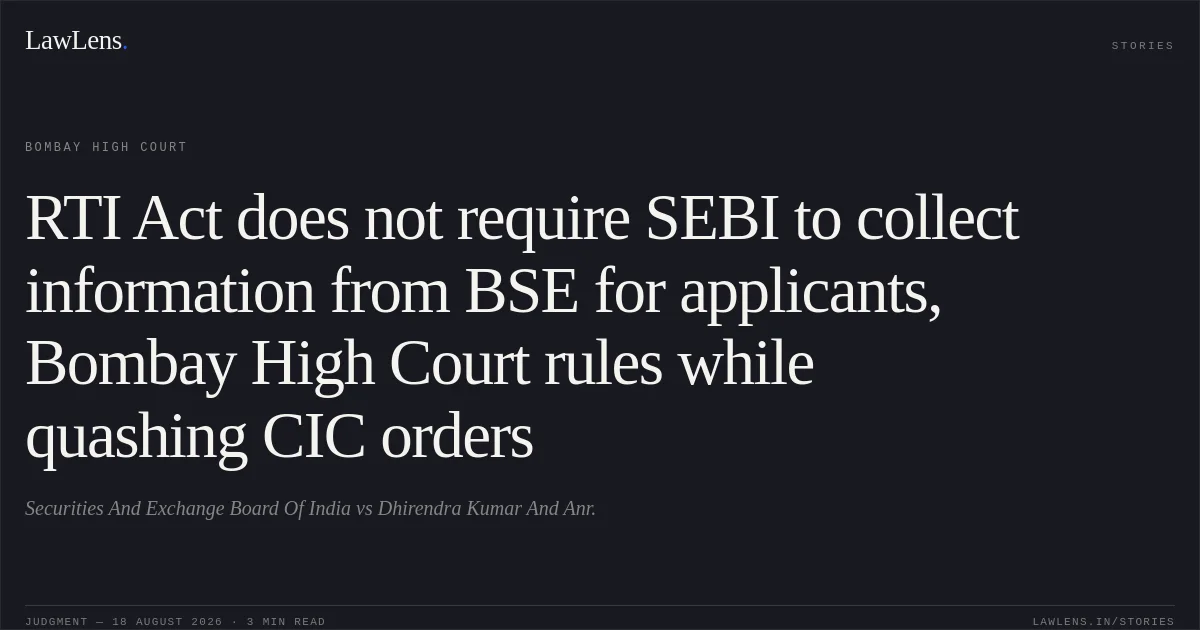
Nine connected writ petitions were filed by the Securities and Exchange Board of India (“SEBI”) and the Bombay Stock Exchange Ltd. (“BSE”) challenging orders of the Central Information Commission (“CIC”) under the Right to Information Act, 2005 (“RTI Act”).
Source reference: paras. 1–4; pp. 3–5The original RTI applicants had sought information from SEBI, in its capacity as a regulator, which required SEBI to obtain certain information from BSE and furnish it to them.
Source reference: paras. 1–4; pp. 3–5The CIC held that SEBI was obliged not only to disclose information already held by it, but also to collect information from third parties such as BSE and provide it to the applicants.
Source reference: paras. 4, 22; pp. 4–5, 16–17The impugned orders were stayed, and the petitions were heard together because they raised a common question of law.
Source reference: para. 3; p. 4Issues
1. Whether Section 2(f) of the RTI Act obliges a public authority to collect or obtain information from a private body or third party and furnish it to an RTI applicant, merely because the public authority has statutory power to access that information
Source reference: paras. 1, 13–14; pp. 3, 10–112. Whether the CIC’s directions requiring SEBI to obtain information from BSE and disclose it to the RTI applicants were contrary to the statutory scheme of the RTI Act and binding Supreme Court precedent
Source reference: paras. 16–23; pp. 12–17Law Applied
The Court applied Sections 2(f), 2(j), 6, 8, 11 and 22 of the RTI Act. Section 2(f) defines “information” broadly, including information relating to a private body that can be accessed by a public authority under another law; however, Section 2(j) limits the right to information to information held by or under the control of a public authority.
Source reference: paras. 11–14; pp. 6–11Under CBSE v. Aditya Bandopadhyay, (2011) 8 SCC 497, the RTI Act provides access to available and existing information and does not require a public authority to collect, collate, create, infer or obtain non-available information from another entity.
Source reference: para. 15; pp. 11–13The Constitution Bench in CPIO, Supreme Court of India v. Subhash Chandra Agarwal, (2020) 5 SCC 481, clarified that information relating to a private body falls within Section 2(f) only where the public authority is legally entitled to access it, subject to statutory preconditions and restrictions; Section 22 overrides restrictions on citizens’ access, but does not remove limitations governing the public authority’s own access to private information.
Source reference: paras. 17–18; pp. 13–16The Court also relied on TRAI v. Akshay Kumar Malhotra, 2025 SCC OnLine Del 10, which held that a public authority is not required to collect, compile or generate information from a private entity to satisfy an RTI request.
Source reference: para. 19; p. 16Reasoning
The Court distinguished between information already held by SEBI or under its control and information that SEBI could obtain from BSE in the exercise of its regulatory powers.
Source reference: paras. 13–14; pp. 10–11Although Section 2(f) has a wide ambit and includes information relating to private bodies, the phrase “which can be accessed by a public authority” does not impose a continuing duty on the authority to initiate regulatory action or obtain fresh information whenever an RTI application is filed.
Source reference: paras. 13–14; pp. 10–11The Supreme Court’s interpretation in Aditya Bandopadhyay expressly excludes an obligation to collect or collate non-available information, while Subhash Chandra Agarwal confirms that any statutory conditions or restrictions governing SEBI’s access to BSE’s information remain applicable.
Source reference: paras. 15–18; pp. 11–16Accordingly, the CIC’s conclusion that information held by BSE automatically became accessible to the RTI applicants because SEBI could seek it under its regulatory statute was held to be inconsistent with the governing law.
Source reference: paras. 20–23; pp. 16–17Holding
The Bombay High Court held that SEBI was not obliged under the RTI Act to collect or obtain information from BSE, a third party, merely to answer the RTI applications.
The CIC’s impugned orders directing SEBI to procure and disclose such information were quashed and set aside as contrary to the Supreme Court’s interpretation of Sections 2(f) and 2(j) of the RTI Act.
Source reference: paras. 21–24; pp. 16–18All nine writ petitions were allowed, the Rule was made absolute, and pending applications, if any, were disposed of.
Source reference: paras. 24–26; p. 18Acts & Sections Cited
12 provisions across 1 statute referred to in this judgment. Each provision opens on LawLens.
Right to Information Act, 2005
Original Court PDF
Securities And Exchange Board Of IndiavsDhirendra Kumar And Anr.
Click to open original judgment
Original judgment, available to read, download and summarize on LawLens.in