Facts
The plaintiffs instituted Special Civil Suit No. 494 of 2011 seeking partition, maintenance, declaration and permanent injunction against the petitioners and other defendants.
Source reference: para. 3The trial court directed the parties to maintain status quo and framed issues on 16 January 2020; the order was not disturbed in appellate proceedings.
Source reference: paras. 3.1–3.3During the plaintiffs’ evidence, they sought to place additional documents on record, including two completion certificates issued by an architect and a family partition agreement, which had been obtained from the Surat Municipal Corporation under the Right to Information Act, 2005.
Source reference: paras. 3.5, 10The defendants objected to documents at Serial Nos. 12 to 14, contending that they were private documents and that RTI certification did not make them public documents or admissible certified copies.
Source reference: paras. 4–4.3, 9The trial court nevertheless exhibited the documents as Exhibits 302 to 315, treating them as public documents. The defendants challenged that order under Article 227 of the Constitution.
Source reference: paras. 2, 3.5Issues
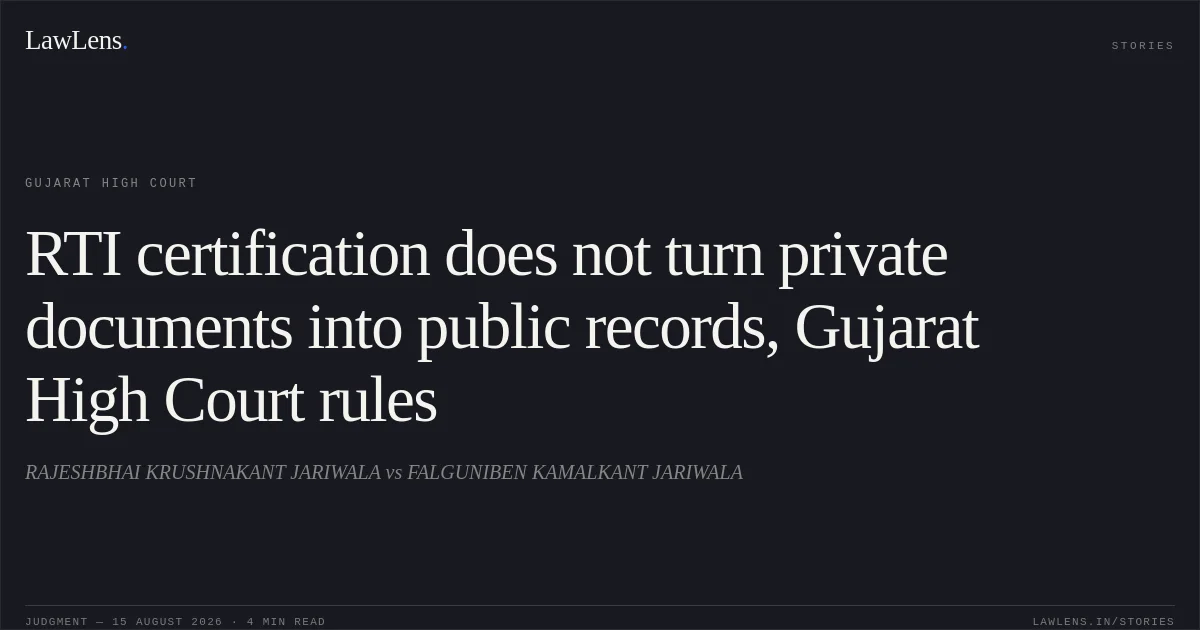
1. Whether a private document obtained under the Right to Information Act, 2005 constitutes a “public document” within the meaning of Section 74(2) of the Indian Evidence Act, 1872?
Source reference: para. 7(i)2. Whether a copy of such a private document obtained under RTI is admissible as secondary evidence under Sections 65(e) or 65(f) of the Evidence Act, 1872?
Source reference: para. 7(ii)Law Applied
The Court applied Sections 61–65, 74–77 and 79 of the Indian Evidence Act, 1872. Sections 61–64 require documentary contents to be proved through primary or legally permissible secondary evidence; Section 65(e) permits secondary evidence where the original is a public document, while Section 65(f) applies where a certified copy is permitted by the Evidence Act or another law.
Source reference: para. 12Section 74(2) treats public records kept by the State of private documents as public documents, but Section 75 classifies all other documents as private. Section 77 permits certified copies of public documents to prove their contents.
Source reference: paras. 12–16The Court relied on Deccan Paper Mills Co. Ltd. v. Regency Mahavir Properties, (2021) 4 SCC 786; Smt. Rekha Rana v. Smt. Ratnashree Jain, AIR 2006 MP 107; Gopal Das v. Shri Thakurji, AIR 1943 PC 83; N.N. Global Mercantile (P) Ltd. v. Indo Unique Flame Ltd., (2023) 7 SCC 1; Jagdishchandra Chandulal Shah v. State of Gujarat, 1989 Cri LJ 1724; and Kumarpal N. Shah v. Universal Mechanical Works Pvt. Ltd., 2019 SCC OnLine Bom 1627.
Source reference: paras. 14–18.4The governing principle was that a private document does not become a public document merely because it is submitted to, stored by, or copied by a public authority; only the public record of that private document may qualify as a public document.
Source reference: paras. 14–18.4RTI certification establishes that the supplied copy is a true copy for RTI purposes, but does not automatically constitute a certified copy under Sections 65(e) or 65(f) of the Evidence Act where the underlying document is private.
Source reference: paras. 18.1–18.4Reasoning
The disputed completion certificates and family partition agreement were private documents and were not themselves acts or records of a sovereign authority, public body, tribunal or public officer.
Source reference: paras. 10, 13Although copies were maintained by the Surat Municipal Corporation and supplied under RTI, the Court held that mere custody or availability in a public office did not establish that the documents formed part of a “public record” within Section 74(2).
Source reference: paras. 16–17Consequently, the RTI-certified photocopies could not be admitted under Sections 65(e) or 65(f) as certified copies of public documents. The plaintiffs were required to lay the statutory foundation for secondary evidence under Sections 65(a), (b) or (c), and to prove the documents in accordance with law.
Source reference: para. 18.2This requirement was particularly significant for the family partition agreement, whose execution, signature and seal were specifically disputed.
Source reference: para. 19The trial court’s assumption that RTI certification automatically made the documents public, without addressing the defendants’ objections, was therefore a gross error of law warranting correction under Article 227.
Source reference: paras. 11, 21Holding
The Court answered both issues against the plaintiffs. The three disputed documents were held to be private documents and not public documents under Section 74(2) merely because they had been obtained from the Surat Municipal Corporation under RTI.
Their RTI-certified copies were not admissible under Sections 65(e) or 65(f) unless the plaintiffs first established the foundation for secondary evidence under Sections 65(a), (b) or (c) and proved the documents in accordance with law.
Source reference: paras. 20, 22The trial court’s order dated 21 September 2021 was accordingly modified; the documents at Serial Nos. 12 to 14 of Exhibit 301 were ordered to be de-exhibited, subject to being exhibited later if duly proved.
Source reference: paras. 23–23.1The remaining exhibits were left undisturbed, and the trial court was directed to proceed with and conclude the suit expeditiously.
Source reference: paras. 23.2–24The petition was partly allowed, Rule was made absolute to that extent, and no costs were imposed.
Source reference: para. 25Acts & Sections Cited
16 provisions across 4 statutes referred to in this judgment. Each provision opens on LawLens.
Right to Information Act, 20051
Registration Act, 1908
Specific Relief Act, 19631
Indian Stamp Act, 18991
Original Court PDF
RAJESHBHAI KRUSHNAKANT JARIWALAvsFALGUNIBEN KAMALKANT JARIWALA
Click to open original judgment
Original judgment, available to read, download and summarize on LawLens.in