Facts
The petitioner, a Principal and Public Information Officer (“PIO”), was the PIO of Government Higher Secondary School, Padigaon, District Raigarh. Respondent No. 4, a Lecturer at the same school, filed applications under the Right to Information Act, 2005 seeking information concerning the school’s functioning, accounts and related documents. The petitioner contended that the requested information had been supplied, whereas the State Information Commission held that the information had not been furnished within the statutory period and imposed the maximum penalty of ₹25,000 upon him under Section 20(1) of the RTI Act.
Source reference: para. 3; p. 5–6Respondent No. 4 had filed a First Appeal before the First Appellate Authority and thereafter a Second Appeal before the State Information Commission. The Commission issued notices, heard the matter, considered the petitioner’s written explanation dated 7 March 2023, and passed the impugned order dated 30 October 2023 imposing the penalty.
Source reference: para. 5; p. 7–8The petitioner challenged the penalty orders in the present batch of writ petitions, contending that the Commission had failed to follow the mandatory requirements of Section 20(1), ignored subsequent furnishing of information, and entertained a parallel or repetitive proceeding.
Source reference: paras. 3–4; p. 5–7The High Court heard all four petitions together because the factual and legal issues were identical. Although it observed that the Second Appeals appeared to have been filed before the First Appeals were adjudicated, it decided the matters on merits since the Commission had already adjudicated them and imposed penalties.
Source reference: para. 1; p. 5; para. 7; p. 8–9Issues
Whether the State Information Commission could impose a penalty under Section 20(1) of the RTI Act without recording a finding that the PIO acted without reasonable cause, deliberately defaulted, or acted with mala fide intent in failing to furnish the information within the prescribed period?
Source reference: paras. 7–8; p. 8–9Whether the subsequent furnishing of information and the petitioner’s explanation concerning administrative transfers and non-availability of records justified setting aside the penalty?
Source reference: paras. 3–5; p. 5–8Whether the Second Appeals were procedurally defective for having been filed before the First Appeals were adjudicated or before the expiry of the prescribed period?
Source reference: para. 7; p. 8–9Law Applied
Section 20(1) of the Right to Information Act, 2005 authorises the Information Commission to impose a penalty on a PIO only where the statutory conditions are established, including failure to furnish information within the prescribed time without reasonable cause, refusal to receive an application, denial of information, knowingly furnishing incorrect or incomplete information, destroying information, or obstructing the furnishing of information.
Source reference: para. 8; p. 9The Court relied on Manohar S/o Manikrao Anchule v. State of Maharashtra, (2012) 13 SCC 14, for the principle that a penalty under Section 20(1) cannot be sustained unless the Commission records a finding that the PIO acted without reasonable cause, committed the relevant default, or acted with mala fide intent.
Source reference: para. 8; p. 9The Court also applied the procedural principle that a Second Appeal ordinarily should not be entertained before the statutory First Appeal is adjudicated or the prescribed period for its disposal has expired.
Source reference: para. 7; p. 8–9Reasoning
The High Court found that the Commission’s orders did not contain any specific finding that the petitioner had acted with mala fide intent, deliberate neglect, or without reasonable cause.
Source reference: para. 5; p. 7–8The Commission had merely concluded that the information was not supplied within time and that administrative transfers or non-availability of records could not extinguish the PIO’s statutory obligation.
Source reference: para. 5; p. 7–8Applying Manohar S/o Manikrao Anchule, the Court held that a finding of statutory delay, by itself, was insufficient to sustain the maximum penalty under Section 20(1); the Commission was required to establish and record the requisite culpable default or absence of reasonable cause.
Source reference: para. 8; p. 9Although the Court noted that the Second Appeals were procedurally premature, it declined to dismiss the petitions on that technical ground because the Commission had already decided the matters on merits. Since the essential statutory findings necessary for imposing penalty were absent, the penalty orders could not stand.
Source reference: para. 7–8; p. 8–9Holding
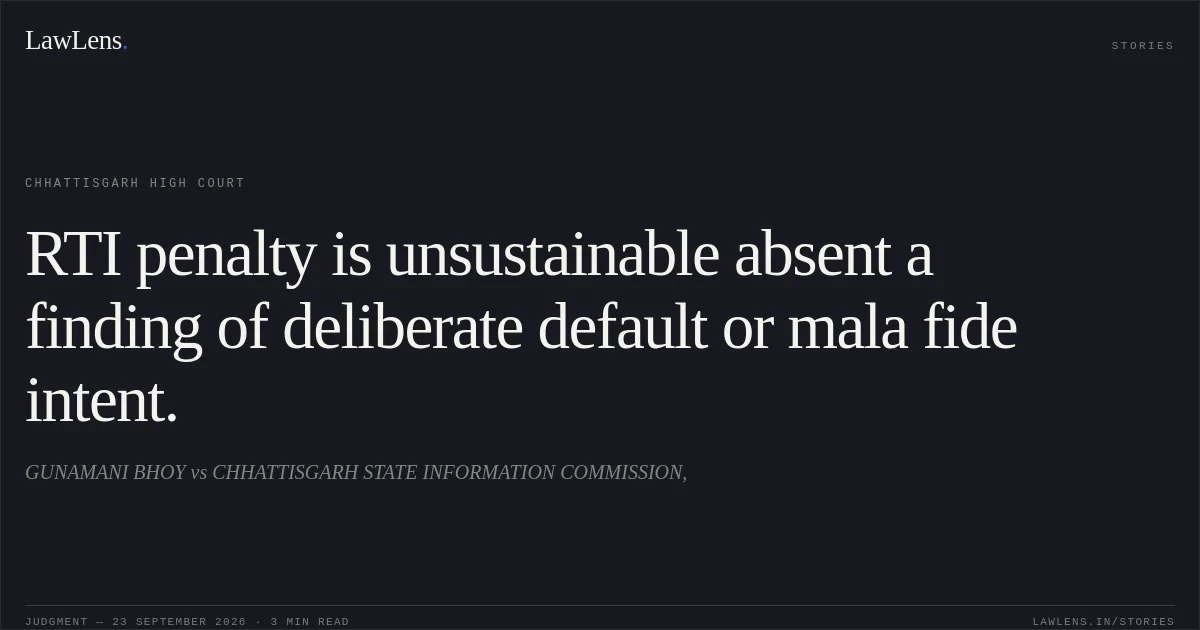
The Court held that the penalties of ₹25,000 imposed upon the petitioner were legally unsustainable because the State Information Commission had not recorded the findings required under Section 20(1) of the RTI Act, particularly a finding of absence of reasonable cause, deliberate default, or mala fide conduct.
Accordingly, the impugned orders were quashed to the extent that they imposed penalties in all four writ petitions. The writ petitions were finally disposed of in those terms.
Source reference: para. 9–10; p. 9Acts & Sections Cited
1 provisions across 1 statute referred to in this judgment. Each provision opens on LawLens.
Right to Information Act, 20051
Original Court PDF
GUNAMANI BHOYvsCHHATTISGARH STATE INFORMATION COMMISSION,
Click to open original judgment
Original judgment, available to read, download and summarize on LawLens.in