01Facts
The petitioner was serving as the Public Information Officer-cum-Secretary of Gram Panchayat, Devrani, Block Bamnhidih, District Janjgir-Champa.
Respondent No. 4 sought, under Section 6(1) of the Right to Information Act, 2005 (“RTI Act”), information relating to the Gram Panchayat’s Grant Register for the period 1 April 2012 to 31 March 2019.
¶ 2The petitioner initially failed to provide the information, resulting in a first appeal before the Chief Executive Officer, Janpad Panchayat. Pursuant to the First Appellate Authority’s order, the petitioner supplied the requested information to respondent No. 4.
¶ 2Despite this, respondent No. 4 filed a delayed second appeal before the Chhattisgarh State Information Commission. The Commission imposed the maximum penalty of ₹25,000 on the petitioner under Section 20(1) of the RTI Act by order dated 8 June 2023, allegedly without recording a finding of deliberate or mala fide withholding of information.
¶ 1–202Issues
i.1. Whether the State Information Commission could impose a penalty under Section 20(1) of the RTI Act without recording a categorical finding, supported by reasons, that the Public Information Officer deliberately and mala fide withheld or delayed the information?
¶ 3, 6–8ii.2. Whether the penalty imposed on the petitioner was sustainable when the requested information had ultimately been supplied and the Commission had not adequately considered that fact?
¶ 2, 8–903Law Applied
Section 20(1) of the RTI Act governs the imposition of penalties upon a Public Information Officer for refusal, delay, or other specified defaults in furnishing information.
¶ 6–7The Court held that imposition of such penalty requires a categorical finding, supported by cogent reasons, that the information was withheld or delayed due to the Public Information Officer’s deliberate and mala fide conduct.
¶ 6–7Mere presumption or inference by the Information Commission, without an express and reasoned finding satisfying the statutory precondition, is insufficient.
¶ 7The Court also considered the principles relied upon by the petitioner from the Division Bench judgment in WA No. 215 of 2020 and the order in WPC No. 5304 of 2026.
¶ 3Provisions in the judgment · 2 · Linked ones open on LawLens
Right to Information Act, 2005 Section 6Section 20
04Reasoning
The Court found that although the petitioner had initially failed to furnish the information, the requested documents were subsequently supplied after the First Appellate Authority’s order.
¶ 2The State Information Commission nevertheless imposed the maximum penalty of ₹25,000 without recording reasons establishing that the delay resulted from a deliberate, conscious, or mala fide act of the petitioner.
¶ 2, 8Applying Section 20(1), the Court held that the Commission could not rely merely on an inference from the delay or surrounding circumstances; it was required to make an explicit and reasoned finding regarding deliberate and mala fide withholding.
¶ 6–8Since the impugned order contained no such finding and did not adequately address the subsequent supply of information, the statutory basis for imposing the penalty was absent.
¶ 6–805Holding
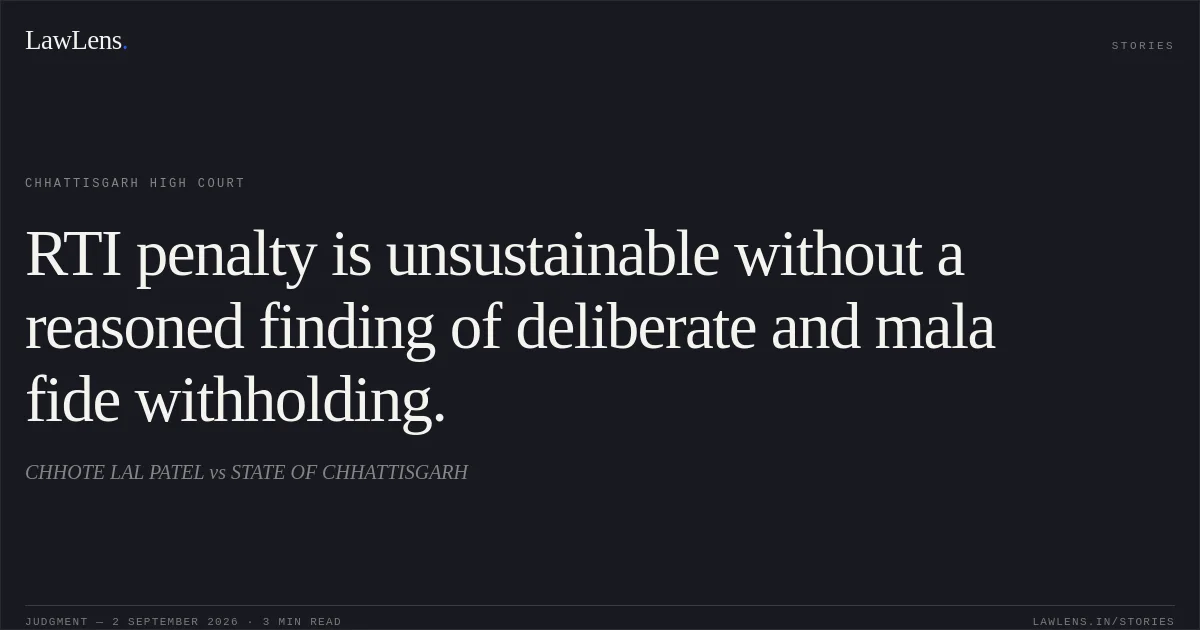
The High Court held that the penalty imposed under Section 20(1) of the RTI Act was legally unsustainable because the State Information Commission had not recorded any cogent finding that the petitioner deliberately or mala fide withheld or delayed the information.
¶ 8Accordingly, the order dated 8 June 2023 was set aside to the extent that it imposed the penalty of ₹25,000 on the petitioner. The writ petition was finally disposed of.
¶ 9–10Original Court PDF
CHHOTE LAL PATELvsSTATE OF CHHATTISGARH
Click to open original judgment
Original judgment, available to read, download and summarize on LawLens.in