01Facts
The petitioner, Secretary and former Public Information Officer (“PIO”) of Gram Panchayat Rohada, was responsible for an RTI application filed by Respondent No. 4 under Section 6(1) of the Right to Information Act, 2005, seeking copies of the Grant Register for the period from 1 April 2012 to 31 March 2019.
¶ 2Although the application was initially addressed to the Chief Executive Officer, Janpad Panchayat, it was forwarded to the Gram Panchayat after a delay of ten days, and the petitioner stated that he never received it.
¶ 2Following the applicant’s first appeal, the First Appellate Authority directed the petitioner to furnish the information, which he subsequently supplied.
¶ 2Despite receiving the information, Respondent No. 4 filed a second appeal before the Chhattisgarh State Information Commission.
¶ 2The Commission imposed a penalty of ₹25,000 on the petitioner.
¶ 2The petitioner challenged the penalty before the High Court, contending that the Commission had not established any deliberate or mala fide withholding of information under Section 20(1) of the RTI Act.
¶ 202Issues
i.Whether the State Information Commission could impose a penalty under Section 20(1) of the RTI Act without recording a categorical finding that the PIO had deliberately and mala fide withheld the requested information
¶ 3, 7–8ii.Whether the penalty was sustainable where the requested information had subsequently been furnished to the information seeker and no deliberate default was established
¶ 5, 7–803Law Applied
Section 20(1) of the Right to Information Act, 2005 requires a finding, supported by cogent reasons, that the PIO knowingly and without reasonable cause failed to furnish information, delayed its furnishing, or otherwise breached the statutory obligation; penal consequences cannot be imposed merely because there was an initial delay or non-supply.
¶ 8The Court relied on Manohar S/o Manikrao Anchule v. State of Maharashtra & Another, (2012) 13 SCC 14, for the principle that imposition of penalty under the RTI Act requires a deliberate or mala fide default to be established.
¶ 8Provisions in the judgment · 2 · Linked ones open on LawLens
Right to Information Act, 2005 Section 6Section 20
04Reasoning
The Court found that the RTI application had been delayed in transmission to the Gram Panchayat and that the petitioner had not received it initially.
¶ 2, 4, 7Once directed by the First Appellate Authority, the petitioner furnished the requested information.
¶ 2, 4, 7The Commission had issued a show-cause notice, but it had not recorded a specific finding, supported by reasons, that the petitioner deliberately or mala fide withheld the information.
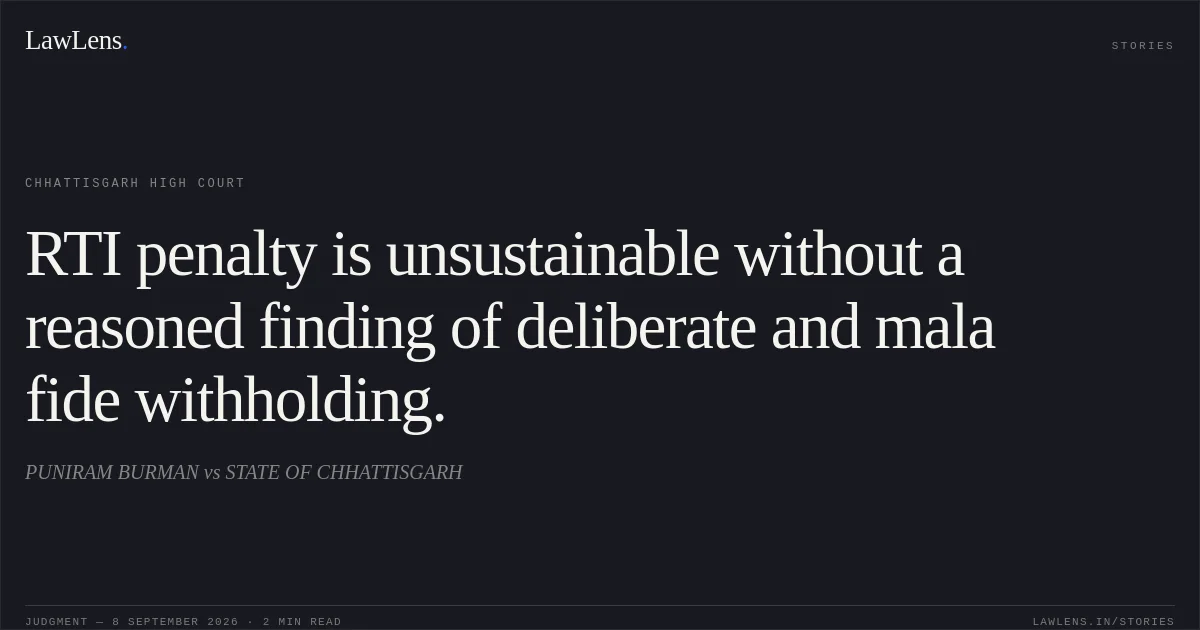
¶ 2, 4, 7Applying the principle in Manohar S/o Manikrao Anchule, the Court held that the absence of a finding of deliberate or mala fide default rendered the penalty unsustainable.
¶ 5, 8The subsequent furnishing of the information and the information seeker’s statement that he had received it further supported setting aside the penalty.
¶ 5, 805Holding
The High Court allowed the petition to the extent of the challenge to the penalty and set aside the Chhattisgarh State Information Commission’s order dated 2 June 2023 insofar as it imposed a penalty of ₹25,000 on the petitioner.
¶ 9–10The petition was accordingly finally disposed of.
¶ 9–10Original Court PDF
PUNIRAM BURMANvsSTATE OF CHHATTISGARH
Click to open original judgment
Original judgment, available to read, download and summarize on LawLens.in