Facts
The petitioner, an undertrial prisoner associated with the "Gogi Gang," was shifted from Mandoli Jail to Central Jail No. 2, Tihar, following a Transfer Order dated 11.11.2025
Source reference: p. 2-3This transfer was based on his OR unsatisfactory conduct, including nine punishments for possessing mobile phones and blocking CCTV surveillance to run a criminal syndicate
Source reference: p. 4, 8The petitioner challenged the transfer and the validity of Rule 1382 of the Delhi Prison Rules, 2018, contending that the jail authorities lacked the power to transfer undertrials and that the transfer to Tihar Jail posed a grave threat to his life due to the presence of the rival "Neeraj Bawana Gang"
Source reference: p. 5Issues
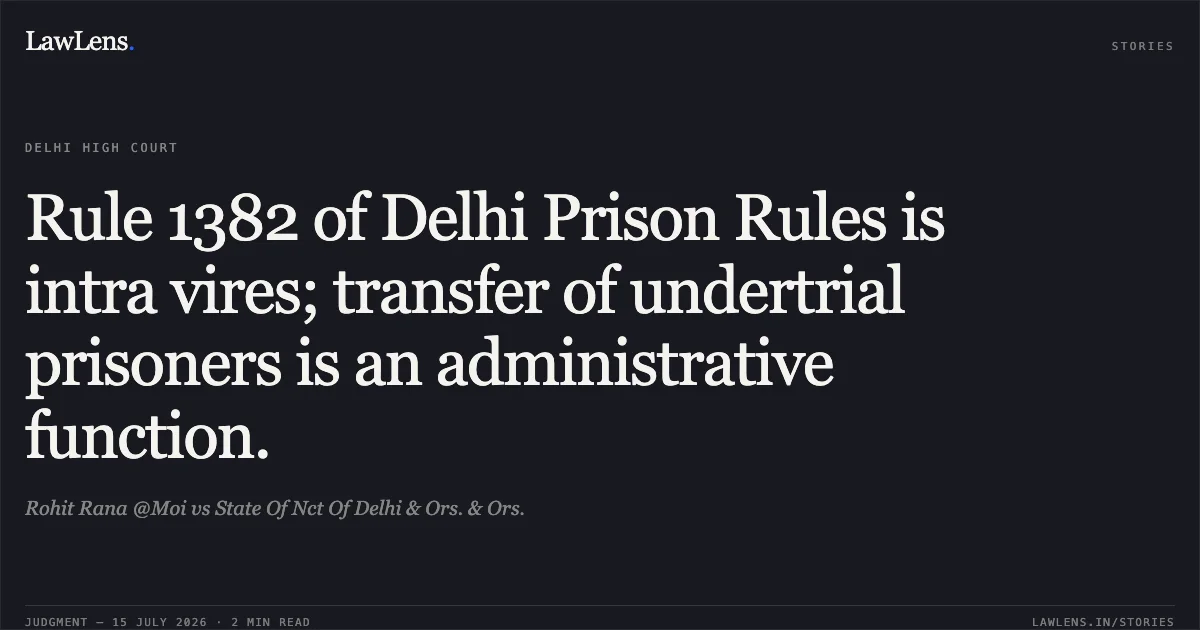
1. Whether Rule 1382 of the Delhi Prison Rules, 2018, is ultra vires the Delhi Prisons Act, 2000, and the Prisoners Act, 1900
Source reference: p. 5 / para. 12.12. Whether the prison administration has the legal authority to transfer an undertrial prisoner between jails for administrative or security reasons
Source reference: p. 6 / para. 12.43. Whether the petitioner’s transfer to Central Jail No. 2, Tihar, violates his fundamental rights under Article 21 due to alleged inter-gang rivalry
Source reference: p. 5 / para. 11.1Law Applied
Section 71(2)(xvii) of the Delhi Prisons Act, 2000, which empowers the government to make rules for the classification and separation of prisoners
Source reference: p. 11-12Section 29 of the Prisoners Act, 1900, which grants the State Government and the Inspector General of Prisons the power to remove any prisoner from one prison to another within the state
Source reference: p. 12The principle from Kalyan Chandra Sarkar v. Rajesh Ranjan, stating that a prisoner’s right under Article 21 is circumscribed by prison manuals and does not grant an absolute right to choose a place of lodging
Source reference: p. 16-17Reasoning
The court reasoned that Rule 1382 is an elongation of the parent Acts and does not travel beyond their scope, as the Delhi Prisons Act explicitly allows for rules regarding prisoner separation, and the Prisoners Act provides the statutory framework for transfers
Source reference: p. 11-13The court found that the power to transfer is an administrative necessity for maintaining prison discipline and security
Source reference: p. 14On the facts, the court determined that the transfer was not arbitrary as it was based on the petitioner's repeated disciplinary breaches and the need for better cell phone jamming facilities at Tihar
Source reference: p. 4, 15Regarding the threat perception, the court reviewed CCTV footage of a cited incident and found no evidence of confrontation. It concluded that mere apprehension of threat from rival gangs is insufficient to override administrative decisions, especially when the authorities issued specific safety advisories to isolate the petitioner from rivals
Source reference: p. 19, 20Holding
The court dismissed the Writ Petition, holding that Rule 1382 is intra vires and that the transfer was a valid exercise of administrative discretion
The court answered that undertrials have no vested right to be lodged in a specific jail and that the judiciary should not interfere in prison management unless there is clear evidence of malice
Source reference: p. 15-18The court directed the Jail Superintendent to ensure the petitioner's safe custody and strictly adhere to the security advisory dated 04.12.2025 to prevent contact with rival inmates
Source reference: p. 20Acts & Sections Cited
4 provisions across 3 statutes referred to in this judgment. Each provision opens on LawLens.
Bharatiya Nagarik Suraksha Sanhita, 20231
Prisoners Act, 19002
Arms Act, 19591
Original Court PDF
Rohit Rana @MoivsState Of Nct Of Delhi & Ors. & Ors.
Click to open original judgment
Original judgment, available to read, download and summarize on LawLens.in