Facts
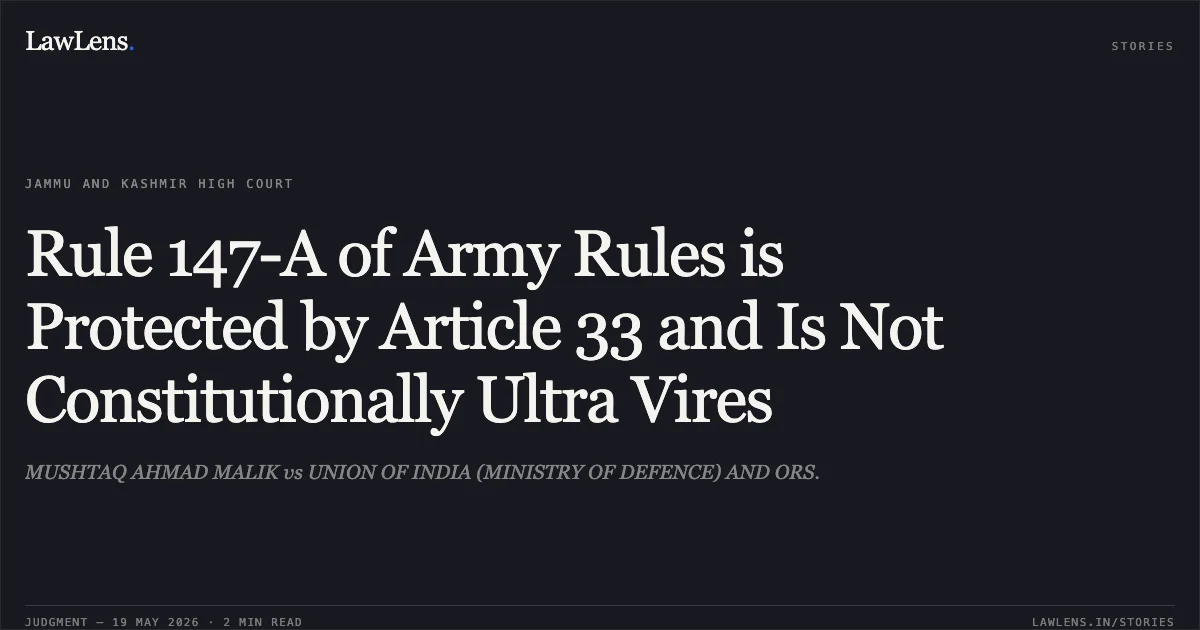
The petitioner, a 36-year-old individual, was tried and convicted by a Summary General Court Martial (SGCM) on October 5, 2022.
Source reference: p. 9the respondents denied him copies of the SGCM proceedings, citing a Central Government certificate issued under Rule 147-A of the Army Rules 1954, which claimed disclosure would prejudice national security.
Source reference: p. 2the AFT dismissed his appeal on April 23, 2024, solely because it was not accompanied by a certified copy of the impugned order.
Source reference: p. 2The petitioner subsequently filed this writ petition challenging the AFT’s dismissal and the constitutional validity of Rule 147-A.
Source reference: p. 1-2Issues
1. Whether Rule 147-A of the Army Rules 1954 is unconstitutional for violating Articles 14 and 21 of the Constitution, or if it is protected under Article 33.
Source reference: p. 5/para. 92. Whether the expression "law" in Article 33 encompasses subordinate legislation such as rules framed under the Army Act.
Source reference: p. 7/para. 133. Whether the Tribunal was justified in dismissing the appeal for lack of a certified copy when the same was legally withheld from the petitioner.
Source reference: p. 10/para. 26Law Applied
Article 33 of the Constitution of India, which empowers Parliament to restrict or abrogate fundamental rights for members of the Armed Forces to ensure discipline.
Source reference: p. 5-6Section 191 of the Army Act, 1950, which delegates rule-making power to the Central Government.
Source reference: p. 6Rule 147 of the Army Rules, 1954 (granting rights to copies of proceedings) alongside Rule 147-A (the exception allowing the State to withhold copies on security grounds while permitting inspection).
Source reference: p. 3-4Article 13(3)(a) to define "law" as including rules and regulations.
Source reference: p. 8Mulkh Raj v. Union of India (1983) which upheld the validity of Rule 147-A.
Source reference: p. 7-8Reasoning
The Court rejected the petitioner’s contention that fundamental rights can only be restricted by an "Act" of Parliament and not by subordinate rules. It reasoned that the term "law" in Article 33 is broad enough to include rules framed under delegated legislation, as supported by the definition in Article 13(3)(a).
Source reference: p. 7-8Rule 147-A is constitutionally shielded by Article 33 and does not violate Articles 14 or 21.
Source reference: p. 7The Court observed an "inbuilt mechanism" in Rule 147-A that allows for the inspection of records even when copies are denied.
Source reference: p. 9The Court found that while Rule 147-A is valid, the AFT erred by applying a technical requirement (the production of a certified copy) that was impossible for the petitioner to fulfill due to the government’s own invocation of Rule 147-A. The Court determined that the Tribunal should have summoned the records in a sealed cover to ensure the petitioner's right to a merits-based appeal was not rendered illusory.
Source reference: p. 10Holding
The Court upheld the constitutional validity of Rule 147-A, holding it is protected by Article 33.
The Court set aside the Tribunal's order dismissing the appeal, restored the appeal to its original number, and directed the Tribunal to decide the matter on its merits by summoning the SGCM records in a sealed cover and allowing the petitioner or his counsel to inspect the proceedings as per the conditions laid down in Rule 147-A.
Source reference: p. 10/para. 28, 29Acts & Sections Cited
3 provisions across 2 statutes referred to in this judgment. Each provision opens on LawLens.
Army Act, 19501
Original Court PDF
MUSHTAQ AHMAD MALIKvsUNION OF INDIA (MINISTRY OF DEFENCE) AND ORS.
Click to open original judgment
Original judgment, available to read, download and summarize on LawLens.in