Facts
Steel Authority of India Limited, Durgapur Steel Plant, manufactured iron and steel products and availed CENVAT credit on various inputs and capital goods, including refractory bricks used in its manufacturing operations.
Source reference: p.2After use, the refractory bricks became waste and scrap and were cleared without payment of duty, relying on Vasavadatta Cement v. Commissioner of Central Excise, 2003 (157) E.L.T. 272 (Tri.-Bang.), which held that waste and scrap of refractory material was not classifiable under the Central Excise Tariff.
Source reference: pp.2–3The Department alleged that the clearances attracted Rule 3(5A) of the CENVAT Credit Rules, 2004, and issued four show-cause notices covering May 2005 to March 2011, demanding aggregate duty of Rs. 98,00,064, besides interest and penalty.
Source reference: pp.3–5The Joint Commissioner confirmed the demands, interest and equivalent penalty, and the Commissioner (Appeals) upheld that order.
Source reference: pp.5–6The appellant consequently approached the Tribunal.
Source reference: p.6Issues
1. Whether used refractory bricks cleared as waste and scrap were “capital goods” attracting Rule 3(5A) of the CENVAT Credit Rules, 2004.
Source reference: paras. 17–202. Whether Rule 3(5) or Rule 3(5A) applied to refractory bricks which had already been used in manufacture and subsequently became waste and scrap.
Source reference: paras. 18, 20–223. Whether the Department could demand duty, interest and penalty on such clearances in the absence of a specific tariff classification for the waste and scrap.
Source reference: paras. 21–22Law Applied
Rule 3(5) of the CENVAT Credit Rules, 2004 requires payment equivalent to the credit availed when inputs or capital goods are removed “as such”; it does not apply where the goods have been used and have subsequently become waste.
Source reference: para. 18Rule 3(5A) applies where capital goods are cleared as waste and scrap and requires payment of an amount equal to the duty leviable on their transaction value.
Source reference: para. 18The Tribunal held that the refractory bricks in the present case were inputs used in the manufacturing process and could not be treated as capital goods merely because CENVAT credit had been availed.
Source reference: para. 20It relied on Vasavadatta Cement v. Commissioner of Central Excise, 2003 (157) E.L.T. 272 (Tri.-Bang.), and Century Cement v. Commissioner of Central Excise, Raipur, 2017 (3) TMI 1071 (CESTAT New Delhi), which held that waste and scrap of used refractory or fire bricks was not liable to duty where it was not specifically classifiable under the Central Excise Tariff.
Source reference: paras. 21–21.2Reasoning
The Tribunal found that the refractory bricks had first been used in the appellant’s manufacturing operations and only thereafter became waste and scrap; therefore, they were not removed “as such” within the meaning of Rule 3(5).
Source reference: para. 21Since the bricks functioned as consumable inputs in manufacture, rather than as capital goods, Rule 3(5A)—which specifically concerns capital goods cleared as waste and scrap—was inapplicable.
Source reference: para. 20The Tribunal further followed its earlier decisions holding that waste arising from used refractory or fire bricks could not be subjected to duty without a specific tariff classification and ascertainable rate of duty.
Source reference: paras. 21–21.2Accordingly, the Department’s demand based on Rule 3(5A) lacked legal foundation.
Source reference: no citationHolding
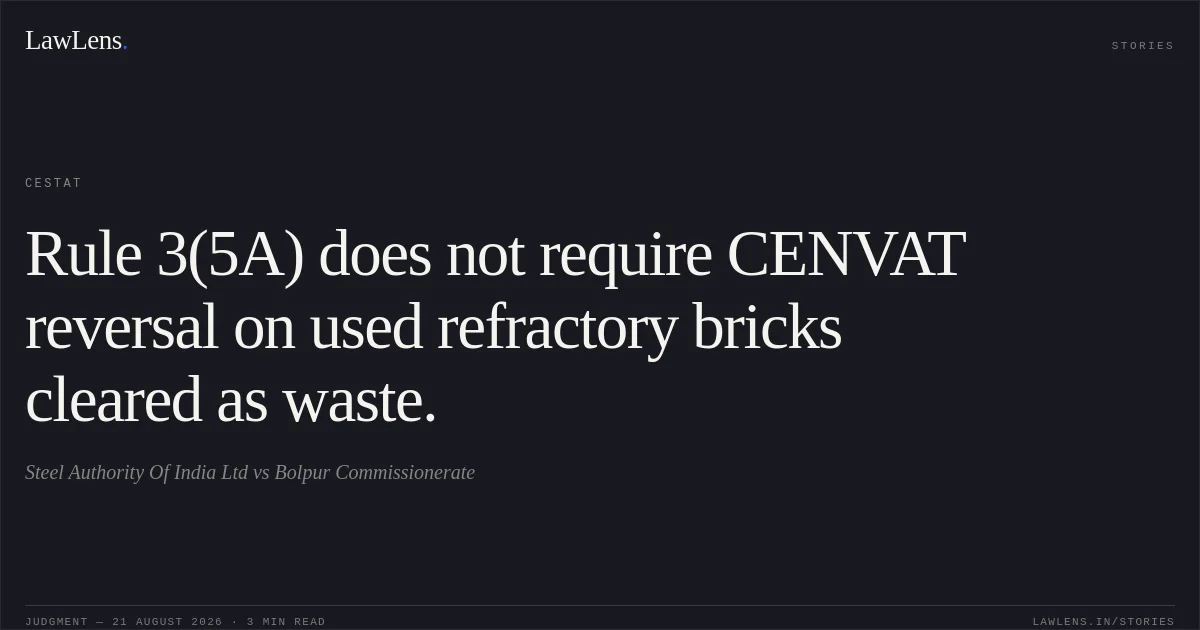
The Tribunal held that Rule 3(5A) of the CENVAT Credit Rules, 2004 did not apply to the appellant’s clearances of used refractory bricks as waste and scrap, and that the appellant was not required to reverse the CENVAT credit availed.
The duty demand of Rs. 98,00,064, together with interest and penalty, was consequently unsustainable.
Source reference: no citationThe impugned appellate order was set aside, the appeal was allowed, and consequential relief was granted in accordance with law.
Source reference: para. 23Acts & Sections Cited
2 provisions across 1 statute referred to in this judgment. Each provision opens on LawLens.
Central Excise Act, 19442
Original Court PDF
Steel Authority Of India LtdvsBolpur Commissionerate
Click to open original judgment
Original judgment, available to read, download and summarize on LawLens.in