Facts
The respondent, appointed as a DSC Khalasi in 1991, was proceeded against for unauthorised absence and compulsorily retired by order dated 11 June 2002.
Source reference: pp. 2–4The Railway authorities settled the benefits admissible on compulsory retirement.
Source reference: pp. 2–4The respondent later sought compassionate allowance under Rule 65 of the Railway Services (Pension) Rules, 1993.
Source reference: pp. 2–4After the authorities rejected his claim, the Central Administrative Tribunal allowed his application in O.A. No. 385 of 2024. The Union of India challenged that order.
Source reference: pp. 2–4The High Court noted that the claim had been made after a substantial delay, described in its reasoning as 15 years.
Source reference: pp. 2–4, 9–10Issues
1. Whether a railway servant compulsorily retired as a disciplinary penalty is eligible for compassionate allowance under Rule 65 of the Railway Services (Pension) Rules, 1993.
Source reference: pp. 4–6, 9–102. Whether the Tribunal could direct the grant of compassionate allowance in these circumstances, particularly after a substantial delay and where compulsory-retirement benefits had already been settled.
Source reference: pp. 4, 9–10Law Applied
Rule 65 of the Railway Services (Pension) Rules, 1993 provides that a railway servant dismissed or removed from service forfeits pension and gratuity, while permitting the competent authority, in a case deserving special consideration, to sanction compassionate allowance of up to two-thirds of the pension or gratuity that would have been admissible on compensation pension.
Source reference: pp. 5–6The Court treated that provision as inapplicable to an employee compulsorily retired, and compassionate allowance as a discretionary concession rather than an enforceable right.
Source reference: pp. 4–5, 9–10It distinguished Mohinder Dutt Sharma v. Union of India (Civil Appeal No. 2111 of 2009, decided 11 April 2014), which concerned dismissal and the pari materia provision in Rule 41 of the CCS Pension Rules.
Source reference: p. 4It also relied on the Division Bench decision in Divisional Personnel Officer v. G. Lakshmi, 2026 MHC 3380, concerning the scope and discretionary character of Rule 65.
Source reference: pp. 5–9Reasoning
The respondent’s punishment was compulsory retirement, not dismissal or removal—the categories expressly addressed by Rule 65. The Court therefore held that Rule 65 did not support his claim.
Source reference: pp. 4–5It considered Mohinder Dutt Sharma inapplicable because that case concerned dismissal, and noted that the respondent had already received the benefits due on compulsory retirement.
Source reference: pp. 4–5In light of the nature of the punishment, the settled benefits, and the substantial delay, the Tribunal’s direction to grant compassionate allowance was contrary to the scope of Rule 65.
Source reference: pp. 9–10Holding
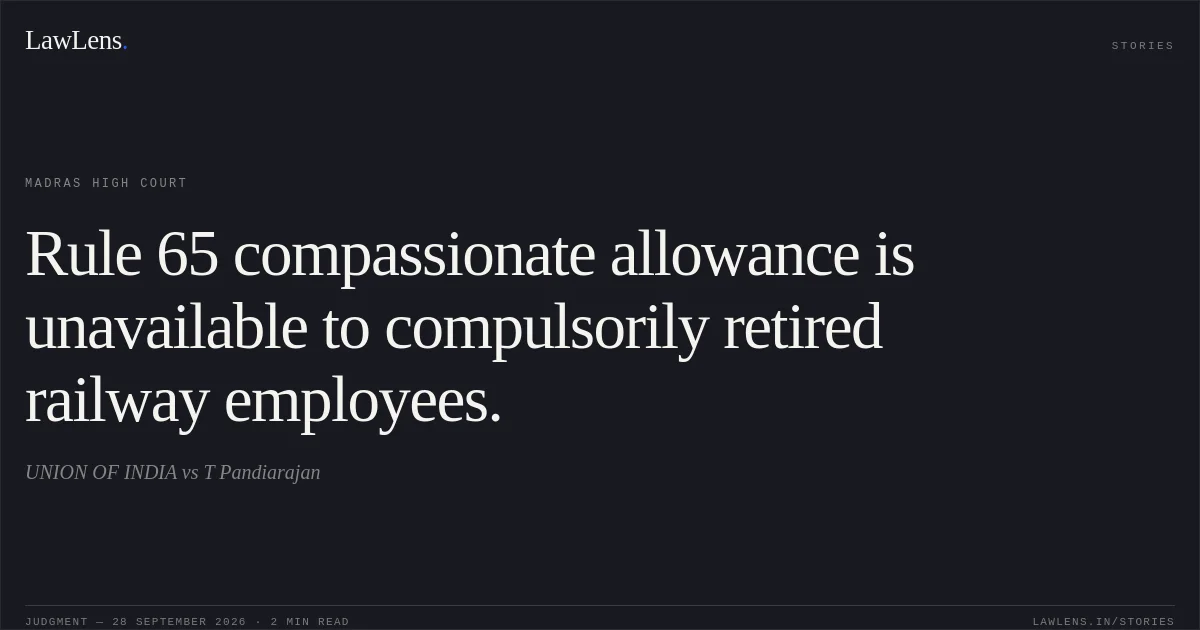
The Court held that the respondent was not entitled to compassionate allowance under Rule 65 on the facts of this case.
It set aside the Tribunal’s order dated 19 November 2024 in O.A. No. 385 of 2024, allowed the writ petition, and closed the connected miscellaneous petition; there was no order as to costs.
Source reference: p. 10Original Court PDF
UNION OF INDIAvsT Pandiarajan
Click to open original judgment
Original judgment, available to read, download and summarize on LawLens.in