Facts
The Respondent (Plaintiff), a partnership firm, sued the Appellant (Defendant), a sole proprietorship, for recovery of ₹14,96,069/- arising from the supply of electrical control panels between 2008 and 2009
Source reference: p. 2The Respondent alleged the parties maintained a running account where the last payment of ₹2,97,628/- was made on 09.03.2010
Source reference: p. 3The Appellant contested the suit, arguing that specific invoices from December 2008 (totaling ₹9,09,622/-) were for goods rejected due to delayed delivery
Source reference: p. 3The Appellant further contended that the suit was barred by limitation and that each purchase order constituted a separate contract rather than a running account
Source reference: p. 4The Trial Court decreed the suit for ₹10,89,733/- with 10% interest
Source reference: p. 8Issues
1. Whether the suit was validly instituted by a competent person on behalf of the partnership firm
Source reference: para 46, Issue I2. Whether the claim was within the period of limitation under the Limitation Act, 1963
Source reference: para 46, Issue II3. Whether the Appellant established a valid rejection of goods under the Sale of Goods Act, 1930
Source reference: para 46, Issue III4. Whether the Delhi High Court had territorial jurisdiction over the matter
Source reference: para 46, Issue VLaw Applied
The court applied Order XXX Rule 1 of the CPC, which allows any one partner to sign and verify pleadings on behalf of a firm
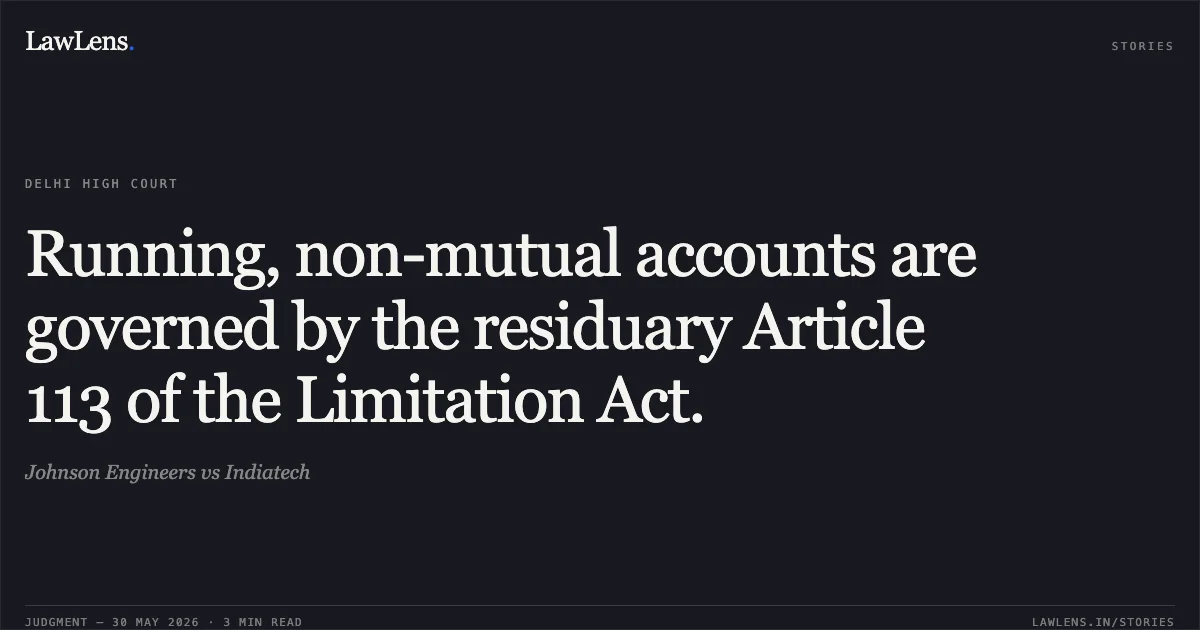
Source reference: p. 13Regarding limitation, the court relied on Article 1 and the residuary Article 113 of the Limitation Act, 1963, distinguishing between "mutual accounts" and "running/current accounts" as per Kesharichand Jaisukhlal v. Shillong Banking Corpn. and Bharat Skins Corpn. v. Taneja Skins Company Pvt. Ltd.
Source reference: p. 15-16Under Sections 41 and 42 of the Sale of Goods Act, 1930, a buyer is deemed to have accepted goods if they retain them beyond a reasonable time without intimating rejection
Source reference: p. 20Section 20 of the CPC was applied to determine territorial jurisdiction based on where the defendant carries on business
Source reference: p. 23Reasoning
The Court found the suit validly instituted as the Respondent proved its registration and the signatory's status as a partner
Source reference: p. 13On limitation, the Court determined that while the account lacked "mutuality" (reciprocal demands), it was a "running and current account" because payments were made "on account" rather than invoice-to-invoice
Source reference: p. 15-16Consequently, following the Bharat Skins precedent, the case fell under the residuary Article 113, and limitation commenced from the last payment (March 2010) and the legal notice (September 2011), making the December 2011 filing timely
Source reference: p. 17-18Regarding the rejected goods, the Court noted the Appellant admitted receipt of goods and failed to issue any written rejection notice
Source reference: p. 19The alleged debit entries for rejection were made only in 2011, which the Court deemed an afterthought inconsistent with Section 42 of the Sale of Goods Act
Source reference: p. 21Territorial jurisdiction was upheld as the Appellant's office was located in Delhi, satisfying Section 20 CPC
Source reference: p. 23-24Holding
The High Court dismissed the appeal and upheld the Trial Court's judgment.
(i) a partner is an agent of the firm competent to sue; (ii) the suit was within limitation under Article 113 as the right to sue accrued upon the last payment and demand notice in a running account; (iii) the Appellant "deemed" to have accepted the goods by retaining them without notice of rejection; and (iv) Delhi courts had jurisdiction as the defendant operated within the territory. The Respondent's decree for ₹10,89,733/- plus interest stands.
Source reference: p. 13, 18, 21, 24Acts & Sections Cited
13 provisions across 4 statutes referred to in this judgment. Each provision opens on LawLens.
Code of Civil Procedure, 19086
Indian Partnership Act, 19322
Limitation Act, 19633
Sale of Goods Act, 19302
Original Court PDF
Johnson EngineersvsIndiatech
Click to open original judgment
Original judgment, available to read, download and summarize on LawLens.in