Facts
The appellant, the informant, challenged the judgment dated 20 December 2016 of the Additional District and Sessions Judge, Hojai, Sankardev Nagar, in Sessions Case No. 42(N)/2016, whereby respondents 3–6 were acquitted of charges under Sections 342/34 and 302/34 IPC.
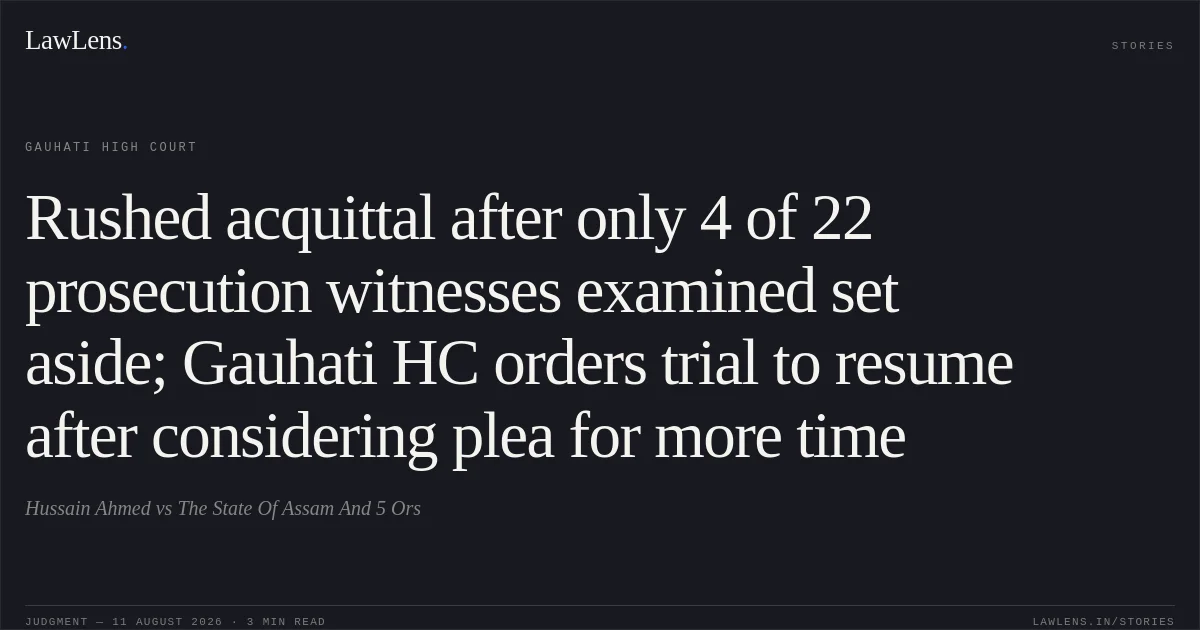
Source reference: para. 2Although the prosecution charge-sheet listed 22 witnesses, the Trial Court examined only four witnesses—three factual witnesses and the Medical Officer.
Source reference: para. 3The Trial Court had fixed 20 December 2016 for recording the evidence of the remaining prosecution witnesses after directing issuance of fresh summons.
Source reference: para. 9(v)On that date, the prosecution witnesses were absent, and the Additional Public Prosecutor submitted a written application seeking time to produce the remaining witnesses.
Source reference: para. 9(vi)However, the Trial Court relied on an alleged oral submission that the prosecution case could not be improved, closed the prosecution evidence, examined the accused under Section 313 CrPC, heard arguments, and delivered the judgment of acquittal on the same day.
Source reference: paras. 10–13Respondent 2 was deleted from the appeal because he had not been charge-sheeted, charged, or tried.
Source reference: para. 14Issues
Whether the Trial Court acted lawfully in closing the prosecution evidence and concluding the trial without examining the remaining cited prosecution witnesses, particularly when the prosecution had sought time by a written application?
Source reference: paras. 12–13, 17–18Whether the acquittal judgment delivered on the same day, following the hurried closure of the prosecution case and examination of the accused under Section 313 CrPC, was sustainable?
Source reference: paras. 11, 13, 18Whether respondent 2, who was neither charge-sheeted nor tried, could remain a party to the appeal?
Source reference: para. 14Law Applied
The respondents had faced charges under Sections 342/34 and 302/34 IPC, relating respectively to wrongful confinement and murder committed in furtherance of common intention.
Source reference: para. 2The Court considered the procedural safeguards associated with Section 313 CrPC, which requires the accused to be examined regarding the circumstances appearing in the evidence against them.
Source reference: para. 11Relying on Bablu Kumar v. State of Bihar, (2015) 8 SCC 787, the Court held that a trial court has a duty, consistent with the concept of a fair trial, to ensure that cited prosecution witnesses are produced or properly summoned and served; where material witnesses remain unexamined, the Court should not mechanically permit the prosecution to close its evidence.
Source reference: paras. 15–16The Court further emphasized that neither the prosecution nor the defence may frustrate the criminal trial and that the trial court must independently apply its mind rather than accept an unreasoned or informal submission of the Public Prosecutor.
Source reference: paras. 15–16Reasoning
The Trial Court had itself fixed 20 December 2016 for the evidence of the remaining 18 prosecution witnesses and had issued fresh summons only five days earlier.
Source reference: para. 13On the date fixed, instead of deciding the prosecution’s written request for further time, it acted upon an alleged oral submission inconsistent with that application and closed the prosecution evidence without determining whether the remaining witnesses were material or whether service and production had been properly effected.
Source reference: paras. 10, 12–13This was contrary to the court’s duty under the fair-trial principles stated in Bablu Kumar.
Source reference: paras. 15–16The subsequent examination of the accused under Section 313 CrPC, hearing of final arguments, and delivery of judgment on the same day—despite that date not having been fixed for such examination—reinforced the arbitrary and hurried nature of the proceedings.
Source reference: paras. 11, 13The resulting acquittal was therefore founded on an irregular and perverse termination of the trial rather than a properly completed evidentiary process.
Source reference: para. 18As respondent 2 had never been an accused or subjected to trial, his inclusion in the appeal was procedurally unsustainable.
Source reference: para. 14Holding
The Gauhati High Court held that the Trial Court’s closure of the prosecution case and the consequent acquittal were arbitrary, perverse, and unsustainable because the prosecution’s written application for time had not been considered and the remaining prosecution witnesses had not been properly dealt with.
The judgment dated 20 December 2016 in Sessions Case No. 42(N)/2016 was set aside, and the case was remanded to the Trial Court to proceed from the stage of deciding the Public Prosecutor’s application dated 20 December 2016 seeking time to produce the prosecution witnesses.
Source reference: para. 19The appeal was accordingly allowed, and respondent 2 was deleted from the array of parties.
Source reference: paras. 14, 20–21Acts & Sections Cited
4 provisions across 2 statutes referred to in this judgment. Each provision opens on LawLens.
Indian Penal Code, 18603
Code of Criminal Procedure, 19731
Original Court PDF
Hussain AhmedvsThe State Of Assam And 5 Ors
Click to open original judgment
Original judgment, available to read, download and summarize on LawLens.in