Facts
Following the deaths of 34 individuals in road accidents on November 2nd and 3rd, 2025, in Phalodi (Rajasthan) and Rangareddy (Telangana), the Supreme Court took suo-moto cognizance of systemic negligence and infrastructure failures on National Highways.
Source reference: para. 1The Court observed that authorities only addressed illegal encroachments after the tragedies occurred, which indicated a dereliction of statutory duty and an infringement on the right to safe passage.
Source reference: para. 1On November 10, 2025, the Court issued notice to State and National authorities and appointed an Amicus Curiae.
Source reference: para. 1Following deliberations between the Solicitor General and the Amicus Curiae, joint suggestions were submitted on April 13, 2026, to provide interim directions for highway safety during the pendency of the proceedings.
Source reference: para. 4Issues
1. Whether the systemic administrative failures and infrastructural gaps on National Highways constitute a violation of the Right to Life under Article 21 of the Constitution
Source reference: para. 1, 52. Whether the Court should exercise its powers under Article 142 to issue mandatory interim directions for highway safety, encroachment removal, and emergency response
Source reference: para. 4, 5Law Applied
Article 21 of the Constitution of India, interpreting the "Right to Life" as a positive mandate upon the State to ensure a safe environment and the right to live with dignity, which includes the safety of commuters.
Source reference: para. 5The Court exercised its extraordinary jurisdiction under Article 142 to ensure complete justice.
Source reference: para. 5Section 26 of the Control of National Highways (Land and Traffic) Act, 2002 (CNH Act) regarding the removal of encroachments.
Source reference: para. 4(b)Previous ruling in Gyan Prakash vs. Union of India and others (2025) regarding road safety compliance.
Source reference: para. 4(b)Indian Roads Congress (IRC) norms for land-use restrictions.
Source reference: para. 4(e)Reasoning
The Court noted a grim statistic: National Highways comprise only 2% of India’s road length but account for 30% of road fatalities, attributing this to "administrative lethargy".
Source reference: para. 5The Court reasoned that a high-speed expressway must not become a "corridor of peril" and that the State’s protective umbrella fails when avoidable hazards like illegal parking or blackspots lead to loss of life.
Source reference: para. 5By framing road safety as a constitutional obligation rather than a mere administrative task, the Court held that pecuniary or administrative constraints cannot outweigh the sanctity of human life.
Source reference: para. 5The Court analyzed the proposed joint suggestions and found them "practical in nature," leading to the formulation of time-bound directions for parking enforcement through Advanced Traffic Management Systems (ATMS), drone-based surveys, and the constitution of District Highway Safety Task Forces to bridge the gap between statutory duty and ground-level execution.
Source reference: para. 4Holding
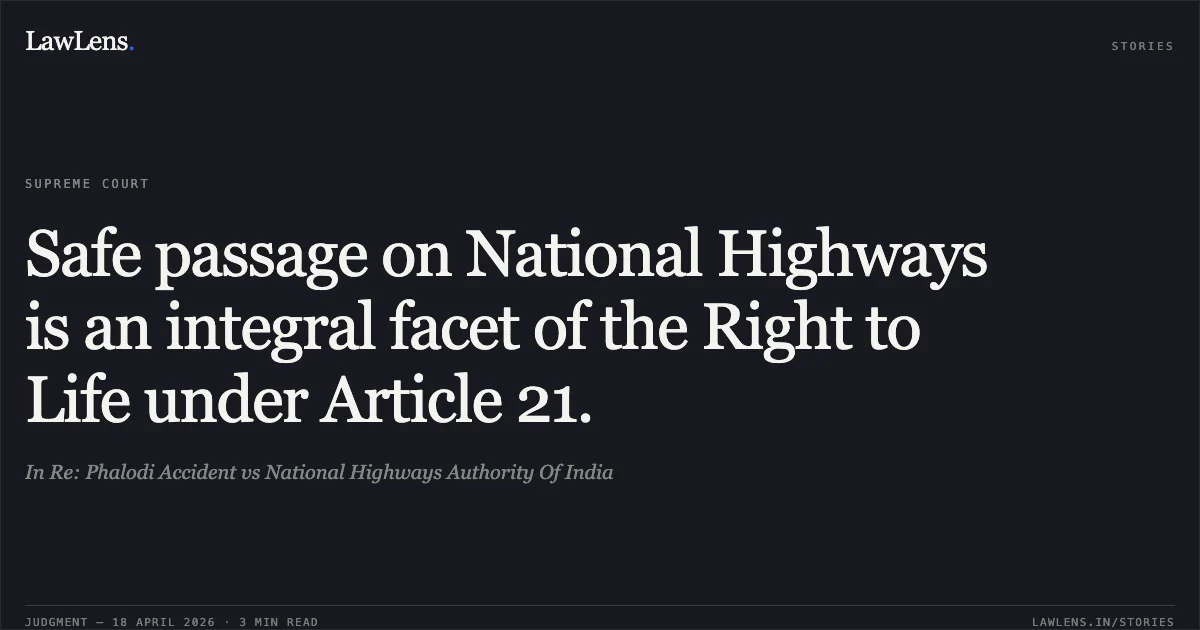
The Court answered the issues in the affirmative, holding that safety is an integral facet of Article 21.
The Court issued a series of interim directions, including: (a) a total prohibition on unauthorized parking on highways with enforcement via e-Challans within 60 days; (b) mandatory removal of all unauthorized structures (dhabas/eateries) within the Right of Way (ROW) within 60 days; (c) the creation of District Highway Safety Task Forces within 15 days; (d) operationalization of ATMS and emergency medical responses (BLS ambulances) every 75 km; (e) the identification and remediation of accident blackspots within 45 days.
Source reference: para. 4(a)-(k)All implementing agencies were directed to file a consolidated compliance report within 75 days. The matter was listed for reporting compliance after two months.
Source reference: para. 4(m), 8Acts & Sections Cited
1 provisions across 1 statute referred to in this judgment. Each provision opens on LawLens.
Control of National Highways (Land and Traffic) Act, 20021
Original Court PDF
In Re: Phalodi AccidentvsNational Highways Authority Of India
Click to open original judgment
Original judgment, available to read, download and summarize on LawLens.in