Facts
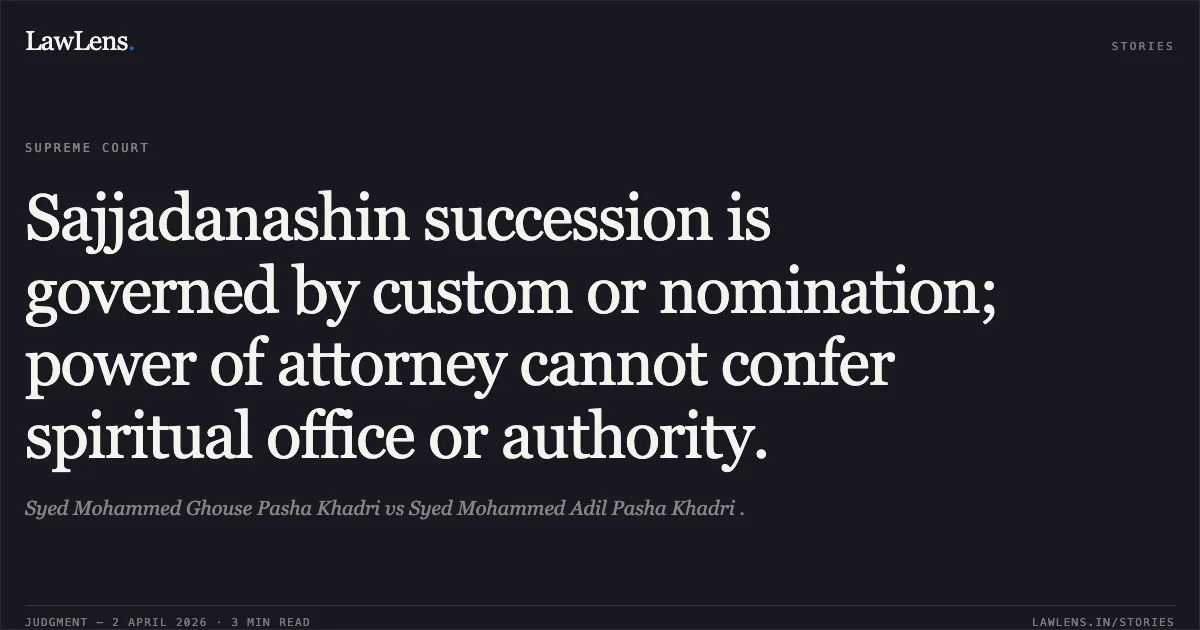
The dispute involves succession to the office of Sajjadanashin (spiritual head) of the Hazarath Mardane-e-Gaib Dargah in Karnataka
Source reference: p. 2, para. 2The original Sajjadanashin, Peer Pasha Khadri, nominated his grandson, Respondent No. 1, as his successor (Jan-Nasheen) via a Khilafatnama (Ex. P-72) dated 26.02.1981 following the death of his eldest son
Source reference: p. 3, para. 4Upon Peer Pasha's death in 1988, Respondent No. 1 assumed office.
Source reference: p. 3, para. 5The Appellant, the youngest son of Peer Pasha, challenged this, claiming the office based on a General Power of Attorney (Ex. D-1), a handwritten Khilafatnama (Ex. D-13), and an affidavit (Ex. D-23)
Source reference: p. 3, para. 5Both the Trial Court and First Appellate Court recorded concurrent findings in favor of Respondent No. 1, holding the office to be hereditary and the nomination valid
Source reference: p. 4-5, para. 7-8The High Court of Karnataka dismissed the Appellant’s second appeals, finding no substantial question of law
Source reference: p. 6, para. 11Issues
1. Whether the High Court was justified in dismissing the second appeals under Section 100 of the CPC in light of concurrent findings of fact
Source reference: p. 15, para. 302. Whether the office of Sajjadanashin is hereditary in nature and governed by nomination by the incumbent
Source reference: p. 16, para. 323. Whether the Khilafatnama (Ex. P-72) validly nominated Respondent No. 1 or was vitiated by interpolation
Source reference: p. 21-23, para. 38-414. Whether a General Power of Attorney or an affidavit can legally confer succession to a spiritual office
Source reference: p. 25-27, para. 46-48Law Applied
The Court applied Section 100 of the CPC, which restricts second appeals to "substantial questions of law" and prohibits interference with concurrent findings of fact unless perverse
Source reference: p. 16, para. 31It relied on Mulla: Principles of Mahomedan Law to define the Sajjadanashin as a spiritual office distinct from the secular Mutawalli, where succession is regulated by custom or nomination by the incumbent
Source reference: p. 18-20, para. 36-37The Court followed Syed Mohd. Salie Labbai v. Mohd. Hanifa (1976) regarding the spiritual character of the office
Source reference: p. 18, para. 36The Court followed H. Venkatachala Iyengar v. B.N. Thimmaiamma (1959) regarding the burden of proof for alleged document interpolation
Source reference: p. 24, para. 42It applied Suraj Lamp Industries (P) Ltd. v. State of Haryana (2012) to hold that a Power of Attorney creates only an agency and cannot transfer title or confer succession
Source reference: p. 26, para. 47Reasoning
The Court observed that the Sajjadanashin is a spiritual preceptor whose succession, absent specific directions in a wakfnama, is governed by custom and nomination
Source reference: p. 20, para. 37It found that Respondent No. 1's nomination via Ex. P-72 was supported by credible testimony from attesting witnesses and a formal religious ceremony
Source reference: p. 21-22, para. 39-40The Court rejected the Appellant's claim of interpolation (the word "Jannasheen") because the Appellant failed to produce expert evidence or prove forgery, noting that mere suspicion cannot displace a proved document
Source reference: p. 23-24, para. 41-42Regarding the Appellant's documents, the Court reasoned that Ex. D-1 (GPA) was merely an instrument of agency that terminated upon the principal’s death and could not confer spiritual succession
Source reference: p. 26, para. 46Similarly, the affidavit (Ex. D-23) was deemed insufficient as it lacked the formality required for such a significant spiritual appointment
Source reference: p. 27, para. 48The Court concluded that the Appellant's arguments regarding shared management did not affect the specific legal right to the office of Sajjadanashin
Source reference: p. 28, para. 51Holding
The Supreme Court dismissed the appeals, affirming the High Court's judgment
The Court held that Respondent No. 1 was validly nominated as the Jan-Nasheen by the original Sajjadanashin and is the lawful successor
Source reference: p. 29, para. 52It further held that since the findings were based on a thorough appreciation of evidence and involved no substantial question of law, the High Court correctly exercised its limited jurisdiction under Section 100 CPC
Source reference: p. 29, para. 53-55All interim orders were vacated
Source reference: p. 30, para. 58Acts & Sections Cited
1 provisions across 1 statute referred to in this judgment. Each provision opens on LawLens.
Code of Civil Procedure, 19081
Original Court PDF
Syed Mohammed Ghouse Pasha KhadrivsSyed Mohammed Adil Pasha Khadri .
Click to open original judgment
Original judgment, available to read, download and summarize on LawLens.in