Facts
Sat Keval Co-operative Housing Society Ltd. purchased land measuring 3,773 sq. metres at Survey Nos. 361, 362 and 366, Final Plot No. 161, Ranip, Ahmedabad, for providing housing to members of the Dataniya community and weaker sections.
Source reference: paras. 4, 7(i)–(ii)The plaintiff claimed to be a member of the Society and alleged that defendants 1 to 3, despite having resigned as members in 1982, continued to represent themselves as the Society’s office-bearers and attempted to alienate its land.
Source reference: paras. 7(iii), 7(x)–(xii), 22, 35–39The plaintiff instituted Civil Suit No. 3991 of 1998 seeking declarations that defendants 1 to 3 had no right, title or authority over the suit property or to act as office-bearers, along with consequential restraint against its transfer.
Source reference: paras. 2, 4, 40(iii)–(vi)An interim injunction was initially granted, but was vacated on 18 February 2000 after an undertaking was given on behalf of the defendants that the property would not be transferred to a stranger.
Source reference: paras. 40(iv)–(vi), 138–139During the pendency of the suit, the Society executed a registered sale deed dated 27 October 2016 in favour of Om Enterprise and its partners for ₹6.75 crore. Jay Bhim Developers and fourteen purported Society members joined as confirming parties.
Source reference: paras. 5, 40(vii)–(xi), 140The plaintiff amended the suit to seek cancellation of the sale deed, alleging that it was founded on fabricated resolutions, improper changes in membership, collusion and breach of the undertaking.
Source reference: paras. 8, 41–55The City Civil Court dismissed the suit on 23 August 2019, holding, inter alia, that the plaintiff had not established membership, that the defendants were entitled to deal with the property, and that the sale deed was valid. The plaintiff preferred the present first appeal.
Source reference: paras. 12, 15Issues
Whether the Civil Court had jurisdiction to entertain the suit, or whether the dispute was barred by the provisions of the Gujarat Co-operative Societies Act, 1961, particularly Sections 96, 166 and 167?
Source reference: para. 134(1); paras. 146, 151, 160–161Whether defendants 1 to 3 had ceased to be members of the Society and consequently lacked authority to act as its Chairman, Secretary or other office-bearers?
Source reference: para. 134(2); paras. 141–145, 157–160Whether the sale deed dated 27 October 2016, executed on behalf of the Society in favour of Om Enterprise and its partners, was unauthorised, fraudulent, void ab initio and liable to be cancelled?
Source reference: para. 134(3); paras. 150–156, 162–168, 173–175Whether the defendants breached the undertaking given to the Trial Court that the suit property would not be transferred during the pendency of the suit?
Source reference: para. 134(4); paras. 169–172Law Applied
The Court applied the Gujarat Co-operative Societies Act, 1961, including Section 37 concerning the Society’s distinct corporate personality, Section 73 vesting final authority in the general body, Sections 81 and 107 concerning regulatory inquiry and administration, Section 96 concerning disputes touching the business of a Society, Section 166 concerning exclusion of civil-court jurisdiction, and Section 167 concerning statutory notice before instituting proceedings against a Society or its officers.
Source reference: paras. 127, 146, 151, 160The Court held that the jurisdictional bar and notice requirement do not apply where the suit is directed against individuals in their personal capacity for allegedly impersonating office-bearers and fraudulently executing a conveyance, rather than against a lawful act of the Society in the ordinary course of its business.
Source reference: paras. 146, 151, 160–161It further applied the principle that a share certificate is strong and conclusive evidence of membership unless displaced by cogent evidence.
Source reference: paras. 148, 157The Court relied on Hill Properties Ltd. v. Union Bank of India, (2014) 1 SCC 635, concerning a member’s right to protect his legally recognised interest connected with Society property; A. Viswanatha Pillai v. Special Tahsildar, (1991) 4 SCC 17, concerning the right of one co-owner to protect common property; and Balwantbhai Somabhai Bhandari v. Hiralal Somabhai Contractor, (2023) 17 SCC 545, holding that a wilful breach of an undertaking given to the Court attracts legal consequences and may constitute civil contempt.
Source reference: paras. 62–65, 171–172The Court also applied the principle that revenue mutation does not confer title and remains subject to adjudication by the competent civil court.
Source reference: para. 150Reasoning
The Court found that the plaintiff had established his locus through the share certificate and the membership-related documents, and that the Trial Court had erred in rejecting Exhibits 158 and 159 merely because they lacked the Society’s seal or an inward stamp.
Source reference: paras. 141, 147–149, 157Exhibit 159, read with the resolution dated 14 March 1982 and the transfer forms, showed that defendants 1 to 3 had ceased to be members and that their relatives had been substituted in the membership records; the defendants produced no reliable evidence of their subsequent reinstatement or valid election as office-bearers.
Source reference: paras. 141–145, 160The Court treated the District Registrar’s detailed order dated 8 September 2017 as significant corroborative material. That order recorded that meetings and minutes had been fabricated, that the original resolution book was unavailable, and that proceedings had been conducted without the majority’s consent.
Source reference: para. 150Although the order was under challenge, the Court held that its factual findings could not simply be ignored in the absence of contrary documentary evidence.
Source reference: paras. 150, 158, 162The Court rejected the jurisdictional objections because the plaintiff’s case was not a challenge to an ordinary decision of the Society but an allegation that persons lacking membership and authority had fraudulently represented themselves as office-bearers and executed a sale deed. Such a dispute did not “touch the business” of the Society in the statutory sense and was maintainable before the Civil Court.
Source reference: paras. 146, 151, 160–161The absence of a formal challenge to the alleged resolution dated 8 October 2016 was also not fatal because the defendants failed to prove that the resolution was genuinely passed by the general body through proper notice, agenda, minutes and majority approval.
Source reference: paras. 152–153, 165, 168The purchaser was held not to be a bona fide purchaser without notice. It proceeded with the transaction despite the pending litigation, the earlier undertaking, and the absence of reliable verification of the defendants’ membership, authority and marketable title.
Source reference: paras. 163, 173–175The execution of the sale deed during the suit also breached the undertaking given to the Trial Court; the Court held that the undertaking was binding and enforceable notwithstanding the absence of a subsisting prohibitory injunction at the time of sale.
Source reference: paras. 139, 169–172Holding
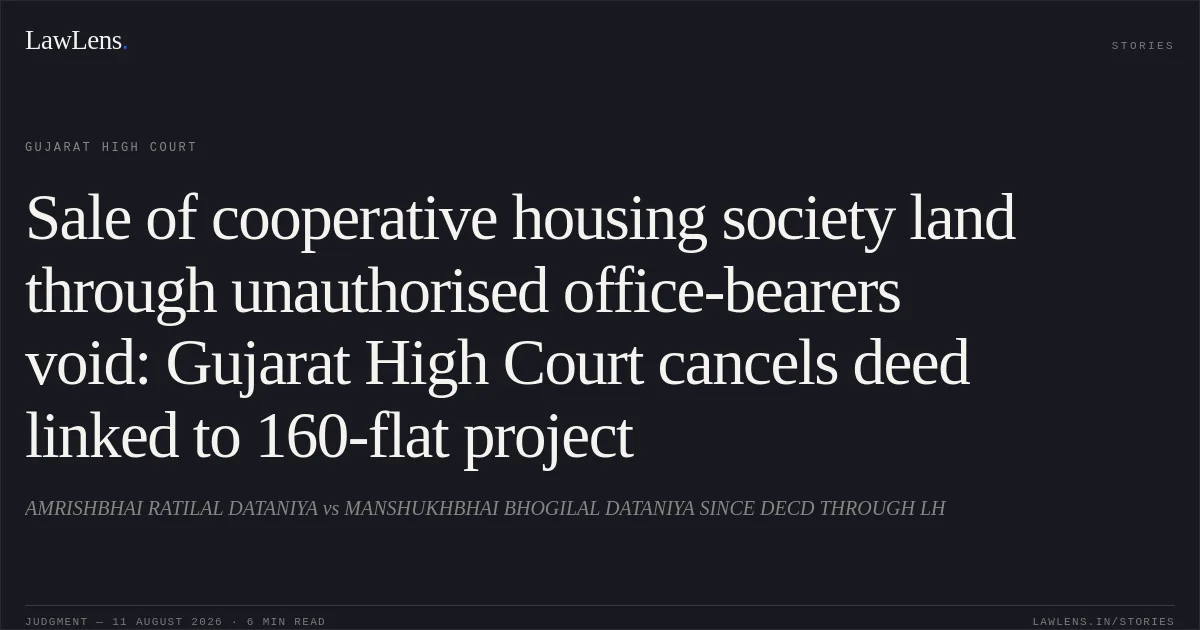
The Gujarat High Court partly allowed the appeal, quashed and set aside the Trial Court’s judgment and decree dated 23 August 2019, and declared that defendants 1 to 3 had no right, title or interest to execute the sale deed on behalf of the Society.
The registered sale deed dated 27 October 2016 in favour of Om Enterprise and its partners was declared invalid, null and void ab initio and was cancelled.
Source reference: para. 178The Court did not grant a permanent injunction because substantial construction of the residential complex had already taken place; the legal consequences of cancellation were left to follow in accordance with law.
Source reference: para. 179The appeal was accordingly disposed of with no order as to costs.
Source reference: para. 180At the request of the purchaser, implementation and operation of the judgment were stayed until 5 October 2026.
Source reference: pp. 154–155Acts & Sections Cited
10 provisions across 2 statutes referred to in this judgment. Each provision opens on LawLens.
Gujarat Cooperative societies Act-1961
Transfer of Property Act, 18821
Original Court PDF
AMRISHBHAI RATILAL DATANIYAvsMANSHUKHBHAI BHOGILAL DATANIYA SINCE DECD THROUGH LH
Click to open original judgment
Original judgment, available to read, download and summarize on LawLens.in