Facts
In 1958, one Mr. Sadashiv Datar ("Datar") was granted a certificate under Section 88C of the Bombay Tenancy and Agricultural Lands Act, 1948 ("the Act") as a landlord with holdings below economic size
Source reference: para. 3Following the Supreme Court’s confirmation of this certificate in 1985, Datar initiated proceedings under Section 33B of the Act in 1990 to terminate tenancy for bona fide personal cultivation
Source reference: para. 4Datar died in 1991, followed by his sisters/heirs
Source reference: para. 5In 2002, the offspring of the sisters applied to continue Datar’s 1990 proceedings, but the application remained pending
Source reference: para. 8In 2017, the current Petitioners filed new Section 33B proceedings, which were rejected by the Tahsildar on the ground that the right to terminate tenancy for personal cultivation abated upon Datar’s death
Source reference: para. 6The Collector reversed this, but the Maharashtra Revenue Tribunal ("MRT") subsequently set aside the Collector’s order in revision, holding against the Petitioners
Source reference: para. 7Crucially, the Petitioners sold their entire interest in the subject property to third parties in 2013 and 2017
Source reference: para. 11(H-I)Issues
1. Whether the right to terminate tenancy for personal cultivation under Section 33B of the Act abates upon the death of the original landlord or can be inherited by heirs.
Source reference: para. 8/11(H)2. Whether the Petitioners could maintain a claim for "bona fide personal cultivation" after selling their right, title, and interest in the subject land to third parties.
Source reference: para. 11(K)Law Applied
Section 88C provides an exemption for small landlords from certain tenancy provisions
Source reference: para. 11(A)Section 33B enables such a landlord to terminate tenancy provided they demonstrate a "bona fide requirement for personal cultivation"
Source reference: para. 11(B), 11(F)The Act establishes a specific timeframe (three months from certification) for initiating such termination
Source reference: para. 11(J)Under the principles of writ jurisdiction, a petitioner must maintain the foundational requirement of the statutory right—here, the intent to personally cultivate—throughout the proceedings
Source reference: para. 11(K), 13Reasoning
The Court found it unnecessary to decide the abstract question of whether the right under Section 33B is generally inheritable because the Petitioners’ actions rendered the claim moot
Source reference: para. 11(H)The core of Section 33B is the landlord’s bona fide need for personal cultivation
Source reference: para. 11(F)The Court observed that the Petitioners sold the subject land on an "as-is-where-is" basis to third parties in 2013 and 2017
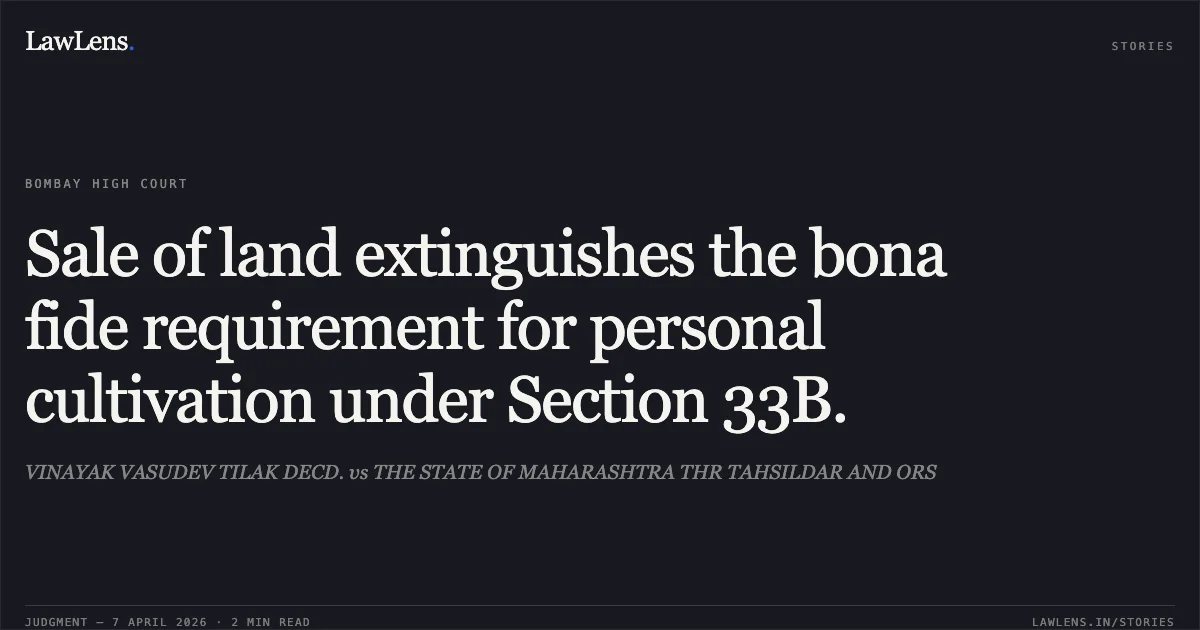
Source reference: para. 11(H-I)By divesting themselves of the property, the "foundational ingredient" of personal cultivation "evaporated"
Source reference: para. 11(K)Even if the right were inheritable, the Petitioners would still need to demonstrate their own personal requirement to cultivate, which became impossible upon the sale of the land
Source reference: para. 11(K)Furthermore, the Court noted that the proceedings were actually being conducted by a third-party transferee acting as a power of attorney holder, rather than the heirs themselves
Source reference: para. 11(I), 12Holding
The High Court dismissed the Writ Petitions and upheld the MRT's order
The Court held that since the Petitioners had unequivocally sold the land, the basis for seeking possession for personal cultivation under Section 33B of the Act had come to an end
Source reference: para. 13Consequently, no case was made out for the Court to exercise its discretionary writ jurisdiction to interfere with the impugned order
Source reference: para. 12-13All petitions were disposed of without interference
Source reference: para. 14Acts & Sections Cited
2 provisions across 1 statute referred to in this judgment. Each provision opens on LawLens.
Bombay Tenancy and Agricultural Lands Act-19482
Original Court PDF
VINAYAK VASUDEV TILAK DECD.vsTHE STATE OF MAHARASHTRA THR TAHSILDAR AND ORS
Click to open original judgment
Original judgment, available to read, download and summarize on LawLens.in