01Facts
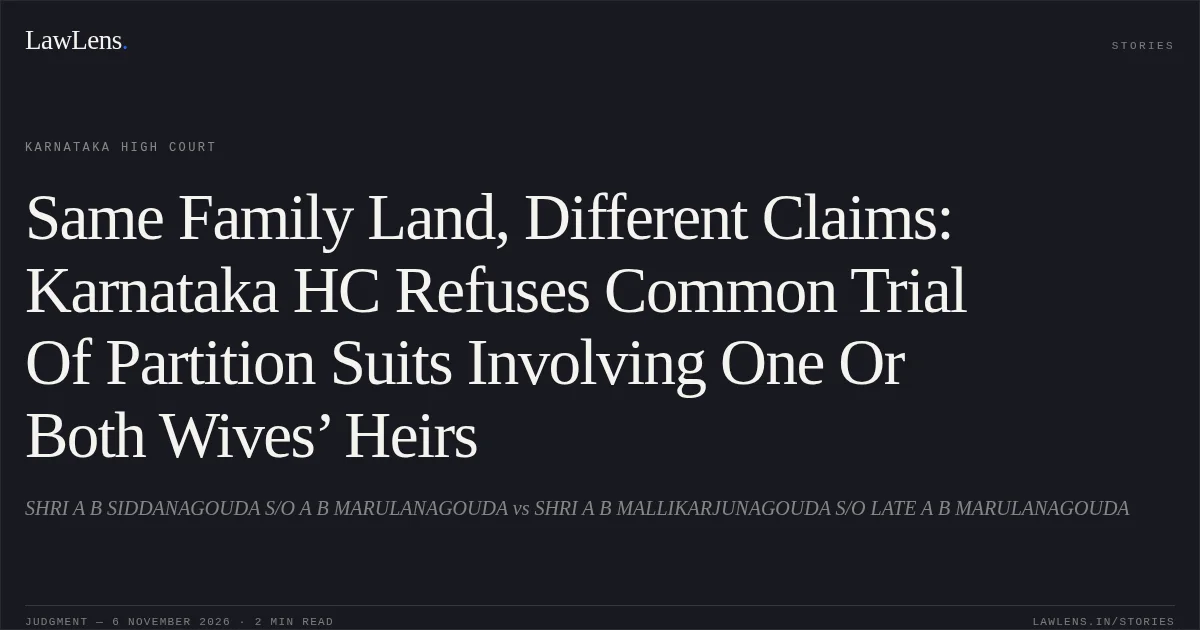
The petitioner, plaintiff No. 1 in O.S. No. 8/2021 and defendant No. 3 in O.S. No. 130/2022, sought to have the two partition suits tried jointly with common evidence.
¶ 1–7Both suits concern properties originally belonging to A.B. Marulanagouda. O.S. No. 8/2021 concerns claims among the children of his second wife, while O.S. No. 130/2022 involves the children of both wives and a broader set of claims.
¶ 1–7The trial court rejected the request for a common trial but directed that the suits be tried and disposed of simultaneously. The petitioner challenged that order under Article 226 of the Constitution.
¶ 1–702Issues
i.1. Whether the substantial overlap in the properties and parties’ family relationships required the two partition suits to be consolidated for a common trial.
¶ 5–10ii.2. Whether the trial court’s direction for simultaneous trials and disposal, rather than a common trial, disclosed an error warranting interference.
¶ 6, 10–1203Law Applied
The Court identified no specific statutory provision or precedent as the basis of its reasoning.
¶ 9–11It applied the procedural principle that overlap in subject matter alone does not require a common trial; the court must consider the causes of action and issues arising in each suit.
¶ 9–11Where the suits involve distinct scopes of claims, simultaneous trial and disposal may be appropriate to avoid conflicting decisions while preserving the separate issues for determination.
¶ 9–1104Reasoning
The Court distinguished the suits by their scope. O.S. No. 8/2021 was confined to the rights and claims of the children of the second wife, with no claim or dispute raised there by the children of the first wife. O.S. No. 130/2022 involved both branches and a broader cause of action, including claims and counterclaims between them.
¶ 9–11The fact that the suits concerned substantially common properties did not, by itself, justify common evidence or a common trial. The trial court’s direction to try and dispose of the suits simultaneously was sufficient to avoid possible confusion and conflicting decisions.
¶ 9–1105Holding
The Court found no error or illegality in the trial court’s order and declined to interfere.
¶ 11–12The writ petition was disposed of, leaving in place the direction for simultaneous trial and disposal of the two suits.
¶ 11–12Original Court PDF
SHRI A B SIDDANAGOUDA S/O A B MARULANAGOUDAvsSHRI A B MALLIKARJUNAGOUDA S/O LATE A B MARULANAGOUDA
Click to open original judgment
Original judgment, available to read, download and summarize on LawLens.in