Facts
On November 29, 2013, Vigilance officials conducted a search of Petitioner No. 1’s (an Ex-ADDL Treasury Officer) residence, uncovering assets Allegedly disproportionate to his known sources of income
Source reference: p. 2-3An FIR was lodged on December 18, 2013, under the Prevention of Corruption (P.C.) Act
Source reference: p. 3During the investigation, the competent authority declined to grant sanction for prosecution on July 14, 2021
Source reference: p. 3, 6However, the Petitioner No. 1 had already retired from service on March 31, 2018
Source reference: p. 6Subsequent to his retirement, a charge-sheet was filed, and the Special Judge Vigilance, Cuttack, took cognizance of the offences on June 3, 2022
Source reference: p. 4, 6The Petitioners moved the High Court under Section 482 Cr.P.C. seeking to quash the cognizance order, contending that the lack of sanction, the selection of the "check period," and the inclusion of Petitioner No. 2’s (wife) independent income rendered the prosecution illegal
Source reference: p. 4-6Issues
1. Whether the trial court could take cognizance of offences under the P.C. Act against a retired public servant despite the refusal of sanction by the competent authority
Source reference: p. 102. Whether the adoption of the entire service period as a "check period" and the inclusion of the wife’s assets/income warrant the quashing of proceedings at the stage of cognizance
Source reference: p. 11-12Law Applied
The court primarily applied Section 19 of the Prevention of Corruption Act, 1988, regarding the requirement of previous sanction for prosecution
Source reference: p. 10It relied on the Supreme Court precedents in K. Veeraswami v. Union of India and CBI v. B.A. Srinivasan, which established that the protection under Section 19 is only available to a public servant while they are in employment; no sanction is necessary to prosecute a person who has ceased to be a public servant (via retirement or otherwise) at the time the court takes cognizance
Source reference: p. 7, 10Furthermore, the court applied Section 482 of the Cr.P.C. (Section 528 of B.N.S.S.) regarding the scope of inherent powers, noting that proceedings should only be quashed if no prima facie case is disclosed or if the prosecution is manifestly malicious
Source reference: p. 9-10Reasoning
The Court reasoned that since Petitioner No. 1 retired on March 31, 2018—prior to the date the Trial Court took cognizance (June 3, 2022)—the statutory requirement for sanction under Section 19 of the P.C. Act was no longer applicable
Source reference: p. 10The Court rejected the argument that the investigation was deliberately delayed to bypass the sanction requirement, noting that delay itself is not a ground for quashing unless malicious intent is proven, which is a matter for trial
Source reference: p. 10-11Regarding the "check period" and the inclusion of Petitioner No. 2’s income, the Court held these to be complex factual determinations involving the scrutiny of income, expenditure, and assets that cannot be resolved in a summary proceeding
Source reference: p. 11-12The Court emphasized that a mini-trial or re-assessment of evidence is prohibited at the quashing stage, and the mere filing of Income Tax returns does not provide an absolute defense if the lawful source of those assets is in question
Source reference: p. 12-13Holding
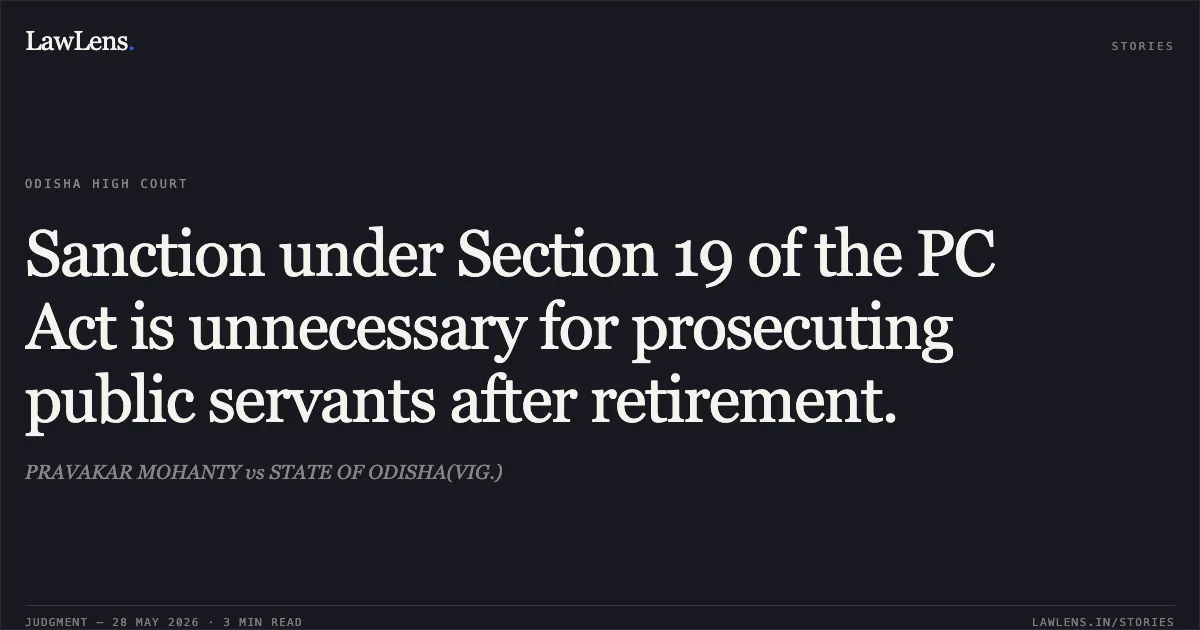
The Court answered that the trial court's order was valid, as no sanction is required to prosecute a retired public servant once they demit office
The High Court held that the materials on record disclosed sufficient prima facie grounds to proceed and that the disputed factual narratives regarding asset valuation and the wife's independent income must be established through evidence at trial
Source reference: p. 14-15Consequently, the Court found no patent illegality or abuse of process and dismissed the CRLMC, vacating any prior interim orders
Source reference: p. 15Acts & Sections Cited
5 provisions across 4 statutes referred to in this judgment. Each provision opens on LawLens.
Code of Criminal Procedure, 19731
Bharatiya Nagarik Suraksha Sanhita, 20231
Prevention of Corruption Act, 19882
Indian Penal Code, 18601
Original Court PDF
PRAVAKAR MOHANTYvsSTATE OF ODISHA(VIG.)
Click to open original judgment
Original judgment, available to read, download and summarize on LawLens.in